


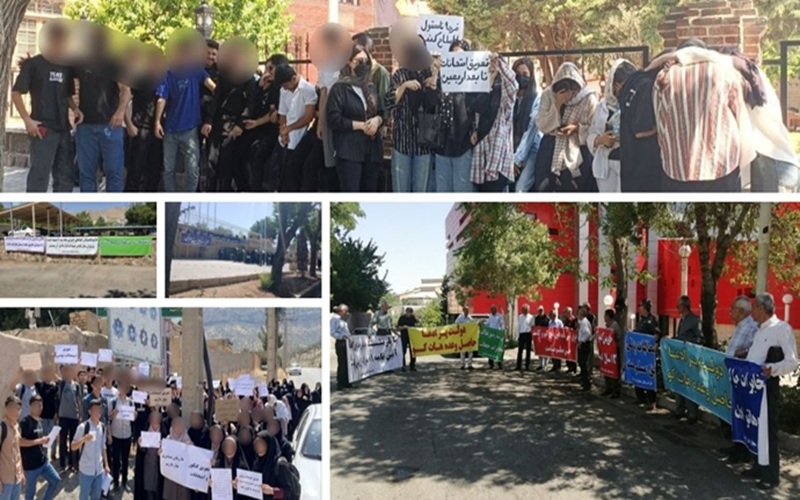

New official data shows Iran’s economy grew just 0.2% in 2025 with oil and contracted without it, raising fears of deeper recession, soaring inflation, and expanding poverty.
Iran’s Economy Shows Minimal Growth Amid Deepening Crises
New figures released by the Statistical Center of Iran on Monday, June 22, reveal that the country’s economy effectively stagnated during the Iranian year 1404 (March 2025–March 2026), highlighting the severe impact of war, domestic unrest, sanctions, and structural economic problems.
According to the report, Iran’s economic growth reached only 0.2 percent when oil revenues are included, while the economy contracted by 0.3 percent excluding oil, indicating that non-oil sectors continued to weaken despite government claims of economic resilience.
The Statistical Center reported that Iran’s gross domestic product (GDP) exceeded 100 trillion rials when calculated with oil revenues and stood at approximately 75 trillion rials without oil.
Wars, Protests, and Sanctions Intensify Economic Pressures
The disappointing growth figures come after a turbulent year for Iran. During 1404, the country experienced a 12-day war with Israel in the summer, followed by the nationwide January protests and a subsequent 40-day conflict involving the United States and Israel during the winter.
Economists point to these developments, alongside years of severe international sanctions, chronic corruption, mismanagement, and declining investment, as major factors behind the sharp slowdown in economic activity.
Agriculture and Industry Register Negative Growth
The latest data shows significant weakness across key productive sectors.
The agricultural sector recorded a 2.9 percent contraction, while industrial output declined by 1.5 percent.
According to figures cited by ISNA, the broader industries and mining sector grew only 0.5 percent, including:
- Oil and natural gas extraction: 1.8%
- Other mining activities: 4.1%
- Manufacturing industry: -1.5%
- Natural gas distribution: 2.0%
- Water and electricity supply: -6.5%
- Construction: 1.4%
Meanwhile, the services sector, which constitutes a large share of Iran’s economy, expanded by only 0.3 percent, reflecting weak domestic demand and declining consumer purchasing power.
Economists Warn of Deeper Recession and Triple-Digit Inflation
Several Iranian economists have warned that economic conditions could deteriorate further during the current year.
Among them, Hojjatollah Mirzaei, former head of Iran’s pension funds organization, stated in June that new economic scenarios project Iran’s growth rate could fall to between negative 8.5 percent and negative 10 percent.
Mirzaei warned that such a downturn could push an additional 4.5 million people below the poverty line, significantly worsening social and economic conditions across the country.
Some analysts have also cautioned that continued economic contraction could drive inflation into the triple-digit range, further eroding the value of the national currency and increasing economic uncertainty.
Long-Term Growth Trend Continues to Decline
The latest figures are consistent with a longer-term slowdown identified by international institutions.
According to a World Bank report published in January 2023, Iran’s GDP growth rate declined from 4.7 percent in 2021 to 2.9 percent in 2022.
The decline occurred after the administration of former president Ebrahim Raisi took office in August 2021.
World Bank projections at the time estimated Iran’s growth would continue slowing, forecasting GDP growth of 2.2 percent in 2023 and 1.9 percent in 2024, trends that now appear consistent with the country’s current economic stagnation.
Recent War Cost Iran Hundreds of Billions of Dollars
The economic consequences of recent military conflicts continue to emerge.
Mohammad-Reza Bahonar, a member of the regime’s Expediency Council, said in an interview published on last Saturday that the recent war caused approximately $30 billion in direct physical damage.
However, he argued that the broader impact on investment and economic development was far greater.
“The war caused at least a $200 billion setback for our country,” Bahonar said, referring to lost investment opportunities and long-term economic damage.
He also highlighted the inflation crisis, stating that Iran has experienced roughly 1,000 percent inflation over the past eight years, meaning average prices have increased tenfold during that period.
“A large portion of our economic middle class has fallen into the lower-income class,” he added.
Growing Public Despair Over Economic Conditions
The worsening economic outlook is increasingly reflected in public sentiment.
Last week, a senior Interior Ministry official reportedly acknowledged that 60 percent of Iranians can no longer tolerate additional economic pressure and have little confidence that conditions will improve in the future.
With economic growth nearing zero, investment declining, inflation remaining elevated, and poverty expanding, the latest official statistics underscore the mounting challenges facing Iran’s economy and the growing concerns about the country’s economic trajectory in the years ahead.