


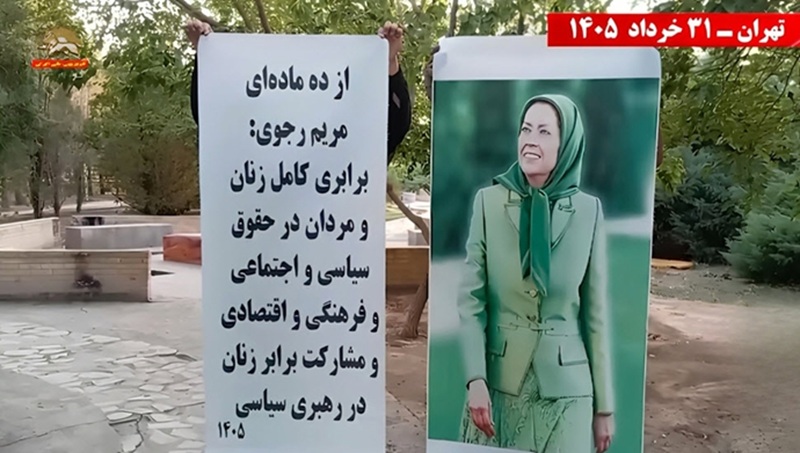

PMOI Resistance Units display messages supporting popular sovereignty, fundamental freedoms, gender equality, judicial independence, environmental protection, and a non-nuclear Iran.
Resistance Units Highlight Vision for a Democratic Iran
On June 21, 2026, PMOI Resistance Units in Tehran and Shiraz carried out a series of public activities promoting the principles of a democratic republic and expressing support for Mrs. Maryam Rajavi’s Ten-Point Plan for Iran’s future.
Through coordinated photo displays and public messaging campaigns, the activists emphasized key democratic values, including popular sovereignty, free elections, human rights, freedom of expression, gender equality, social justice, judicial independence, environmental protection, and the separation of religion and state.
The activities coincided with the Free Iran 2026 gathering and reflected growing support among resistance supporters for an alternative based on democracy and pluralism.
Shiraz: Calls for Popular Sovereignty and Fundamental Freedoms
In Shiraz, Resistance Units displayed a series of messages advocating democratic governance and individual liberties.
One display declared:
“No to Velayat-e Faqih. Yes to the sovereignty of the people in a republic based on free and pluralistic elections.”
Other messages emphasized freedom of expression, political parties, public assembly, independent media, and unrestricted access to cyberspace.
The activists also called for the protection of individual and social rights in accordance with the Universal Declaration of Human Rights, while highlighting the importance of separating religion from the state and guaranteeing freedom of religion and belief.
The campaign underscored the demand for a political system founded on free elections, pluralism, and the will of the people.
Tehran: Equality, Justice, and a Non-Nuclear Future
In Tehran, Resistance Units focused on additional aspects of Maryam Rajavi’s democratic platform, including gender equality, judicial reform, minority rights, economic justice, environmental protection, and peaceful international relations.
One display called for:
“Full equality between women and men in political, social, cultural, and economic rights, and equal participation of women in political leadership.”
Other messages advocated an independent judiciary based on international standards, the presumption of innocence, the right to legal defense, public trials, and judicial independence. The campaign also called for the abolition of laws imposed under the regime’s interpretation of religious rule and the dismantling of Revolutionary Courts.
The activists further highlighted the rights of Iran’s ethnic communities and nationalities, supporting autonomy proposals outlined by the National Council of Resistance of Iran for Iranian Kurdistan and calling for an end to discrimination against ethnic groups.
Promoting Social Justice and Environmental Protection
The Tehran campaign also stressed equal opportunities in employment and business for all Iranians, presenting economic justice as a central component of a future democratic republic.
In addition, Resistance Units drew attention to the environmental crisis facing the country, calling for the protection and restoration of ecosystems that have suffered decades of mismanagement under the clerical regime.
One of the displays stated:
“Protection and restoration of the environment devastated under the rule of the mullahs.”
Advocating a Non-Nuclear Iran
Another prominent theme of the campaign was the call for a non-nuclear Iran committed to peace and international cooperation.
The activists displayed messages supporting:
“A non-nuclear Iran, free of weapons of mass destruction. Peace, coexistence, and international and regional cooperation.”
This position reflects one of the central principles of Maryam Rajavi’s Ten-Point Plan, which advocates a democratic, secular, and non-nuclear republic living in peace with its neighbors and the international community.
Continuing Resistance for Democratic Change
The activities in Tehran and Shiraz demonstrated the continued efforts of PMOI Resistance Units to promote an alternative vision for Iran based on democratic governance, human rights, equality, and popular sovereignty.
By publicly highlighting the principles of Maryam Rajavi’s Ten-Point Plan, the activists sought to reinforce demands for a future Iran founded on free elections, social justice, gender equality, religious freedom, and peaceful coexistence with the world.