


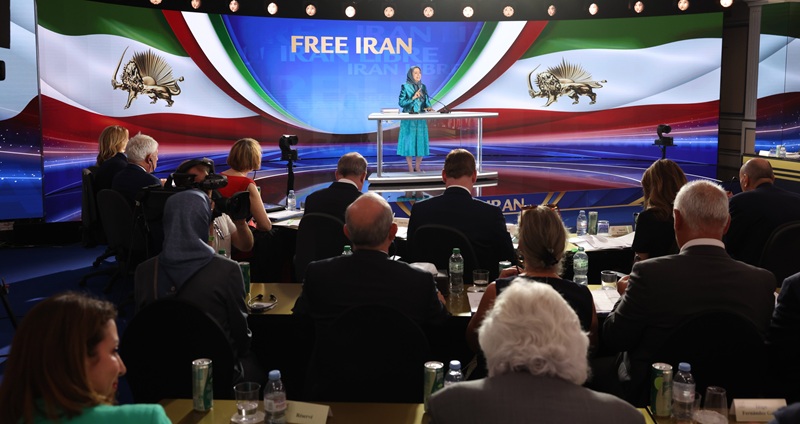

International lawmakers and former officials argue that executions, repression, economic decline, and recurring uprisings reveal a regime increasingly fearful of its own people.
For decades, Iran’s ruling clerical establishment has sought to project an image of strength and permanence. Yet speakers at the Free Iran 2026 conference in Paris delivered a markedly different assessment, arguing that the regime’s escalating repression, economic failures, and reliance on fear reveal a government increasingly vulnerable to the demands of its own people.
Addressing the gathering on June 20, lawmakers, former ministers, and political figures from Europe and North America repeatedly emphasized that authoritarian regimes often appear strongest shortly before they begin to unravel. Drawing on historical examples from Eastern Europe, Ukraine, and other democratic movements, speakers argued that Iran may be approaching a similar turning point.
Repression as a Sign of Fear
Several speakers pointed to the regime’s response to the nationwide protests of January 2026 as evidence of growing insecurity within the ruling establishment.
German parliamentarian Carsten Müller rejected Tehran’s efforts to portray itself as stable and confident, arguing that the true measure of a government’s strength lies in the support it receives from its people.
He noted that Iran continues to experience widespread censorship, torture, executions, and political repression, adding that the high number of executions carried out each year reflects fear rather than confidence.
Müller also referenced the January uprising, during which dozens of protesters were reportedly killed, arguing that governments secure in their legitimacy do not resort to such levels of violence against their own citizens.
Canadian parliamentarian Judy Sgro echoed that assessment, describing the regime’s response to the January protests as unprecedented repression. She cited reports of thousands of arrests, killings, torture, and enforced disappearances, while emphasizing that resistance activities have continued despite the crackdown.
According to several speakers, the regime’s increasing reliance on executions and intimidation demonstrates concern about the persistence of organized opposition and public unrest.
Economic Crisis Undermining Regime Stability
Beyond political repression, participants highlighted Iran’s deteriorating economic conditions as another indicator of systemic weakness.
Former Romanian Prime Minister Petre Roman argued that Tehran’s claims of victory and stability are contradicted by economic realities facing ordinary Iranians.
He described an economy in crisis, noting that millions of citizens struggle with declining living standards and growing hardship. Rather than demonstrating resilience, he suggested, these conditions expose the regime’s inability to provide even basic economic security for large segments of the population.
Speakers linked these economic pressures to broader public dissatisfaction, arguing that years of corruption, mismanagement, and costly regional interventions have eroded public confidence in the ruling establishment.
The result, they said, is a widening gap between the regime’s official narrative and the realities experienced by ordinary citizens.
Lessons from Other Dictatorships
A recurring theme throughout the conference was the comparison between Iran’s current situation and the final years of other authoritarian systems.
Roman drew on his experience during the Romanian Revolution of 1989, recalling how the dictatorship of Nicolae Ceaușescu appeared firmly in control even as public anger mounted beneath the surface.
He recounted how security forces opened fire on demonstrators before the regime suddenly collapsed, arguing that authoritarian governments often fall far more quickly than observers expect.
A similar perspective was offered by former Ukrainian Foreign Minister Dmytro Kuleba, who compared Iran’s struggle to Ukraine’s democratic movements and resistance against Russian aggression.
Kuleba reminded attendees that many international observers believed Ukraine could not survive either the 2014 revolution or the full-scale invasion launched in 2022. Yet Ukrainians defied those expectations.
His message to Iranians was that freedom movements frequently succeed despite predictions of failure and despite overwhelming state repression.
“Regimes vanish. People prevail,” he told the audience.
Organized Resistance and Public Defiance
Another factor cited by speakers was the continued existence of organized opposition networks despite decades of repression.
Judy Sgro argued that Tehran’s harsh treatment of political prisoners and opposition supporters reflects concern about the growth of organized resistance.
She pointed specifically to the case of political prisoners facing execution because of alleged ties to opposition movements, arguing that such prosecutions reveal the regime’s fear of political alternatives.
John Baird, Canada’s former foreign minister, similarly argued that the resistance demonstrated during the January protests has provided greater political legitimacy than the ruling establishment itself.
Several speakers praised Resistance Units operating inside Iran and residents of Ashraf 3 in Albania, describing them as evidence that opposition to the regime remains active and organized despite sustained efforts to eliminate it.
A Regime Facing Growing Challenges
While speakers differed in their political backgrounds and nationalities, they shared a common conclusion: Tehran’s increasingly aggressive tactics should not be mistaken for strength.
Instead, they argued, executions, censorship, mass arrests, and violent crackdowns reveal a leadership concerned about its future and increasingly dependent on coercion to maintain control.
For many participants, the events of January 2026 reinforced the belief that public demands for political change have not been extinguished. Combined with economic deterioration and continued resistance activity, they argued that these pressures are creating conditions that authoritarian governments historically struggle to withstand.
Whether such pressures will ultimately lead to political transformation remains uncertain. However, speakers at Free Iran 2026 consistently presented a central message: beneath its displays of power, Iran’s ruling establishment appears increasingly challenged by forces it has been unable to silence.