
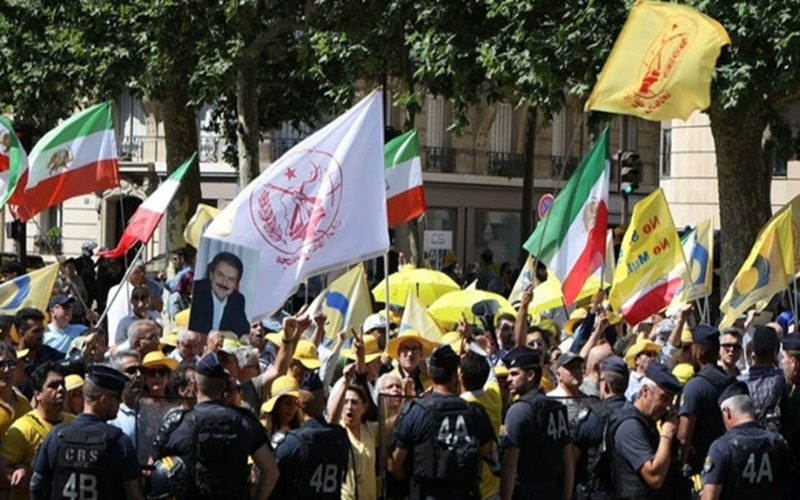

The attempted ban on the Iranian Resistance gathering in Paris became a political scandal that revealed the convergence of interests between Tehran’s ruling regime, monarchist networks, and a Western policy of appeasement.
The sudden decision to block the Iranian Resistance’s planned June 20 gathering in Paris was supposed to silence a growing movement for democratic change in Iran. Instead, it produced the opposite result. What was intended as a security measure became an international scandal that exposed uncomfortable truths about the forces aligned against Iran’s democratic alternative.
The controversy surrounding the Paris gathering revealed more than a bureaucratic dispute. It exposed the extent to which the Iranian regime, remnants of the former monarchy, and advocates of Western appeasement share a common objective: preventing the emergence of a credible, organized, and independent democratic opposition.
A Ban That Raised Serious Questions
Questions began to emerge when the timing of the French authorities’ decision came under scrutiny.
According to Reuters, the prohibition was imposed only hours after a telephone conversation between French Foreign Minister Jean-Noël Barrot and his Iranian counterpart Abbas Araghchi. The sequence of events inevitably raised concerns about political pressure and the influence of Tehran over decisions affecting Iranian dissidents in Europe.
More troubling revelations followed.
The Associated Press reported that documents submitted before the Paris Administrative Court indicated that activists linked to networks associated with the former Shah’s security apparatus had allegedly threatened disruptive actions, including bomb threats, should the demonstration proceed. At the same time, reports cited security threats attributed to Iran’s Islamic Revolutionary Guard Corps (IRGC).
The implications were striking. The official justification for banning the event rested on threats allegedly originating from two forces that publicly present themselves as enemies of one another: the clerical dictatorship and elements associated with the former monarchy.
Two Opposing Camps—or Two Sides of the Same Coin?
For years, many observers have viewed the Iranian regime and monarchist groups as political opposites competing for Iran’s future. Yet the events surrounding June 20 suggest a different reality.
When faced with an organized democratic alternative capable of mobilizing large numbers of Iranians, both camps appeared to benefit from the same outcome: the suppression of the Resistance’s public voice.
The irony is impossible to ignore. Those who claim to represent opposing visions for Iran found themselves, intentionally or otherwise, contributing to the same political objective.
This is why the Paris affair matters far beyond a single gathering. It revealed that the principal divide in Iranian politics may not be between monarchy and theocracy, but between dictatorship in all its forms and the democratic aspirations of the Iranian people.
The Resistance Refused to Be Silenced
What happened next demonstrated the limits of repression.
Despite the ban, thousands of Iranians and their supporters traveled to Paris from across Europe. Reports indicated that participants had organized transportation from numerous countries and had planned for months to attend the event.
Rather than disappearing from public view, protesters gathered at multiple locations throughout Paris, including Place de la République, Bastille, and Trocadéro. Their message remained unmistakable.
According to media reports, demonstrators chanted slogans rejecting both the ruling clerics and the return of monarchy. They carried photographs of political prisoners and victims of execution while demanding freedom, democracy, and human rights for Iran.
The attempt to silence the movement ultimately amplified its message.
The images that emerged from Paris did not show a defeated opposition. They showed a movement adapting, persevering, and continuing to make its presence felt despite significant obstacles.
The Failure of Appeasement
The controversy also reignited criticism of Western governments that continue to prioritize engagement with Tehran despite the regime’s record of repression, executions, and regional destabilization.
Several prominent political figures condemned the events.
Former European Parliament Vice President Alejo Vidal-Quadras argued that Western governments have become enablers of the Iranian dictatorship through policies of accommodation and hesitation. Others pointed to what they viewed as an alarming willingness to restrict democratic voices while citing threats originating from the very forces responsible for those threats.
Such criticism highlights a broader problem. Appeasement often claims to preserve stability, but it frequently achieves the opposite. By rewarding coercion and intimidation, it encourages further pressure from authoritarian actors.
The Paris episode demonstrated this dynamic in stark fashion.
A Lesson From Paris
The most important lesson from June 20 is that democratic resistance cannot be contained by administrative orders, political pressure, or intimidation.
The attempt to prevent a large-scale gathering succeeded only in drawing greater international attention to the cause it sought to suppress. It exposed contradictions within the policy of appeasement, raised questions about the role of monarchist networks, and underscored the enduring determination of Iranians seeking democratic change.
Paris became more than the site of a prohibited gathering.
It became a symbol of a larger political reality: that the forces of dictatorship—whether wrapped in the banner of theocracy or monarchy—remain united in their opposition to a democratic republic. Yet it also demonstrated that the Iranian Resistance continues to grow despite those efforts.
The voices heard across Paris carried a message that neither bans nor threats could silence: Iran’s future belongs not to the mullahs, nor to the return of the Shah, but to the people who continue to fight for freedom.