


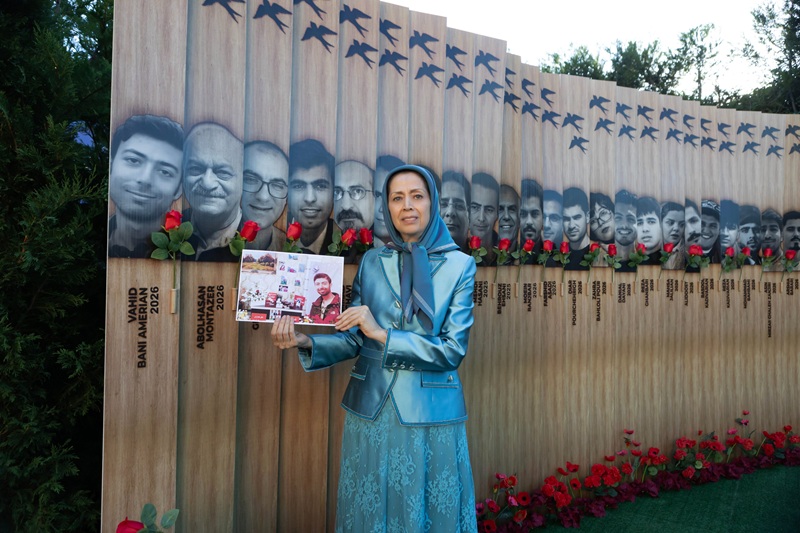

Speakers at Free Iran 2026 argued that Iran’s democratic transformation must come from within, led by protesters, Resistance Units, and supporters of the organized opposition.
One of the clearest messages emerging from the Free Iran 2026 conference in Paris was that the future of Iran will not be determined by foreign military intervention or diplomatic bargaining, but by the Iranian people themselves.
Across speeches delivered by lawmakers, former ministers, and political figures from Europe and North America, participants repeatedly emphasized that the driving force behind democratic change is the network of protesters, Resistance Units, political activists, and supporters of the organized opposition operating inside and outside Iran.
Rather than portraying Iranians as passive victims of repression, speakers described them as active participants in a sustained struggle that has continued despite executions, arrests, torture, and decades of state violence.
Change Must Come from Within
Former British Prime Minister Boris Johnson argued that recent military operations had demonstrated an important lesson: freedom cannot be delivered from abroad.
“Change must come from within, and it will come from within,” he said.
Johnson described Iran’s population as young, educated, and increasingly determined to choose a different future, comparing the current movement to the popular uprisings that helped bring down apartheid in South Africa and communist regimes in Eastern Europe.
His assessment was echoed by former European Council President Charles Michel, who said that military confrontation and diplomatic appeasement had both failed to address the roots of Iran’s political crisis.
According to Michel, the real alternative lies in an organized democratic resistance capable of empowering the Iranian people against tyranny.
Resistance Units as the Front Line
Many speakers highlighted the role of the Resistance Units, small networks of activists operating inside Iran despite the risk of arrest and execution.
Charles Michel praised their willingness to continue organizing even under intense repression, describing them as evidence that the demand for freedom remains alive across the country.
Canadian parliamentarian Judy Sgro similarly pointed to the persistence of resistance activities after the January 2026 uprising, arguing that the regime’s harsh treatment of political prisoners reflects its fear of organized opposition.
John Baird went further, saying that the resistance demonstrated on Iran’s streets has greater political legitimacy than the clerical establishment itself.
“There is more political legitimacy from those on the streets in the organized resistance in Iran than from any mullah or any relative of the last dictator,” Baird declared.
Ashraf 3 and the Continuity of the Movement
Several speakers addressed supporters of the resistance gathered in Ashraf 3, the Albanian community that houses members of the Iranian opposition.
Robert Torricelli described Ashraf 3 as a symbol of endurance during some of the darkest periods of Iran’s modern history.
He told residents that future generations of Iranians would remember those who refused to compromise when hope appeared nearly lost.
Carsten Müller, who recently visited Ashraf 3, also praised what he called the movement’s extraordinary resilience and emphasized that its supporters had not been forgotten by the international community.
For many conference participants, Ashraf 3 represented more than an exile community; it symbolized the continuity of a resistance movement that has survived repeated attempts to eliminate it.
Women at the Center of the Resistance
Another recurring theme was the central role of women in the struggle for democratic change.
Naike Gruppioni paid tribute to Iranian women who have transformed “pain into strength” and “fear into courage,” while Judy Sgro described women as leaders of the current protest movement.
Speakers argued that the prominence of women in demonstrations, resistance activities, and opposition leadership distinguishes the present movement from many previous political struggles in the region.
For them, the participation of women is not simply symbolic but a defining characteristic of the democratic alternative being proposed for Iran’s future.
A Movement That Has Survived Decades of Repression
Supporters of the resistance also stressed the movement’s longevity.
Carsten Müller noted that the People’s Mojahedin Organization of Iran (PMOI/MEK) has paid a heavy price over six decades of struggle, while John Baird argued that the National Council of Resistance of Iran has demonstrated the determination necessary to confront the regime over more than forty years.
This history of survival, speakers said, is itself significant.
Authoritarian governments often rely on the assumption that sustained repression will eventually destroy organized opposition. The continued existence of resistance networks, political prisoners willing to defy the regime, and activists operating inside Iran was presented as evidence that this strategy has not succeeded.
The Central Message of the Conference
Despite differences in political background, nearly all speakers converged on one conclusion: the Iranian people are not waiting for others to secure their freedom.
From protesters in Tehran to Resistance Units operating clandestinely across the country, conference participants argued that the foundations of change already exist inside Iran.
The role of the international community, they said, is not to impose a future on Iran but to recognize and support the democratic aspirations of those already risking their lives for it.
As former Ukrainian Foreign Minister Dmytro Kuleba told the audience, authoritarian regimes may possess weapons, prisons, and propaganda machines, but history repeatedly shows that determined people can outlast them.
That belief—that organized resistance and public defiance remain the decisive force for change—emerged as one of the defining themes of Free Iran 2026.