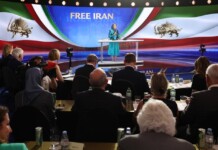
International lawmakers and former officials argued that decades of concessions and engagement have neither improved human rights nor moderated the Iranian regime’s behavior.
Throughout the Free Iran 2026 conference in Paris, speakers directed sharp criticism not only at Iran’s ruling establishment but also at Western policies that they argued have enabled the regime to survive and expand its influence.
Lawmakers, former ministers, and political leaders from Europe and North America repeatedly warned that decades of engagement, concessions, and diplomatic accommodation have failed to produce meaningful change in Iran. Instead, they argued, policies aimed at moderating the regime have coincided with increased repression at home and continued destabilizing activities abroad.
For many participants, the debate was no longer about whether appeasement had succeeded. It was about how long Western governments would continue pursuing a strategy they described as demonstrably ineffective.
A Policy Under Increasing Scrutiny
Several speakers argued that successive Western governments hoped that dialogue, economic engagement, and diplomatic outreach would encourage more moderate behavior from Tehran.
According to conference participants, those expectations have not been fulfilled.
They pointed to Iran’s continued use of executions, the suppression of political dissent, restrictions on civil liberties, and the persecution of opposition activists as evidence that engagement has failed to improve the regime’s human rights record.
At the same time, they argued that regional tensions, support for proxy groups, and the expansion of Tehran’s military influence have continued despite years of diplomatic efforts aimed at changing the regime’s conduct.
For many speakers, these developments raised fundamental questions about the assumptions that have guided Western policy for decades.
Human Rights Cannot Be Secondary
German parliamentarian Carsten Müller argued that democratic governments must place human rights at the center of their policy toward Iran.
He criticized approaches that separate diplomatic engagement from concerns about political prisoners, executions, and state repression, warning that silence on such issues risks emboldening those responsible for abuses.
Müller maintained that international relations should not come at the expense of fundamental democratic principles and called for greater accountability for officials involved in human rights violations.
His remarks reflected a broader theme throughout the conference: that human rights should be treated as a central component of foreign policy rather than a secondary concern.
The Cost of Looking Away
Several participants suggested that the international community has too often underestimated the consequences of inaction.
Italian parliamentarian Naike Gruppioni argued that neutrality in the face of repression effectively benefits those carrying out the repression.
She pledged continued efforts to expose human rights abuses, support political prisoners, and advocate for stronger measures against individuals responsible for violations.
Her message resonated with many conference attendees who viewed silence and passivity as forms of political acquiescence.
According to this perspective, democratic governments face a moral and political responsibility to respond when fundamental freedoms are systematically violated.
Calls for Greater Pressure
Although speakers proposed different policy approaches, many agreed that stronger pressure on Tehran is necessary.
Recommendations included targeted sanctions against officials involved in human rights abuses, increased diplomatic isolation of those responsible for repression, and stronger support for international investigations into executions and political persecution.
Participants argued that accountability measures should focus on those directly involved in implementing repressive policies rather than on ordinary Iranian citizens.
Several speakers also called for greater international attention to political prisoners and individuals facing execution because of their political beliefs or alleged links to opposition movements.
These proposals reflected a broader conviction that pressure, rather than accommodation, offers a more effective means of influencing the regime’s behavior.
Support for the Iranian People, Not the Regime
A recurring distinction throughout the conference was between Iran’s rulers and the Iranian people.
Speakers repeatedly emphasized that opposition to appeasement does not mean opposition to Iran itself.
On the contrary, they argued that stronger support for democratic values, civil society, and human rights represents a form of solidarity with the Iranian population.
Former Canadian Foreign Minister John Baird argued that Western governments should place greater emphasis on the aspirations of ordinary Iranians rather than on maintaining relationships with those who suppress them.
Several participants similarly urged policymakers to recognize the role of protesters, political activists, and Resistance Units as legitimate voices in discussions about Iran’s future.
Lessons from Past Experience
Some speakers drew comparisons with previous authoritarian regimes that benefited from international hesitation or excessive optimism.
Former Romanian Prime Minister Petre Roman recalled the final years of communist rule in Eastern Europe, arguing that democratic governments sometimes underestimate the resilience of opposition movements while overestimating the stability of authoritarian systems.
Others pointed to historical examples where dictatorships exploited diplomatic engagement without implementing meaningful reforms.
These comparisons were used to support the argument that Western governments should evaluate Tehran based on its actions rather than its promises.
A Different Approach to Iran
Beyond criticizing past policies, speakers also sought to outline an alternative approach.
Rather than viewing Iran solely through the lenses of nuclear negotiations, regional security concerns, or diplomatic engagement, they argued that policymakers should pay greater attention to democratic aspirations inside the country.
Supporters of this view contended that lasting stability cannot be achieved by strengthening authoritarian institutions. Instead, they argued, stability will ultimately depend on the emergence of a government that enjoys popular legitimacy and respects fundamental rights.
For many conference participants, this principle should guide future relations between democratic nations and Iran.
The End of an Era?
One of the strongest messages to emerge from Free Iran 2026 was that the policy debate surrounding Iran may be entering a new phase.
Speakers from different political traditions and countries repeatedly reached the same conclusion: decades of engagement have failed to moderate the regime’s behavior, reduce repression, or address the grievances driving repeated waves of unrest.
While opinions differed on specific policy measures, participants broadly agreed that the status quo is no longer sustainable.
Their message was clear: democratic governments should stop treating the regime as a force for stability and instead align themselves more closely with the Iranian people’s aspirations for freedom, accountability, and democratic change.