


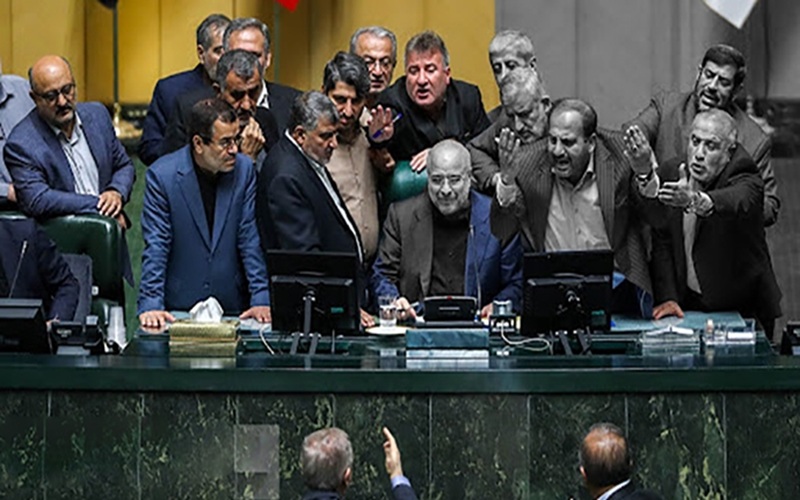

While the proposed U.S.-Iran framework may ease immediate diplomatic pressures, it is already exposing deep fractures within the ruling establishment and highlighting the unresolved crises driving public unrest.
The reported 14-point draft memorandum between the United States and Iran’s regime has yet to become a final agreement. Nevertheless, regardless of whether it ultimately succeeds or fails, its political consequences are already beginning to reshape the dynamics inside the Iranian regime.
At this stage, the document should be viewed less as a finalized settlement and more as a framework for future negotiations. According to available reports, the draft outlines the conditions under which both sides would enter a negotiation process expected to continue for several weeks. The most contentious issues remain unresolved, and any final outcome will depend on difficult bargaining ahead.
Yet even before reaching that stage, the proposal has triggered visible reactions within Tehran’s power structure.
Early Signs of Fractures at the Top
One of the most notable developments has been the apparent reluctance among senior regime figures to assume political responsibility for the negotiations. Reports and public statements suggest efforts by key power centers to distance themselves from potential concessions and to shift responsibility toward other institutions.
Such behavior reflects a broader concern inside the ruling establishment. For decades, the regime has presented certain policies—particularly regarding its nuclear program, regional influence, and strategic posture—as non-negotiable principles. Any compromise on issues previously portrayed as “red lines” risks creating political liabilities for those associated with the decision.
Iran’s political history demonstrates that whenever the leadership has been forced to retreat from long-standing ideological positions, internal rivalries have intensified. Competing factions have often sought to blame one another for unpopular decisions while attempting to preserve their own political standing.
The emerging debate surrounding the draft agreement appears to be following a similar pattern.
Economic and Social Pressures Remain Unresolved
At the same time, the significance of the proposed framework extends beyond elite political disputes.
Iran enters this new phase amid a convergence of severe economic and social challenges. Years of inflation, declining purchasing power, growing poverty, chronic energy shortages, water crises, environmental degradation, and widespread public frustration have created conditions fundamentally different from those that existed during previous diplomatic negotiations.
Even if negotiations ultimately produce a broader agreement, such a development would not automatically resolve these structural problems. Many of the grievances that have fueled repeated waves of protests in recent years originate from domestic economic mismanagement, corruption, political repression, and declining living standards rather than from sanctions alone.
As a result, public expectations could become a new source of pressure on the regime. Any perception that negotiations fail to improve daily life could deepen existing dissatisfaction. Conversely, even limited economic relief may struggle to meet the demands of a population that has experienced years of hardship.
The Shadow of Future Protests
The January 2026 protests demonstrated that social tensions remain highly volatile. Although the authorities succeeded in suppressing the demonstrations, the underlying causes were not eliminated.
The combination of economic strain, declining trust in state institutions, and growing frustration among various sectors of society suggests that the potential for future unrest remains significant. Any political development—including a major diplomatic agreement—will inevitably be judged by its impact on ordinary citizens rather than by diplomatic achievements alone.
This means that the current negotiations should not be interpreted as a decisive victory for the regime. The government continues to face a substantial legitimacy challenge at home, and the social pressures that have repeatedly erupted into protest remain largely intact.
Not the End of the Regime, But Not a Strategic Victory Either
At the same time, it would be premature to conclude that the draft agreement signals the imminent collapse of the ruling establishment.
The Iranian regime has repeatedly demonstrated an ability to adapt to crises, manage internal rivalries, and deploy extensive security mechanisms to preserve its hold on power. Internal divisions, while significant, do not automatically translate into systemic breakdown.
What the current moment does reveal is a growing gap between the regime’s political narrative and the realities it confronts. Different factions are already positioning themselves to avoid responsibility for difficult decisions and to shift potential costs onto their rivals. This process could intensify as negotiations progress and as the implications of any future agreement become clearer.
A Period of Intensifying Contradictions
The 14-point draft memorandum should therefore be understood as more than a diplomatic document. Whether it eventually leads to a comprehensive agreement or collapses during negotiations, it is already acting as a catalyst that exposes existing contradictions within Iran’s political system.
The coming months are likely to be defined by two parallel developments: increased competition among factions inside the ruling establishment and continued pressure from a society burdened by deep economic and social crises.
Neither dynamic alone is likely to determine Iran’s future. Together, however, they point to a period in which many of the regime’s long-standing contradictions—both within the state and between the state and society—will become increasingly difficult to contain.