


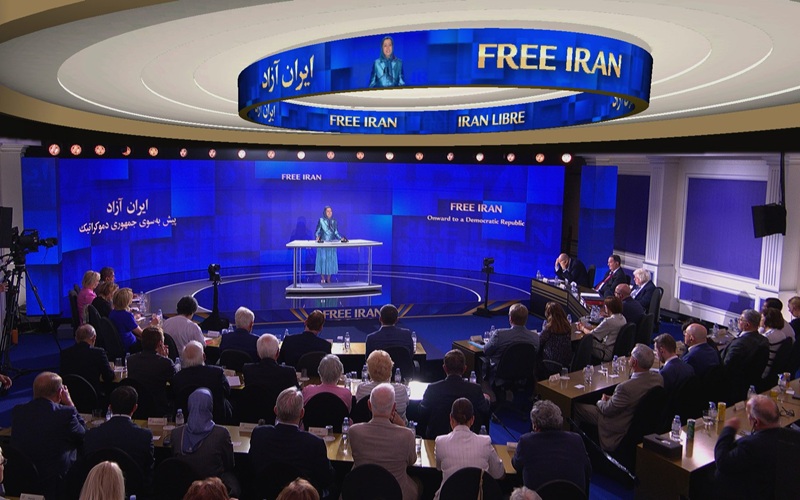

Speakers at the Paris conference argued that Iran’s future should be defined neither by clerical rule nor by a return to monarchy, but by democratic self-government.
Throughout the Free Iran 2026 conference in Paris, participants discussed a wide range of issues, from human rights and political prisoners to international policy and democratic transition. Yet beneath these discussions lay a broader political question: what kind of government should replace the current regime if democratic change occurs in Iran?
For many speakers, the answer was clear.
The conference repeatedly emphasized the idea of a democratic republic founded on free elections, political pluralism, and popular sovereignty. Participants argued that Iran’s future should not be defined by a choice between competing forms of authoritarian rule, but by the establishment of democratic institutions accountable to the people.
This vision emerged as one of the most consistent and unifying themes of the gathering.
Beyond the Politics of the Past
Several speakers argued that debates about Iran’s future are often framed too narrowly.
According to this view, discussions frequently assume that opposition to the current theocratic system must lead either to political chaos or to the restoration of a previous form of rule.
Conference participants challenged that assumption.
They argued that Iran’s democratic movement seeks not a return to the past but the creation of a new political order based on modern democratic principles.
The emphasis throughout the event was not on replacing one ruling elite with another, but on establishing institutions that derive legitimacy from the will of the people.
For many speakers, that distinction is fundamental.
Popular Sovereignty as the Source of Legitimacy
A recurring theme throughout the conference was the belief that political authority should come from citizens rather than religious doctrine, hereditary privilege, or unelected institutions.
Former European Council President Charles Michel argued that the Iranian people should be empowered to determine their own future through democratic mechanisms.
Similarly, lawmakers from Europe and North America stressed that governments gain legitimacy through elections and public consent rather than historical claims or ideological authority.
The repeated references to free elections and universal suffrage reflected a broader commitment to the principle that sovereignty belongs to the people.
According to speakers, this principle should form the foundation of any future political system in Iran.
Rejecting Theocratic Rule
Criticism of the current political system was unsurprisingly a central feature of the conference.
Participants argued that the concentration of power in religious institutions has undermined democratic accountability, restricted political freedoms, and limited citizens’ ability to influence public affairs.
Speakers pointed to censorship, political repression, restrictions on civil society, and widespread human rights abuses as evidence of the failures of clerical governance.
Many argued that meaningful democratic reform would require separating religion from the state and ensuring that political institutions operate independently of religious authority.
This principle was presented as an essential condition for protecting both democracy and religious freedom.
Rejecting a Return to Monarchy
At the same time, several speakers suggested that Iran’s future should not be defined by a return to hereditary rule.
Former Canadian Foreign Minister John Baird delivered one of the conference’s clearest statements on the issue.
He argued that Iran’s democratic aspirations cannot be fulfilled by replacing one unelected system with another and stressed that political legitimacy should come from citizens rather than family lineage.
His remarks reflected a broader sentiment expressed throughout the conference: that the objective is democratic self-government rather than the restoration of any previous political order.
While speakers devoted most of their attention to criticizing the current regime, many also emphasized that the future should be built on democratic participation rather than nostalgia for the past.
The Role of the Ten-Point Plan
Maryam Rajavi’s Ten-Point Plan served as the principal framework through which speakers articulated their vision of a democratic republic.
Participants repeatedly cited commitments to free elections, gender equality, religious freedom, judicial independence, and the abolition of the death penalty as evidence that the opposition has developed a concrete political program rather than merely a protest movement.
Supporters argued that these principles provide a foundation for democratic governance while avoiding the concentration of power that has characterized previous political systems.
For many conference participants, the significance of the plan lies not only in its policy proposals but also in its emphasis on democratic accountability.
A Republic Defined by Rights and Participation
Speakers described a future republic as one in which citizens enjoy equal political rights regardless of gender, ethnicity, religion, or political belief.
They emphasized the importance of competitive elections, an independent judiciary, freedom of expression, and protections for civil society.
Many also highlighted the prominent role of women in the resistance movement, arguing that democratic transformation must be accompanied by meaningful political and social equality.
The vision presented at the conference was therefore not limited to a change in leadership. It involved a broader transformation of the relationship between citizens and the state.
A Third Path for Iran
One of the defining messages of Free Iran 2026 was that Iran’s future should not be viewed as a choice between competing forms of authoritarianism.
Instead, speakers argued that a third path exists—one based on democratic institutions, political pluralism, and the principle that citizens alone should determine the country’s future.
Whether discussing human rights, international policy, resistance activities, or democratic transition, participants repeatedly returned to this idea.
Their argument was that the central political divide in Iran is not between rival elites or competing historical traditions. It is between authoritarian rule and democratic self-government.
By the conclusion of the conference, that vision of a democratic republic had emerged not merely as one theme among many, but as the political foundation connecting all the others.
The calls for human rights, support for resistance activities, criticism of appeasement, and demands for accountability all pointed toward the same objective: a future Iran governed not by clerics, monarchs, or unelected authorities, but by its citizens.