
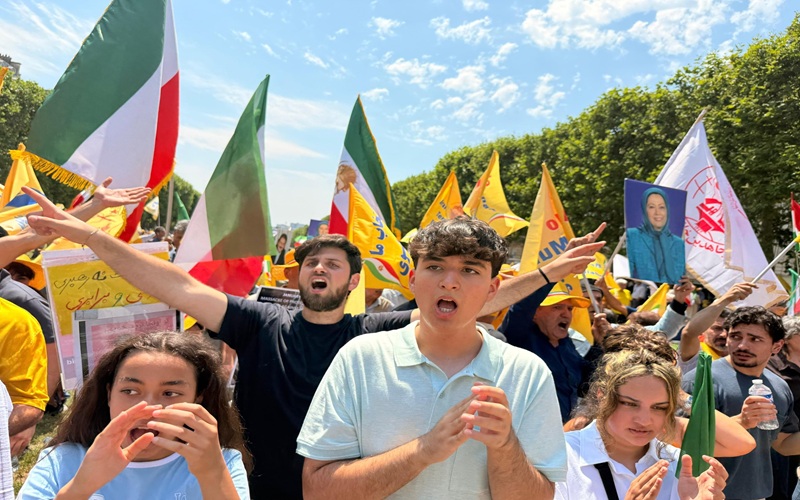

Speakers at the Paris conference argued that preventing a major gathering of Iranian opposition supporters raised concerns about freedom of assembly and democratic principles in Europe.
The Free Iran 2026 conference was intended to focus on Iran’s future, democratic change, and support for the Iranian people. Yet one of the most discussed topics throughout the event was not developments inside Iran, but a decision taken in France.
In the days leading up to the conference, authorities prevented a large gathering of Iranian opposition supporters that had been planned near Place Vauban in Paris. The decision transformed what was initially a logistical and security issue into a political controversy that resonated throughout the conference hall.
Speakers from across Europe and North America repeatedly returned to the subject, arguing that the restrictions raised broader questions about freedom of assembly, democratic rights, and the ability of political dissidents to make their voices heard in democratic societies.
For many participants, the controversy became inseparable from the conference itself.
A Gathering That Never Took Place
Organizers had expected tens of thousands of supporters of the Iranian Resistance and democratic change in Iran to gather in Paris on June 20.
Instead, the planned public demonstration was prevented from taking place.
While conference activities continued indoors, many speakers expressed disappointment that a peaceful political gathering had been blocked despite France’s long-standing reputation as a defender of democratic freedoms.
The issue quickly became one of the dominant themes of the event, with participants viewing it not merely as an administrative decision but as a matter of political principle.
France’s Democratic Tradition at the Center of the Debate
Several speakers emphasized France’s historic role as a symbol of liberty, democracy, and political rights.
Former British Prime Minister Boris Johnson described the situation as deeply disappointing, arguing that France has traditionally stood as a beacon of democratic values.
While acknowledging the country’s important role in defending freedom throughout modern history, he questioned whether preventing a peaceful gathering was consistent with those traditions.
Others made similar arguments, stressing that democratic societies derive their strength from allowing citizens and political movements to express their views openly and peacefully.
For these speakers, the controversy was not simply about one event but about the principles that democratic nations seek to uphold.
Criticism from International Lawmakers
Criticism came from politicians representing a wide range of countries and political backgrounds.
German parliamentarian Carsten Müller expressed concern that restrictions had affected individuals seeking to advocate for democracy and human rights in Iran.
Former Romanian Prime Minister Petre Roman likewise argued that the decision sent an unfortunate message to those struggling against authoritarianism.
Several speakers noted that many participants had traveled long distances specifically to take part in the gathering.
Their disappointment, they said, reflected not only frustration over a canceled event but also concern that democratic voices had been denied an opportunity to be heard.
“France Is Better Than This”
One of the strongest reactions came from former U.S. Senator Robert Torricelli.
While expressing admiration for France and its democratic traditions, he criticized the decision to prevent the gathering.
“France, you are better than this,” he told the audience, a remark that drew a strong response from attendees.
Torricelli argued that societies committed to liberty should be especially careful when limiting political expression, particularly when the individuals involved are advocating democratic change rather than violence or extremism.
His comments captured a sentiment that appeared repeatedly throughout the conference: disappointment from individuals who view France as a historic champion of freedom.
Concerns About the Signal Sent to Tehran
Beyond the immediate issue of assembly rights, some speakers argued that the decision could be interpreted beyond France’s borders.
They warned that restrictions affecting democratic opposition groups risk sending an unintended message to authoritarian governments.
Several participants suggested that when democratic activists face obstacles in Europe, regimes that routinely suppress dissent may view such developments as politically advantageous.
For that reason, speakers argued that democratic governments should exercise particular caution when limiting peaceful political activities.
According to this perspective, the issue concerns not only domestic civil liberties but also the international credibility of democratic institutions.
Freedom of Assembly as a Democratic Principle
Throughout the conference, speakers repeatedly framed the controversy within a broader discussion about fundamental freedoms.
They emphasized that freedom of assembly, freedom of expression, and political participation are rights that democratic societies must actively protect, especially when those rights are exercised peacefully.
Some participants observed that many Iranians had come to Paris precisely because such freedoms do not exist in their own country.
That reality, they argued, made the restrictions particularly difficult for many attendees to understand.
For these speakers, protecting democratic rights means defending them even when doing so is politically inconvenient.
An Issue That Shaped the Conference
Although Free Iran 2026 featured extensive discussions about Iran’s political future, resistance activities, human rights, and democratic alternatives, the Paris rally controversy became one of the defining stories of the event.
What began as a dispute over a public gathering evolved into a broader debate about democratic values and the responsibilities of democratic governments.
Whether viewed as a security decision, an administrative measure, or a political miscalculation, the restrictions ensured that questions about freedom of assembly remained at the center of the conference.
For many participants, the lesson was clear: support for democratic change abroad must be accompanied by a consistent commitment to democratic freedoms at home.
The controversy surrounding the planned Paris gathering ensured that this message would resonate far beyond the conference itself.