
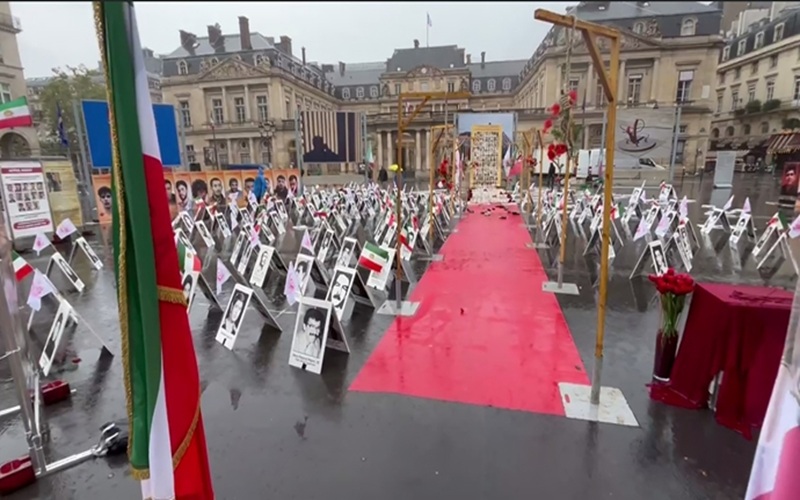

International warnings over executions of political prisoners and new restrictions on contact with foreign journalists expose the Iranian regime’s intensifying campaign of repression.
Iran’s human rights situation has sharply deteriorated in recent months, with a dramatic increase in executions, including those of political prisoners, alongside new restrictions targeting freedom of expression and access to information.
In an interview with INTV examining the latest developments, human rights commentator Sahar Sanaei pointed to executions as one of the clearest indicators of the regime’s worsening human rights record. She noted that while countries such as Lebanon have taken steps toward abolishing the death penalty, Iran has moved in the opposite direction.
Since March, executions have increased significantly. According to Sanaei, 56 political prisoners have been executed in the intervening months, representing the highest number in approximately 35 years.
The scale and speed of the executions have triggered growing international concern.
UN Warns Over Surge in Executions
UN High Commissioner for Human Rights Volker Türk issued a warning in August, expressing deep concern over the growing number of executions in Iran, particularly the execution of political prisoners. He called on the Iranian regime to halt executions.
The regime has also resorted to public executions as a tool of intimidation. Two young men were reportedly executed in public in Isfahan, further demonstrating how the death penalty is being used not only as punishment but as a means of spreading fear throughout society.
The international alarm extends to prisoners currently facing execution. UN experts—including the Special Rapporteur on the human rights situation in Iran, the Special Rapporteur on extrajudicial executions and the Special Rapporteur on torture—have raised concerns over the cases of 12 individuals sentenced to death in connection with the Ali Khani case.
The experts called on the regime to halt the executions, warning that the judicial process had failed to meet international standards and that serious questions remained about how the proceedings had been conducted.
They also urged Iran to create a moratorium on executions and to respect freedom of expression and other fundamental rights.
Executing a Human Rights Activist
The execution of human rights activist Majid Adineh provides another example of the regime’s approach.
Adineh had reportedly spent approximately two decades working as a human rights activist, including helping and supporting families in need. He had also participated in the December protests.
Rather than recognizing his humanitarian work, the regime executed him in recent weeks.
His case underscores the widening definition of “crime” employed against those who challenge or criticize the authorities. Activities that would normally be regarded as civic engagement or human rights advocacy are increasingly treated by the regime as threats to its security.
Contact With Foreign Journalists Criminalized
The repression is not confined to prisons and execution chambers.
The regime has also moved to restrict the flow of information by criminalizing contact with foreign journalists. A measure approved by the regime’s parliament reportedly treats communication with foreign reporters as a criminal offense.
Such restrictions stand in stark contrast to international efforts to strengthen freedom of expression and protect citizens’ access to information.
The measure also reveals what the regime fears most: the possibility that information about conditions inside Iran will reach the outside world and that the grievances of Iranian society will become more widely known.
By restricting communication with foreign media, the regime is attempting to control not only what Iranians can say, but also what the international community can hear about Iran.
International Pressure Meets Domestic Resistance
UN experts have repeatedly issued warnings over the deteriorating situation. The UN Special Rapporteur on Iran, Mai Sato, has also remained active in raising concerns about developments inside the country.
The continuing stream of international warnings highlights the depth of the crisis. As Sanaei noted, UN rapporteurs and international experts often gain a fuller understanding of the scale of abuses only after examining the regime’s record and the cases brought before them.
The pattern emerging from these developments is unmistakable: executions are increasing, political prisoners are being targeted, human rights activists are being punished, public executions are being used to spread fear, and restrictions on freedom of expression are expanding.
The Iranian regime’s response to growing social discontent is therefore increasingly centered on repression.
But executions and censorship cannot eliminate the underlying causes of public anger. Instead, they expose the regime’s fear of a society that increasingly refuses to accept repression as the price of political survival.
The growing international scrutiny of Iran’s human rights violations, together with the continued resistance of political prisoners and Iranian society, demonstrates that the regime’s campaign of intimidation has not succeeded in silencing opposition.