Warnings from Iran’s regime media ahead of Masoud Pezeshkian’s New York visit reveal growing concern over factional disputes, mixed messages, and the appearance of weakness.
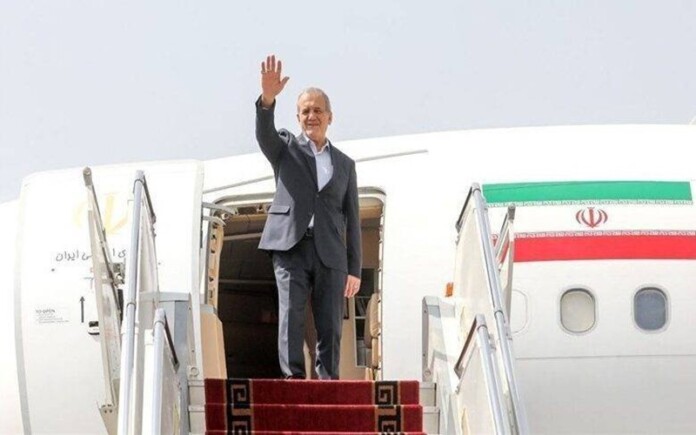
Masoud Pezeshkian’s scheduled trip to New York for the 2026 United Nations General Assembly has triggered an unusual wave of warnings from Iran’s regime media. Rather than simply preparing the president for a major diplomatic appearance, publications associated with different power centers are warning him about what he must—and must not—say.
The warnings are significant because they expose a deeper problem: the regime’s struggle to maintain a unified public position while competing factions increasingly challenge one another.
On September 18, Kayhan, the newspaper closely associated with Supreme Leader, warned Pezeshkian against following what it described as “dangerous” prescriptions from the Western-oriented current. It also cautioned against sending any signal that could be interpreted by the regime’s adversaries as a sign of weakness.
The message was clear: whatever Pezeshkian says in New York will not be treated as the personal position of the president. He will be viewed as representing the entire regime.
“You represent the entire regime”
This point was explicitly emphasized in the warnings surrounding Pezeshkian’s trip. Anyone traveling to New York as the regime’s representative, Kayhan argued, represents the government as a whole.
On the surface, this is an obvious principle of state diplomacy. A government normally expects its official representative at the United Nations to communicate an agreed position.
But the very need to emphasize this principle exposes the regime’s problem.
The warnings indicate that there is concern that Pezeshkian—or factions around him—could send messages that differ from those favored by other centers of power. The issue is therefore not merely the wording of a speech at the UN. It is whether the regime can project a coherent political position when its own factions are openly disputing the boundaries of acceptable policy.
Pezeshkian himself has previously used the term “administrator” or “facilitator” to describe the limited nature of the presidency within Iran’s political system. Former President Mohammad Khatami similarly described his own position as that of a “facilitator.”
Whatever terminology is used, the warnings surrounding Pezeshkian’s New York trip underscore the constraints placed on the presidency by the broader power structure.
When the government cannot agree on its own message
The contradiction becomes sharper when viewed against the regime’s factional disputes.
The problem is not simply that different officials hold different opinions. Political systems routinely contain internal disagreements. The more revealing issue is the way such disagreements can become public accusations of disloyalty.
There is a basic expectation of international representation: when one official speaks on behalf of a government, another representative of that same government would not normally be expected to publicly denounce the first as a traitor, spy, or “compromiser.”
Yet this is precisely the kind of internal conflict that has increasingly become visible within the Iranian regime.
The warnings from Kayhan and other regime media therefore serve a dual purpose. They instruct Pezeshkian on what to say, but they also reveal the anxiety of other power centers about what he might say.
The result is a striking contradiction. Pezeshkian is expected to represent the entire regime abroad, while factions inside the regime remain deeply concerned about whether they can trust the message he will deliver.
Foreign trips become factional battlegrounds
The tension is not confined to the upcoming UN General Assembly.
The regime’s “Jaan-Fada” ceremony provided another revealing example of how internal factional disputes can surface even during carefully staged official events. During the ceremony, Pezeshkian was reportedly confronted with chants accusing him of being a “compromiser.”
The episode is significant not because of the ceremony itself, but because of what it illustrates.
A government seeking to project cohesion would normally use major public ceremonies to reinforce unity. When accusations against the president emerge even in such settings, however, the ceremony itself becomes another arena for factional confrontation.
This helps explain why Pezeshkian’s foreign travel can become politically sensitive inside the regime. Every international appearance creates an opportunity not only to present a unified image abroad but also to expose disagreements at home.
A broader crisis beyond Pezeshkian
The conflict surrounding Pezeshkian’s UN trip cannot be separated from the wider pressures confronting the regime.
The regime has repeatedly relied on external crises, regional intervention, and confrontation as mechanisms for postponing a more direct confrontation with mounting domestic problems.
Khamenei himself has articulated this logic in remarks concerning the regime’s military and political involvement in countries such as Syria and Iraq. He argued that if the regime did not confront its enemies there, it would eventually have to confront them inside Iran.
This reasoning reflects a broader strategic approach in which external confrontation is used to keep internal threats at a distance.
But this strategy has increasingly reached its limits. Rather than resolving the regime’s fundamental problems, each new crisis adds another layer of pressure, while the underlying economic, social, and political problems remain unresolved.
That pressure is then reflected inside the ruling structure itself.
The “crisis of no solution”
The regime’s deepest problem is increasingly a “crisis of no solution”—a point where mounting economic, social, political, and international pressures can no longer be addressed separately.
This is where the different elements of the current situation come together.
Economic pressures, social discontent, international confrontation, and internal political disputes do not exist separately. They interact with one another. When a government has difficulty resolving mounting problems, disagreements over how to respond can become increasingly bitter.
The result is greater pressure on every official who attempts to represent the regime.
Pezeshkian’s position illustrates this contradiction. He must present himself internationally as the representative of the Iranian government, while domestic power centers simultaneously warn him against making statements that could be interpreted as conciliatory or weak.
His New York trip therefore carries a significance beyond the speech he may deliver at the United Nations.
It provides a window into the regime’s internal struggle over how to respond to the pressures confronting it.
New York as a test of regime cohesion
The central question surrounding Pezeshkian’s visit is consequently not simply what message he will deliver at the UN.
It is why the regime feels compelled to warn him so publicly about the limits of that message.
The statements from Kayhan and other regime media demonstrate that Pezeshkian’s words abroad are being watched through the lens of the regime’s internal factional struggle. Any attempt to project flexibility can be attacked as weakness; any attempt to emphasize confrontation can carry its own diplomatic consequences.
This places the president in the middle of a contradiction that goes far beyond one UN appearance.
The regime wants its representative to project unity abroad. At the same time, its own factions are publicly policing that representation and challenging one another over what constitutes an acceptable message.
The New York trip thus becomes another stage on which the regime’s internal contradictions are visible. The warnings issued before Pezeshkian even leaves Iran suggest that the struggle over the regime’s message is already underway—before he reaches the United Nations.