



Accounts aired by Iran’s own regime media reveal how soaring prices, stagnant incomes, and restrictions on informal work are pushing more people into economic insecurity.
For millions of people in Iran, earning enough to cover the most basic needs has become an increasingly difficult struggle. Even regime-affiliated media are airing accounts that expose the widening gap between household incomes and the cost of living.
One young man interviewed in the regime’s media describes a life in which working hard is no longer enough to make ends meet. He says his income does not keep pace with his expenses and that he has spent two years trying unsuccessfully to buy a car. Even repairing his phone has become unaffordable, leaving it broken for a year.
His account captures a broader reality: the country’s economic crisis has reached a point where ordinary purchases that were once considered routine have become unattainable for many households.
The growing value of the dollar has also become embedded in everyday life. The young man describes his financial situation as being shaped by a currency he has never even handled. This reflects how exchange-rate instability has translated into higher prices for goods and services across the economy, even for people whose incomes are entirely in rials.
From Metro Vendors to Street Sellers: The Struggle to Survive
As formal incomes fail to cover household expenses, more people are turning to informal work to make ends meet.
A young vendor featured in the regime’s media sells inexpensive goods on the Tehran metro, carrying his merchandise from carriage to carriage. His products include chewing gum, candy, air fresheners, and other low-cost items.
The scene is revealing. People are not necessarily entering the informal economy because of entrepreneurial opportunity; many are simply trying to generate enough income to survive.
At the same time, the purchasing power of ordinary consumers has deteriorated so sharply that even low-cost goods are increasingly difficult to sell. A vendor cited in the same coverage acknowledges the problem bluntly: people cannot afford to buy.
This creates a vicious cycle. Workers and unemployed people seek additional sources of income, while consumers themselves have less money to spend.
Prices Rise Faster Than Wages
The scale of the purchasing-power crisis becomes clearer when the price of consumer goods is compared with incomes.
Regime media recently cited the price of Apple’s iPhone 18 series as an example. According to the figures presented in the report, an iPhone 18 Pro or Pro Max priced at roughly $1,200 in the United States would cost around 240 million tomans in Iran.
The report claimed that an Iranian would need the equivalent of roughly 360 days of income to purchase the phone, compared with only several days of income for a worker in parts of Europe. It also cited comparisons with Southeast Asian countries, where the same product would require substantially fewer days of earnings.
The significance of the comparison is not the phone itself. It demonstrates the extraordinary deterioration in purchasing power when wages are measured against internationally traded goods.
Older iPhone models are reportedly selling in Iran for between 300 million and 500 million tomans. For households already struggling to pay for food, housing, transportation, medicine, and other necessities, such prices illustrate the widening gulf between earnings and the cost of goods.
Even Basic Food Is Becoming a Burden
The crisis is not confined to imported electronics or other discretionary purchases. The same reports point to sharp increases in the price of everyday food.
One example cited is a hamburger that reportedly cost around 10,000 tomans in 2016 but now costs roughly 50 times more. Over the same period, the daily wage of a worker is said to have increased only about 20 times.
The result is a straightforward erosion of real income: prices for basic necessities have risen substantially faster than wages.
For workers and low-income families, this means that maintaining the same standard of living requires an ever-larger share of their income. Expenses that once consumed a manageable portion of a household budget can now determine whether a family can afford adequate food or other essentials.
The problem is compounded by the fact that workers have few ways to compensate for declining purchasing power. Formal wages remain inadequate, while inflation continually raises the cost of basic goods.
When Even Survival Work Is Targeted
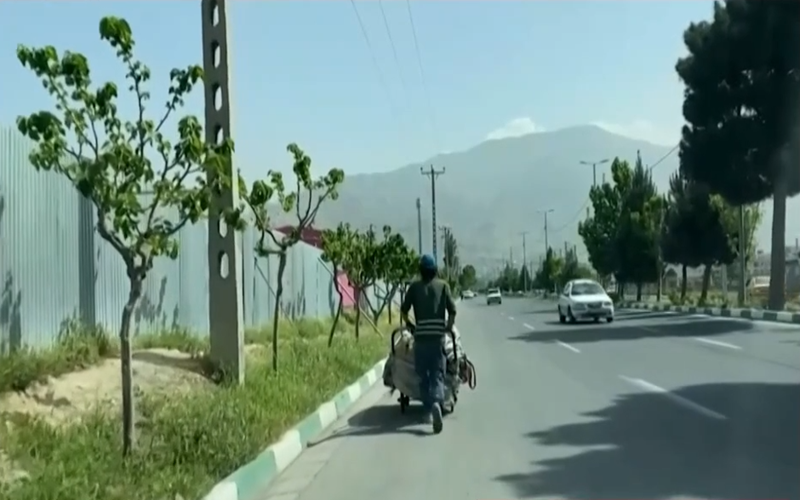
For those unable to survive on wages alone, street vending and other informal activities can become a last resort.
Yet even this avenue of survival is subject to repression.
Images cited in the regime-media coverage show municipal forces confronting street vendors and confiscating their merchandise. For people who have turned to selling goods because their regular income is insufficient, losing their entire stock can mean losing the means to feed themselves and their families.
This creates a particularly destructive economic cycle. Rising prices undermine purchasing power. Inadequate wages force people toward informal work. Informal workers then face confiscations and restrictions, leaving them with even fewer options to earn an income.
The result is not merely inflation. It is a deepening crisis of livelihood.
Economic Hardship and Growing Public Anger
The material conditions described in these reports help explain why economic grievances increasingly appear alongside expressions of anger toward the ruling system.
Graffiti and other public messages cited in the coverage reflect the accumulation of frustration over poverty, high prices, and repression. These expressions do not emerge in isolation. They are rooted in the daily experience of people who work but cannot afford what they need, who seek informal employment but face confiscation, and who watch the value of their earnings decline.
The striking aspect of these accounts is that they come through media operating within Iran’s own regime-controlled information environment. Even within that framework, the depth of the economic hardship is difficult to conceal.
For ordinary Iranians, the crisis is ultimately measured not in abstract economic indicators but in much simpler terms: whether they can repair a phone, buy a car, afford food, or bring home enough money to support their families.
When earning a living no longer guarantees the ability to meet basic needs, the cost-of-living crisis becomes a crisis of survival.