


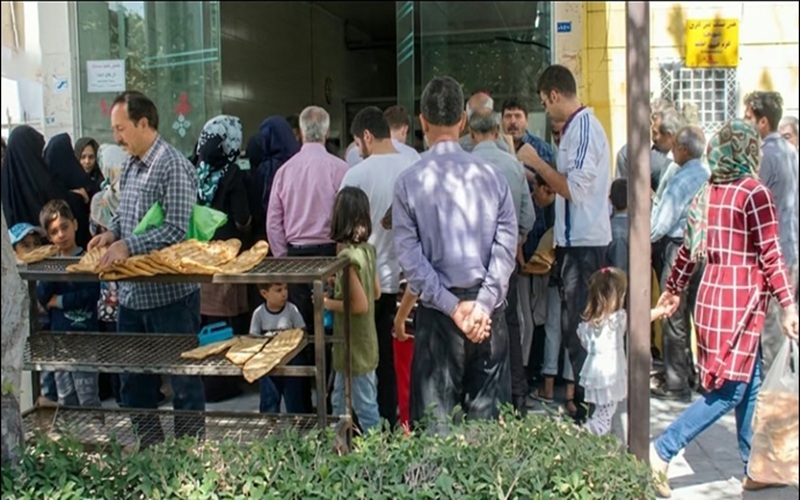

From internet and gasoline to bread, food, vehicles, and foreign currency, a series of economic decisions over the past two months has increased the financial burden on Iranian households, while cuts to welfare support threaten to deepen the pressure.
Iranian households have faced a succession of price increases over the past two months, affecting nearly every aspect of daily life. Higher internet tariffs, more expensive gasoline, the removal of preferential exchange rates for thousands of imported goods, rising food prices, and increases in vehicle costs have added to the financial pressure on an already struggling population.
The cumulative impact extends beyond individual price adjustments. The measures affect essential goods and services that families cannot easily eliminate from their budgets. At the same time, the government of Masoud Pezeshkian has begun removing households from the list of recipients of subsidized food credits, further weakening the purchasing power of lower-income families.
The latest developments point to a broader pattern in which the costs of the regime’s economic crisis are increasingly transferred to ordinary citizens.
Internet and gasoline become more expensive
One of the latest increases concerns telecommunications. Beginning at midnight on Friday, October 23, 2026, mobile internet tariffs rose by as much as 40 percent. Irancell also announced a 40 percent increase in fixed internet prices. Packages purchased before the adjustment remained valid at their original prices until expiration.
These increases followed two previous rounds of mobile internet price hikes: 20 percent in December and another 18 percent in March. Together, those adjustments amounted to a cumulative increase of approximately 38 percent before the latest round.
Although domestic messaging applications are charged at one-third of the regular internet rate, successive tariff increases have made online work, education, and everyday communication more expensive.
Fuel costs have also risen. The third-tier gasoline price doubled from 5,000 to 10,000 tomans per liter, while the allocation of free-market gasoline through fuel cards was discontinued in 11 provinces.
The higher fuel price directly affects household transportation expenses and the operating costs of drivers and transport services. These increases also risk feeding into the prices of goods through higher distribution and transportation costs.
Removal of preferential exchange rates threatens another wave of price increases
A major source of concern is the removal of preferential and official exchange rates for thousands of imported goods.
According to a report published on November 1, 2026, preferential exchange-rate arrangements were withdrawn for 4,533 categories of goods that had previously benefited from government-subsidized foreign currency.
The difference between the former import exchange rate and the free-market rate is substantial. One reported figure placed the former rate at approximately 190,000 tomans per dollar, compared with around 270,000 tomans in the open market after the change. This represents a difference of approximately 80,000 tomans per dollar.
The resulting increase in import costs is likely to be reflected in the domestic prices of affected products.
Hossein Samsami, a member of the Iranian parliament’s Economic Affairs Committee, disclosed a letter from the Ministry of Industry to the Central Bank concerning the exchange-rate changes. Another committee member warned that the prices of goods and vehicles could increase by 40 to 50 percent within one to two months. The Ministry of Industry’s spokesperson also implicitly acknowledged that the letter had been written.
Such warnings point to the possibility of another significant round of inflation, particularly for imported products and goods dependent on imported raw materials.
Bread, flour, and basic food become increasingly expensive
Food prices have continued to rise, placing additional pressure on household budgets.
Reports on November 4 indicated that flour shortages had forced some bakeries to close in several Iranian cities. Although the reports did not provide a nationwide figure for the number of affected bakeries, subsequent accounts raised further concerns about bread supplies.
On November 12, citizens reported reductions in flour allocations and changes in the taste and color of bread. These accounts have not been independently verified.
In Tabriz, the price of bread produced by bakeries operating outside the subsidized system also increased. A November 12 report put the price of Type 10 flour at 3.2 million tomans, adding to production costs and putting further pressure on bread prices.
Other basic food products have become considerably more expensive. Reports published on October 23 cited chicken prices of around 360,000 tomans and egg prices reaching 540,000 tomans. By November 15, the reported market price of a tray of eggs had climbed to 800,000 tomans.
These increases are particularly damaging for lower-income households, for which bread, eggs, and chicken constitute essential sources of nutrition rather than discretionary purchases.
Vehicle, gold, and livestock prices add to economic pressure
The rising cost of living has also extended beyond food and essential services.
Reports from November described renewed price increases in the automobile market, including record-high prices for the Saipa Quick in the open market. Higher vehicle prices affect not only families seeking to purchase a car but also transportation costs and the second-hand vehicle market.
On November 11, reports also documented increases in gold and coin prices, alongside rising prices for live sheep in several provinces.
Although these markets serve different economic purposes, their simultaneous increases reflect the broader pressure affecting household purchasing power. For families, higher transportation, food, and other living expenses leave less income available for savings and other necessities.
Welfare cuts undermine the value of food assistance
The government’s food-credit program, known as Kalabarg, has also become a source of concern.
Authorities have begun removing some households from the list of beneficiaries. In the first phase, approximately one million households are expected to lose eligibility.
According to government spokesperson Eman Zanganeh, 54 percent of households qualify for an increase of 500,000 tomans in their food-credit allocation, bringing the amount to 1.5 million tomans per person.
However, approximately 7.4 million household heads have not yet completed the required self-declaration process, while fewer than 10 percent of households have been placed in the review category.
Even for those who remain eligible, the nominal increase in food assistance does not necessarily translate into greater purchasing power. As food prices continue to rise, the real value of the credit declines. Removing approximately one million households from the program adds another layer of financial insecurity for families already struggling to cover basic expenses.
Budget crisis shifts the burden onto ordinary Iranians
The successive increases in prices and the reduction of welfare coverage cannot be viewed simply as routine annual adjustments. Their combined effect reveals a deeper economic problem: the growing transfer of the regime’s financial crisis onto the population.
The Pezeshkian government faces a budget deficit estimated at between 1,200 and 2,000 trillion tomans, or 1,200 to 2,000 hemats. With limited resources to cover this shortfall, the government is increasingly relying on measures that raise the cost of living, reduce subsidies, and shift economic pressures onto consumers.
The consequences are particularly severe because the increases affect goods and services that people cannot simply stop buying. Families may postpone purchasing a vehicle or reduce certain expenses, but they cannot do without bread, food, fuel, or essential communication services.
The removal of preferential exchange rates threatens to push prices higher still, while currency fluctuations continue to undermine the stability of the domestic market. Rising transportation and production costs add further pressure to food prices and other basic necessities.
As Iran approaches December, households face the prospect of another round of increases across essential sectors. What has unfolded over the past two months is not merely a collection of unrelated price adjustments. It is a sustained erosion of purchasing power in which the costs of the regime’s budgetary and economic failures are increasingly borne by ordinary people.