


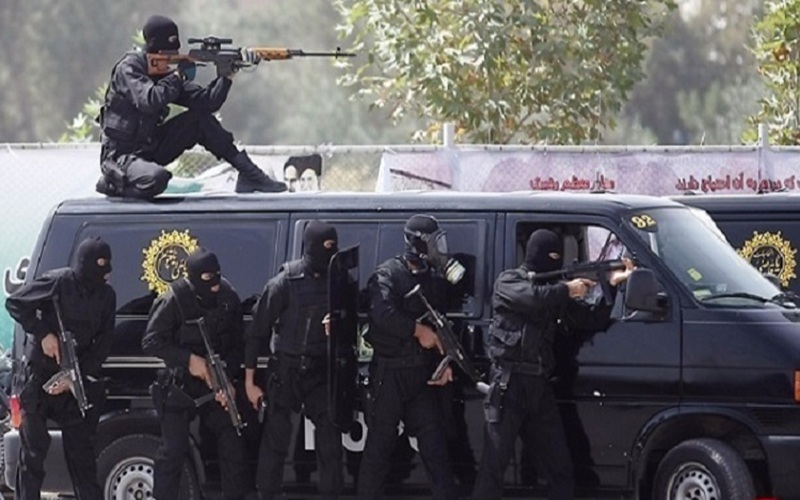

The deployment of 35,000 IRGC and Basij members, 21,000 police personnel, and 4,000 Iraqi and Afghan proxy fighters, alongside armed neighborhood patrols and expanded checkpoints, reflects growing concern over mounting economic grievances and renewed protests.
Iran’s regime has placed approximately 60,000 security personnel on full alert across Greater Tehran, expanding its military-style presence in the capital amid mounting economic pressures, public discontent, and fears of renewed nationwide protests.
The deployment, reportedly initiated on November 15, includes 35,000 Islamic Revolutionary Guard Corps (IRGC) and Basij forces, 21,000 state security personnel, and 4,000 Iraqi and Afghan proxy fighters. Additional measures include armed Basij neighborhood patrols, round-the-clock checkpoints, weapons storage in schools, and surveillance of residents and motorists.
The scale and nature of the deployment point to growing concern within the ruling establishment about the possibility of another uprising, particularly as economic hardship, energy shortages, and rising living costs intensify public dissatisfaction.
Economic crisis fuels fears of renewed protests
Recent statements by President Masoud Pezeshkian have offered a revealing picture of the regime’s economic difficulties.
On November 17, 2026, speaking at a meeting with Olympiad medalists, Pezeshkian openly acknowledged the government’s predicament, saying, “We are in trouble and have problems,” while adding that officials were being told there was no money.
Two days later, on November 19, during an energy working group meeting at the Pishgaman-e Rahayi student congress, he described the government’s difficulties in even more explicit terms. He acknowledged that Iran could not secure sufficient oil supplies, access foreign currency, or purchase gasoline. He also admitted that the country faces a natural gas deficit of between 250 million and 300 million cubic meters per day during the winter peak, even without a war.
Pezeshkian has consequently urged people to reduce energy consumption, switch off unnecessary lights, keep household temperatures between 18 and 20 degrees Celsius, wear warmer clothing indoors, and walk rather than drive where possible.
More significantly, he acknowledged the potential political consequences of the economic crisis. Warning about industrial shutdowns and rising unemployment, he stated that unemployed workers would take to the streets and that the result would be protests.
These admissions come amid mounting reports of higher gasoline prices, shortages of bread, and sharp increases in food costs. For households already struggling with inflation and declining purchasing power, the deterioration of basic living conditions is adding to the pressure on the regime.
Armed patrols, foreign fighters, and surveillance across Tehran
Against this background, the deployment of approximately 60,000 security personnel represents an extensive effort to tighten control over the capital.
According to information published on November 20, neighborhood-based Basij patrols that previously carried handguns have now reportedly been equipped with Kalashnikov rifles. Additional armed patrols have been authorized to operate independently under the regime’s so-called “at-will” orders.
Security forces have also reportedly been dispersed in smaller units across major urban centers, while schools have been used to store weapons and ammunition.
At round-the-clock checkpoints, security personnel are reportedly inspecting mobile phones belonging to motorists and pedestrians in an effort to identify individuals suspected of participating in anti-government activities.
The reported involvement of 4,000 Iraqi and Afghan proxy fighters in securing Tehran is particularly significant. Their deployment alongside domestic security forces raises questions about the regime’s reliance on foreign personnel to reinforce its internal security apparatus.
Other reported measures reveal the extent of the precautions being taken. Three paid guards are reportedly assigned to protect large banners displaying images of Mojtaba Khamenei from evening until morning. They receive meals and a payment of 500,000 tomans for their overnight shifts.
The regime has also organized military training sessions for individuals recruited under the label “Jan-Fada” (self-sacrificing volunteers), who appear at nighttime gatherings presented as public demonstrations of support.
Taken together, these measures indicate that security preparations extend beyond conventional crowd control to include surveillance, protection of regime symbols, and the mobilization of additional manpower.
Resistance activities continue despite the security buildup
The extensive security deployment has not eliminated organized anti-regime activities.
During the anniversary of the November 2019 uprising, resistance units have carried out successive campaigns involving political graffiti, public messaging, and anti-repression activities across the country.
In the eighth installment of the campaign, published on November 19, 50 activities were reported in 18 cities. These included political imagery in Tehran’s Niavaran Highway, Bandar Abbas’s Isar Street, and Sanandaj’s Soleiman Khater Street, alongside other activities in Tehran, Karaj, Tabriz, Isfahan, Shiraz, Rasht, Qazvin, Zahedan, Iranshahr, Sarpol-e Zahab, Kangavar, Mahabad, Javanrud, Mashhad, Kermanshah, Ahvaz, Hamedan, Ilam, and Babolsar.
Earlier installments included another 50 activities on November 17, as well as campaigns involving 60 activities and 30 additional operations.
These developments demonstrate that political opposition and anti-regime activity continue across multiple cities despite intensified surveillance and security deployments.
Pensioners and workers continue protesting
Public protests have also persisted despite the increasingly militarized atmosphere.
During November, pensioners and workers staged demonstrations in Tehran, Isfahan, Kermanshah, Ahvaz, Shush, Rasht, Sanandaj, Bijar, and Ilam.
On November 17, retired employees of Iran’s national airline, Homa, gathered in Tehran to protest their conditions. Retirees from the telecommunications, steel, and social security sectors have also continued their demonstrations.
Their slogans have directly challenged the authorities, including:
- “We will not give up until we obtain our rights.”
- “Our state broadcaster is a disgrace.”
- “A nation has never witnessed such incompetence.”
The persistence of these demonstrations illustrates how economic grievances continue to bring different sections of society into confrontation with the authorities, even under heightened security conditions.
Executions and prison protests expose another front of resistance
The regime’s efforts to intimidate society have also included an intensified use of executions.
According to a statement issued on November 19, at least 13 prisoners were executed on November 17 and 18, while two women were executed in Shiraz on November 15. The executions coincided with the examination of Iran’s human rights record at the United Nations General Assembly.
Yet repression inside prisons has not silenced protests against capital punishment.
On November 17, the nationwide “No to Execution Tuesdays” hunger-strike campaign entered its 147th consecutive week. With the participation of Nourabad Mamasani Prison in Fars Province, the campaign expanded to 67 prisons across Iran.
Young activists in several cities also carried out activities in support of the campaign, demonstrating that opposition to executions continues both inside and outside prison walls.
The persistence of this movement, despite the threat of execution and other forms of punishment, represents another challenge to the regime’s strategy of intimidation.
The regime’s security apparatus faces a deeper social crisis
The scale of the current security mobilization also highlights a fundamental weakness in the regime’s approach to maintaining control: its reliance on coercion cannot resolve the economic and social grievances driving public discontent.
Former IRGC Intelligence Organization chief and current Basij commander Hossein Taeb previously acknowledged this problem when he stated that neighborhood security could only be ensured by addressing people’s needs.
That principle stands in sharp contrast to the current situation. The government itself acknowledges severe financial constraints, shortages of energy supplies, and mounting difficulties in maintaining production. Meanwhile, inflation and poverty continue to undermine household security.
Deploying tens of thousands of armed personnel, bringing in foreign proxy fighters, checking mobile phones at checkpoints, and guarding regime propaganda banners cannot address these underlying problems.
The extensive security preparations in Tehran therefore reveal more than a campaign to prevent demonstrations. They reflect a ruling establishment increasingly concerned about the political consequences of its economic failures and the persistence of organized opposition.
A government confident in its social support would not need to turn its capital into an extensively monitored security zone. The growing reliance on armed deployments and extraordinary surveillance measures underscores the depth of the regime’s concern about the possibility of another nationwide uprising.