

Khamenei-aligned Friday prayer leaders attack Pezeshkian’s economic policies, while government officials warn of financial collapse and an explosive society. Conflicting positions on domestic and regional policies expose divisions the regime can no longer contain.
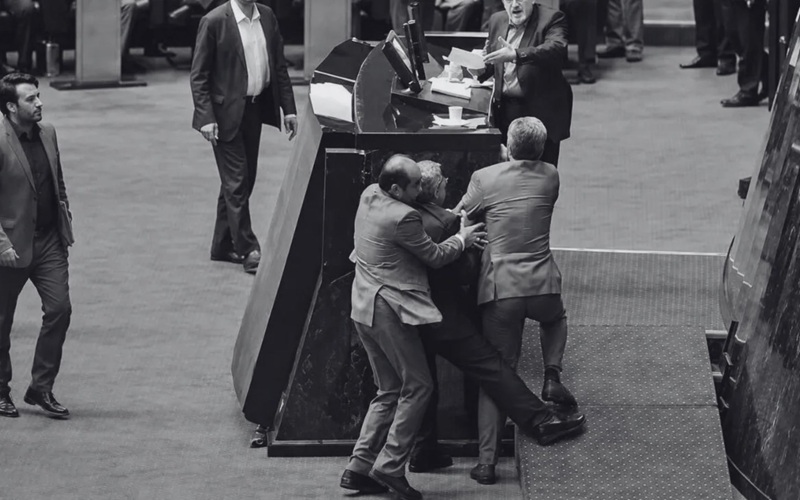
Iran’s regime is increasingly exposing its internal divisions as economic deterioration, mounting public discontent, and strategic deadlock intensify the struggle between competing factions. Attacks by Khamenei-aligned Friday prayer leaders against President Masoud Pezeshkian’s government have become more explicit, revealing disagreements that extend beyond economic policy to fundamental questions about the regime’s identity, priorities, and survival.
The latest exchanges show that appeals for unity from the highest levels of the establishment have done little to contain the infighting. Instead, officials and clerics are increasingly confronting one another publicly over responsibility for the country’s deteriorating conditions, the treatment of neighboring countries, and the growing threat of popular unrest.
Khamenei-aligned clerics turn against Pezeshkian’s economic policies
Ahmad Alamolhoda, Khamenei’s representative in Mashhad and Friday prayer leader, has sharply criticized the government’s plans to eliminate preferential foreign-exchange rates and implement what officials describe as economic restructuring.
Questioning the government’s approach, Alamolhoda argued that ordinary people should not bear the cost of economic reforms through higher prices, reduced access to food, and declining living standards. He also criticized decisions affecting gasoline distribution cards, questioning how an adviser could influence such policies without parliamentary oversight.
His intervention was framed as concern for the public, but it also amounted to a direct challenge to Pezeshkian’s administration.
The contradiction is particularly striking given the role of the clerical establishment itself in creating the conditions it now condemns. Institutions such as Astan Quds Razavi, associated with Alamolhoda, have accumulated considerable economic influence while operating outside many of the financial obligations imposed on ordinary businesses and citizens. The question of why powerful institutions should be exempt from taxation while the population faces mounting economic pressure remains largely unanswered.
Pezeshkian, meanwhile, has repeatedly acknowledged the government’s financial limitations. Defending the difficulty of maintaining current spending levels, he has questioned where the necessary resources should come from, particularly when the government is losing money and cannot simply continue printing currency.
His remarks expose the fundamental problem facing the administration: monetary expansion fuels inflation, while the government struggles to finance its obligations without further undermining the purchasing power of the population.
The resulting confrontation is not simply a disagreement over how to implement economic reforms. It is a struggle over who will bear responsibility for the consequences of a crisis that the regime’s competing factions have collectively helped create.
Contradictions over regional policy expose deeper divisions
The divisions extend well beyond domestic economic management.
Pezeshkian has also called for a change in the regime’s approach toward neighboring countries, warning that hostile rhetoric and insults directed at regional governments undermine trade and economic relations. He has argued that countries cannot be expected to maintain normal commercial relations with Tehran while being publicly attacked by its officials.
This position has been met with a sharply different message from Khamenei-aligned clerics.
In Qom, Khamenei’s Friday prayer representative condemned Muslim-majority countries that allow foreign military forces to use their territory, describing their governments as hypocritical and even worse than unbelievers.
The contrast illustrates the incompatible priorities operating within the establishment. While the government acknowledges the need for regional economic engagement, the hardline clerical faction continues to promote an ideological and confrontational approach.
These contradictions are becoming increasingly difficult to conceal. The government needs economic relations and regional cooperation to ease financial pressure, while the ideological apparatus remains committed to positions that undermine those very objectives.
Appeals for unity cannot conceal a fundamental struggle
The increasingly public nature of these disputes has also raised questions about the effectiveness of directives calling for unity within the ruling establishment.
Earlier appeals attributed to Mojtaba Khamenei urged officials to avoid statements that could undermine internal cohesion. Yet the confrontations have continued, suggesting that the problem is far deeper than differences in communication or political style.
In the regime’s parliament, Zohreh Lajevardi, the daughter of notorious former prison official Asadollah Lajevardi, challenged Pezeshkian over what she described as fundamental disagreements about the country’s ideological foundations.
She argued that the conflict was not merely a difference of opinion over administrative methods but a divergence over the regime’s underlying identity and ideological principles. Her criticism targeted what she portrayed as attempts to move away from the foundations of the 1979 revolution and toward liberalism.
Meanwhile, Lotfollah Dezhkam, Khamenei’s Friday prayer representative in Shiraz, complained about the increasingly open confrontations between political factions, comparing their behavior to children quarrelling and cheating during a street game.
Such remarks reveal the extent to which internal disputes have become a public embarrassment for the establishment.
But the underlying conflict cannot be resolved through calls for discipline or unity. The factions are confronting structural problems that threaten the regime’s ability to govern and maintain control.
Fear of an explosive society drives the factional conflict
At the heart of the confrontation is a shared fear repeatedly acknowledged by officials themselves: the explosive state of Iranian society.
The country’s deteriorating economic conditions have made popular discontent an increasingly central concern for the ruling establishment. The factions disagree over how to confront this threat, but they recognize that the consequences of continued economic deterioration could extend far beyond ordinary protests.
Parliament Speaker Mohammad Bagher Ghalibaf has described production and people’s livelihoods as the regime’s principal battlefield alongside the military arena.
His statement underscores the importance the establishment attaches to the economic crisis. The issue is no longer simply whether the government can implement particular policies or balance its budget. It is whether it can prevent economic hardship from translating into renewed public protests.
Pezeshkian has also acknowledged the government’s mounting difficulties. Restrictions on oil sales and the resulting shortage of foreign currency, declining industrial activity, and shrinking government revenues have left the administration with fewer options. As economic activity contracts, the government also faces difficulties collecting taxes and financing its expenditures.
These pressures create a vicious cycle: reduced revenues deepen the budget deficit, monetary expansion intensifies inflation, and rising living costs further aggravate public anger.
Ultimately, ordinary Iranians are left paying the price for the regime’s policies, while its factions accuse one another of mismanagement and failure.
The regime’s increasingly visible infighting reflects a deeper crisis of governance. Its competing factions cannot agree on how to manage the economy, how to engage with neighboring countries, or how to preserve the ideological foundations of their rule. Yet they share one overriding concern: preventing mounting public anger from turning into another nationwide uprising.
The more openly these divisions emerge, the harder it becomes for the ruling establishment to present an image of cohesion and control. Appeals for unity cannot resolve a crisis rooted in the regime’s political and economic foundations. And as living conditions deteriorate, the struggle between its factions increasingly revolves around one question: who will bear the consequences when public discontent erupts into the streets?