


Egg prices have more than doubled since March, milk and chicken are becoming increasingly expensive, and official statistics show producer-price inflation reaching 120.9 percent year-on-year in summer 2026, signaling further pressure on household budgets.
December is approaching, but there is little relief in sight for Iranian households struggling with the combined effects of rising prices, economic mismanagement, and the consequences of the regime’s policies. Food prices continue to climb, further eroding purchasing power, with low-income families bearing the heaviest burden.
Reports in Iranian media at the beginning of December describe another wave of increases in essential food products. Eggs, milk, and chicken have all become more expensive, while higher prices for industrial food products are also expected. At the same time, official statistics reveal the scale of inflationary pressure building throughout the economy, with producer-price inflation exceeding 120 percent year-on-year.
Essential food prices continue to climb
Egg prices have recorded one of the sharpest increases. On Sunday, November 22, Didar News reported that a carton of 30 eggs had reached 714,000 tomans, describing the latest increase as another record.
The outlet noted that the same quantity had sold for approximately 315,000 tomans in March 2026. This means the price has more than doubled in just eight months, increasing by approximately 127 percent.
Milk prices are following a similar trajectory. On November 22, Fars News Agency reported that some 900-gram bottles of milk had become as much as 20,000 tomans more expensive in a single day, reaching 180,000 tomans in Tehran.
The increase came just one day after a new price for raw milk was approved, illustrating how quickly higher production costs are being passed on to consumers.
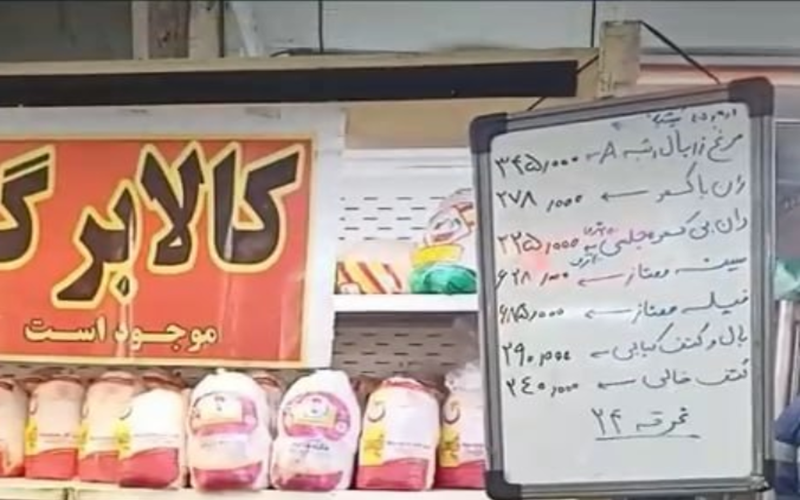
Chicken prices are also rising. According to figures published on November 22 by the Civil Market Protest Telegram channel, chicken prices had reached 345,000 tomans per kilogram at Tehran’s wholesale market in Bahman Square, in the Naziabad district.
Market participants said retail prices elsewhere in Tehran and in other cities could be even higher, depending on transportation costs, distance from distribution centers, and local market conditions.
These increases affect some of the most basic components of Iranian household diets. As prices rise across several essential food categories simultaneously, families with limited incomes have fewer opportunities to adjust their spending without sacrificing the quantity or quality of food they consume.
Higher wheat prices threaten further increases in processed foods
The pressure is not limited to products already becoming more expensive.
Agriculture Minister Gholamreza Nouri Ghezeljeh said that the price of wheat supplied to subsidized bakeries would remain unchanged, but increases in the prices of products such as pasta, biscuits, and industrial bread were inevitable.
According to the ISNA news agency, the minister said the price of wheat supplied to subsidized bakeries would remain at 900 tomans per kilogram. However, implementation of the budget law and changes in the price of wheat used by food industries would lead to higher production costs for other products.
Although the government says there are no plans to ration bread or liberalize its price, the anticipated increases in industrial food products add another source of pressure on household budgets.
The distinction between subsidized bread and other wheat-based products offers little reassurance to families whose food expenses are already rising across multiple categories.
Producer-price inflation exceeds 120 percent
The latest figures from Iran’s Statistical Center reveal that rising consumer prices are part of a much broader inflationary process affecting the production sector.
According to the center’s report on the Producer Price Index (PPI) for summer 2026, the year-on-year increase in producer prices reached 120.9 percent. In other words, the average prices received by domestic producers for their goods and services were more than twice as high as in the corresponding period of 2025.
The report, published by Iranian media on November 22, recorded a producer-price index of 751.6 for the summer quarter.
The main indicators show the extent of the increase:
| Producer-price inflation indicator | Summer 2026 |
|---|---|
| Year-on-year inflation | 120.9% |
| Quarterly inflation | 22.4% |
| Annual inflation (four-quarter average) | 87.3% |
The industrial sector recorded the highest year-on-year producer-price inflation among the main sectors, at 147.3 percent. Services had the lowest rate, at 67.5 percent.
The annual inflation measure also deteriorated considerably. The Statistical Center reported that producer-price inflation over the four quarters ending in summer 2026 reached 87.3 percent, compared with 66.7 percent in the preceding quarter. This represents an increase of 20.6 percentage points.
Agriculture recorded the highest annual producer-price inflation among the main sectors, at 108.8 percent, while services registered the lowest, at 55.9 percent.
Although quarterly producer-price inflation declined from 28.3 percent in the previous quarter to 22.4 percent in summer, the broader annual indicators show that inflationary pressures remain severe.
Rising production costs threaten further increases for consumers
Producer-price inflation measures the changes in prices received by businesses for goods and services they produce, rather than the prices consumers pay in shops. It therefore provides an important indication of cost pressures throughout the production chain.
When producers face rapidly rising costs, they may pass some or all of those increases on to consumers through higher retail prices. The latest figures consequently point to the risk of further price increases in the months ahead, particularly for food and other essential goods.
The simultaneous escalation in agricultural, industrial, and consumer prices demonstrates how deeply inflation has spread across Iran’s economy.
For households already struggling to afford eggs, milk, chicken, and other basic necessities, the consequences are immediate. And with producer prices continuing to rise at an extraordinary pace, the latest wave of food-price increases may be far from over.
The beginning of December is therefore bringing no respite for ordinary Iranians. Instead, the combination of soaring essential food prices, mounting production costs, and accelerating inflation is further narrowing the ability of low-income households to meet even their most basic needs.