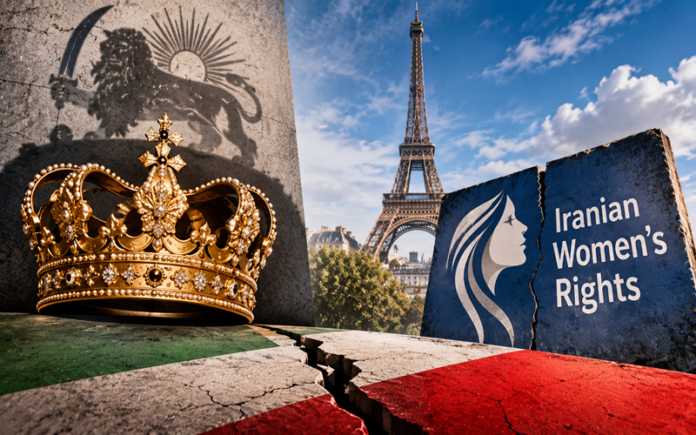
The disruption of a Paris event on Iranian women’s rights, attended by French Foreign Minister Jean-Noël Barrot, has exposed how monarchist activism, intimidation, and attacks on democratic opposition can serve the interests of the clerical dictatorship.
Beyond the immediate disruption, however, the incident raises a more fundamental political question: who benefits when an event addressing the repression of Iranian women is turned into a platform for intimidation, confrontation, and attacks on other opposition voices?
For anyone familiar with Iran’s political landscape, the answer is difficult to overlook. Such conduct serves the interests of the clerical establishment, whose survival depends not only on repression inside Iran but also on divisions, confusion, and fragmentation among its opponents abroad.
The issue is not simply a disagreement over Iran’s future political system. It concerns the methods used to advance a political project and the kind of political culture that its supporters bring into public life.
When political activism turns into intimidation
Iran has a long history of political power operating through street-level enforcers and organized groups of intimidation. Under successive authoritarian systems, political agendas have often been implemented not merely through official institutions, speeches, or legislation, but through networks operating in streets, neighborhoods, universities, and public spaces.
Under Ruhollah Khomeini, this machinery included street gangs and vigilante groups, armed thugs, the Revolutionary Committees, the Islamic Revolutionary Guard Corps (IRGC), and, in later years, morality patrols. These forces became instruments for suppressing dissent, intimidating opponents, enforcing compulsory social rules, and maintaining the regime’s ideological control.
The record includes the systematic persecution and murder of political dissidents, the mass execution of political prisoners in the summer of 1988, and the ongoing repression of women through compulsory veiling and morality policing.
The methods may take different forms under different political systems, but the underlying principle remains the same: using intimidation and coercion to silence political opponents rather than accepting pluralism and democratic debate.
The conduct displayed by sections of the monarchist movement at the Paris event raises serious questions about whether the political culture associated with Reza Pahlavi’s supporters is distancing itself from this authoritarian tradition or reproducing its methods in a different political setting.
The internet exposes a movement’s political culture
The internet has become an increasingly revealing public record of political attitudes and behavior. Social media platforms provide a space in which individuals expose their historical understanding, political judgment, ethical standards, and attitudes toward those who disagree with them.
A significant part of the monarchist current has repeatedly demonstrated three recurring tendencies.
First, its activists seek to whitewash the documented abuses of the Pahlavi dictatorship, which ruled Iran for 57 years, presenting the former monarchy as a legitimate or desirable alternative while minimizing its record of repression.
Second, they attack or discredit the democratic and freedom-seeking movements that have shaped Iran’s political history over the past 120 years. These struggles, from the Constitutional Revolution onward, challenged absolutism and the concentration of political power.
Third, they attempt to associate Iran’s uprisings over the past two decades with demands for a return to previous forms of dictatorship, distorting the democratic aspirations expressed by protesters.
These positions are politically consequential. By attempting to rehabilitate the former monarchy and discredit struggles against authoritarian rule, monarchist activists weaken the democratic foundations of the opposition to the current regime.
The result is a political narrative that replaces the demand for freedom and popular sovereignty with nostalgia for another authoritarian system.
Abuse and threats are not democratic politics
The problem becomes even more visible in the way some monarchist activists respond to criticism.
Rather than engaging with historical evidence or answering political arguments, some resort to obscene, sexually abusive, and threatening language against critics of the Pahlavi monarchy. Others openly identify themselves with the former SAVAK intelligence service, glorify authoritarian methods, or threaten opponents with violence and death.
Such behavior is not a substitute for political argument. It reveals an inability or unwillingness to accept criticism and political pluralism.
A democratic political movement must be able to tolerate disagreement, acknowledge historical wrongdoing, and defend its positions through evidence and debate. It cannot claim to represent freedom while treating opponents as enemies who must be humiliated, intimidated, or silenced.
The distinction is particularly important in the Iranian context, where generations have suffered under systems that equated political disagreement with hostility toward the state and used violence to eliminate dissent.
Replacing the symbols of one dictatorship with those of another does not constitute democratic change.
Division among opponents benefits Tehran
The disruption in Paris should also be considered in the broader context of the Iranian regime’s efforts to prevent the emergence of a coherent democratic alternative.
The clerical establishment benefits whenever opposition forces turn against one another, when historical revisionism replaces political debate, and when intimidation drives activists and critics out of public discussion.
Attacks on democratic opposition groups, women’s rights activists, journalists, and other critics of authoritarianism divert attention from the central struggle against the ruling establishment.
They also help Tehran portray the opposition as fragmented, intolerant, and incapable of supporting a democratic political order.
This does not require every individual involved in such conduct to be acting on behalf of the regime. The political consequences are sufficient to demonstrate who benefits from the resulting divisions.
The Paris incident therefore deserves attention beyond the immediate controversy. An event devoted to the rights of Iranian women should have provided an opportunity to expose the regime’s systematic oppression. Instead, the disruption shifted attention toward confrontation among Iranians themselves.
That outcome serves neither women’s rights nor the democratic aspirations of the Iranian people.
The responsibility to defend democratic political space
The struggle to overthrow the clerical dictatorship cannot be separated from the struggle to establish a democratic political culture.
Iran’s opposition must reject both the religious dictatorship currently ruling the country and any attempt to restore hereditary authoritarianism. The demand for freedom cannot be reconciled with the glorification of SAVAK, political intimidation, censorship, or threats against opponents.
Iranian activists, particularly those participating in public discussions and political campaigns abroad, have a responsibility to expose these practices and defend the right to criticize every authoritarian project.
This is not a secondary dispute or an internal argument that can be postponed until after the regime’s overthrow. Political pluralism, freedom of expression, and respect for opposing views are essential foundations of the alternative Iran needs.
The objective must be a democratic republic based on popular sovereignty, political freedoms, equality before the law, and the rejection of both monarchy and clerical rule.
The Paris disruption has offered another warning about the dangers of allowing authoritarian political behavior to take root within the opposition. The fight against the mullahs’ dictatorship must not become an excuse for legitimizing another form of dictatorship.
Exposing intimidation, historical revisionism, and anti-democratic conduct is therefore part of the broader responsibility to clear the political space for a genuine democratic movement in Iran.