

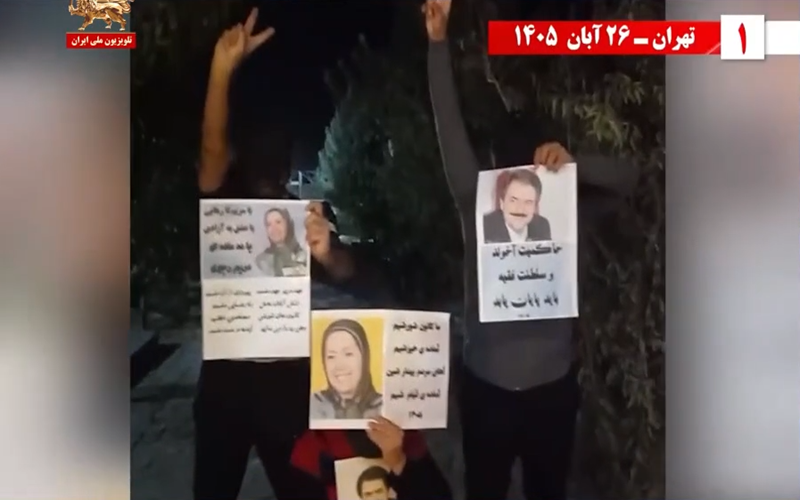

Fifteen anti-repression operations targeting regime security structures and nightly propaganda gatherings highlight the expanding activities of resistance units, while senior officials warn of the growing influence of organized resistance inside Iran.
The latest operations, carried out under the campaign title Clusters of People’s Wrath, included 15 anti-repression actions in response to the regime’s demolition of homes belonging to impoverished residents in Sistan and Baluchestan Province, particularly in the Chabahar area. The actions were presented as a response to the destruction of homes and the persecution of already marginalized communities.
Another 15 operations targeted the regime’s nightly gatherings, which authorities have been organizing in streets and public spaces to demonstrate support for the ruling establishment and maintain the presence of their security forces and Basij members.
These gatherings, accompanied by loudspeakers and nighttime noise, have also become a source of disruption and harassment for local residents. The regime uses them as a propaganda instrument and an attempt to create a visible barrier against potential protests and renewed popular unrest.
The recent operations were also dedicated to the victims of the November 2019 uprising, particularly those killed during the regime’s massacre in Mahshahr, where security forces used heavy weapons against protesters and residents.
More than 150 operations during November
The latest activities follow an extensive campaign during November, marking the anniversary of the November 2019 uprising.
According to reports on the Resistance Units’ activities, eight separate campaigns during the month involved approximately 150 anti-repression operations, including arson and explosions targeting centers associated with the regime’s security and repressive apparatus.
Targets included Basij and Islamic Revolutionary Guard Corps (IRGC) facilities, as well as institutions associated with the regime’s judiciary. These operations formed part of more than 700 revolutionary activities carried out during November.
Despite extensive censorship and efforts by the regime’s media apparatus to prevent the dissemination of such reports, the activities continue to circulate, demonstrating the challenges authorities face in controlling information and suppressing organized opposition.
The central message of these operations is that political change must be driven by the Iranian people themselves, through their own organization, determination, and capacity to challenge the ruling establishment.
Regime spends heavily to protect propaganda displays
The regime’s growing concern is also reflected in the extraordinary measures it reportedly takes to protect its propaganda installations and security facilities.
According to reports, authorities have begun hiring guards to protect their street banners against destruction or arson. In some cases, three guards are reportedly assigned to each banner, with a payment of 500,000 tomans for round-the-clock protection, in addition to breakfast and dinner.
The reported arrangements illustrate the resources the regime is devoting to preserving its propaganda displays in public spaces, even as it struggles to maintain their credibility among the population.
Protecting Basij and IRGC facilities, as well as judicial institutions, requires additional security measures and expenditures to prevent attacks against these centers.
These defensive arrangements accompany increasingly explicit warnings from senior officials about the activities of organized resistance.
Senior officials warn of resistance influence
Ramadan Sharif, a senior IRGC commander, recently warned against what he described as being influenced by individuals operating from Albania who, in his words, were attempting to shape the regime’s media environment. His remarks reflected concern over the reach and influence of the organized resistance and its ability to communicate with audiences inside Iran.
Former Iranian ambassador to Iraq and Afghanistan Kazem Gharibabadi’s colleague and former regime envoy Kazemi Qomi also offered revealing comments about the nature of the confrontation facing the authorities. Describing the current situation as a decisive struggle, he argued that the conflict extends beyond military and diplomatic dimensions.
He characterized it as a broader confrontation involving soft operations and psychological warfare, particularly in the social and security spheres.
His remarks underscore the regime’s recognition that its challenges are not limited to external conflicts. Even while dealing with international tensions, the authorities remain deeply concerned about domestic resistance and the possibility of renewed popular unrest.
Former parliament speaker Ali Akbar Nategh-Nouri has also warned about the activities of the People’s Mojahedin Organization of Iran (PMOI/MEK) in universities and public spaces. He expressed concern that these activities could intensify divisions within the ruling establishment.
Police chief Ahmad-Reza Radan has similarly warned of what he called the possibility of new unrest, claiming that security forces were prepared to prevent any such developments at their earliest stages. Judiciary chief Gholamhossein Mohseni-Ejei has also threatened severe action against those he described as disrupting security.
Taken together, these statements reveal the extent to which the regime views organized resistance as a serious domestic security challenge.
Decades of repression have failed to stop the expansion of resistance
The growing activities of the Resistance Units represent the continuation of an organized strategy that has developed over several years.
Following the regime’s escalating repression of the opposition, the formation of Resistance Units inside Iran became a central component of efforts to establish an organized network of resistance in cities across the country.
Since then, their activities have expanded in both scale and operational scope. Their presence has repeatedly become a concern for the authorities, particularly during periods of popular uprising, when resistance networks have played an active role.
The regime has responded with mass arrests, executions, and intensified security operations targeting members and supporters of the resistance. Yet these measures have failed to halt the expansion of their activities or prevent increasingly extensive anti-repression operations.
The continued warnings issued by senior officials, alongside the resources devoted to protecting regime installations and propaganda displays, reflect the authorities’ difficulty in containing this challenge.
The message emerging from the latest activities is that repression alone has not eliminated the determination to resist. Instead, the Resistance Units continue to demonstrate their ability to organize and sustain activities despite the risks.
Regime media revisits the origins of organized resistance
Another revealing indication of the regime’s concern appeared in a recent article published by Tasnim, an outlet affiliated with the IRGC’s Quds Force, marking the anniversary of the formation of the People’s Mojahedin Organization’s militia in December 1979.
The article recalled the organization’s opposition to the constitutional referendum and its rejection of Ruhollah Khomeini’s political leadership. It also discussed the announcement of the formation of a popular militia and the subsequent establishment of the regime’s own Basij organization.
According to the article, Khomeini announced the formation of a 20-million-member Basij force only days later.
The historical sequence is significant. It highlights how early the ruling establishment recognized the threat posed by an organized opposition movement and sought to establish a mass mobilization structure to counter it.
Tasnim concluded by warning against what it called the appropriation of national and religious slogans by opposition currents to create conditions for unrest and the overthrow of the regime.
The fact that an IRGC-affiliated media outlet devoted considerable attention to this history, while explicitly drawing lessons for the present, reflects the continuing importance the authorities attach to the organized resistance movement.
The struggle for change must come from within Iran
The latest developments also underline a central political distinction: the overthrow of dictatorship cannot be achieved through foreign military intervention or reliance on external powers.
Neither foreign war nor bombing provides a solution to Iran’s political crisis. Such approaches risk replacing one form of authoritarian rule with another and reinforcing political dependency rather than establishing democratic sovereignty.
The regime also benefits from political diversion and fragmentation among its opponents. Promoting alternative authoritarian models and encouraging divisions within the opposition can undermine the development of a coherent democratic movement and weaken the potential for organized resistance.
Against this backdrop, the continued activities of the Resistance Units carry a broader political message: the struggle for freedom must be rooted in Iranian society and driven by the Iranian people.
The regime’s increasingly frequent warnings, heightened security measures, and costly efforts to protect its propaganda infrastructure suggest that it remains deeply concerned about the spread of this organized challenge.
Despite decades of executions, arrests, censorship, and intimidation, the authorities have not succeeded in eliminating organized resistance. The expanding activities of rebellious youth indicate that the confrontation over Iran’s political future remains very much alive.