


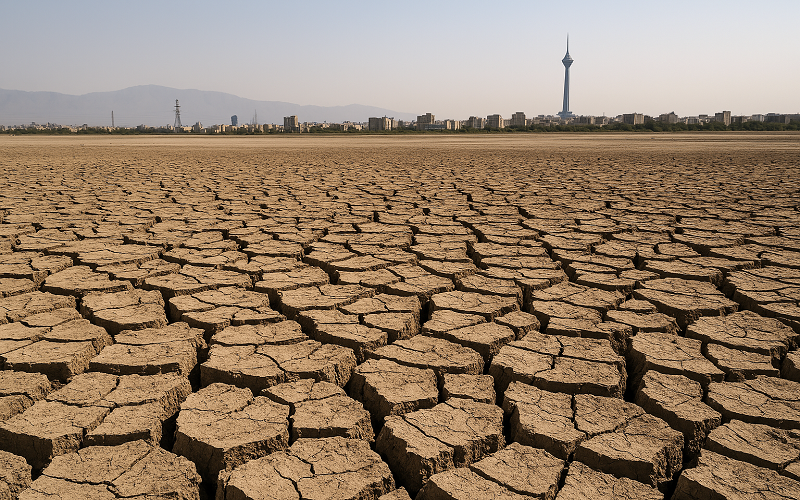

As early and widespread blackouts sweep across various regions of Iran, the Ministry of Energy has announced a plan to implement 12-hour water cuts in the coming months.
This drastic measure, introduced amidst mounting public concern, has been officially described as targeting only “high-consumption customers.” Issa Bozorgzadeh, a spokesperson for the water industry, attempted to justify the plan by insisting that it would affect only a small segment of users.
However, this narrative omits the regime’s longstanding mismanagement of water resources, a primary factor behind Iran’s current water crisis.
Rather than addressing structural failures or past policy errors, officials continue to deflect responsibility by urging public cooperation and prioritizing so-called “cultural measures” to regulate consumption.
This familiar pattern of blaming citizens, often by pointing to drought and low rainfall, resurfaces whenever the crisis reaches a tipping point.
Official figures from the Ministry of Energy reveal that only about 5% of subscribers fall into the “misuse” category. Yet, real-world experience contradicts this claim.
Water cuts in recent years have affected a much broader segment of the population, including households with moderate or low consumption levels.
The “high-consumption” label, it seems, serves more as a political tool than a technical classification—one used to justify widespread restrictions while shielding the regime from accountability and social backlash.
Currently, Iran’s water reserves are reported to be in an “unprecedented decline.” Yet instead of pursuing long-overdue investments in infrastructure, watershed management, or comprehensive water transfer reviews, authorities are doubling down on punitive policies—threatening subscribers and introducing steep tariffs rather than reforming the system.
The water crisis is now being compounded by a new wave of power outages, which began unusually early this year on April 7.
Once again, the government has avoided presenting any tangible plans to address production shortfalls or improve distribution efficiency. Instead, officials have blamed the public for not adhering to an “optimal consumption pattern.”
According to Tavanir, Iran’s Power Generation, Distribution, and Transmission Company, Tehran residents can monitor planned outages through platforms like “My Electricity” or the “Smart Emergency System of the Greater Tehran Electricity Distribution Company.” But these digital tools do little to alleviate the deeper crisis at hand.
In a recent announcement, Minister of Energy Abbas Aliabadi projected that the country’s electricity shortfall in 2025 will exceed 20,000 megawatts. To address this, he revealed a new “stepped tariff” plan that will impose extreme financial penalties on high-usage consumers—up to 40 times the base rate—and eliminate their access to energy subsidies.
These policy choices reflect a broader trend: in the face of deepening energy and infrastructure crises, the regime continues to rely on punitive, short-term measures rather than implementing structural reforms.
The situation is particularly alarming as the summer months approach, bringing not just heat and resource strain but new threats to communication systems. Farhad Shahraki, a member of the Parliament’s Energy Commission, recently warned that repeated power outages have severely damaged the batteries of telecommunications towers.
Without urgent replacements, Iran could face widespread internet and mobile service disruptions in the coming months.
Ultimately, the regime’s ongoing reliance on ineffective and repressive crisis-management strategies stems from its deeper political priorities. By diverting resources away from development-oriented investment in vital sectors like water, energy, and telecommunications, the government has entrenched a cycle of decay.
As the energy and water crises continue to escalate, the regime risks plunging into severe security challenges that threaten its already precarious grip on stability.