


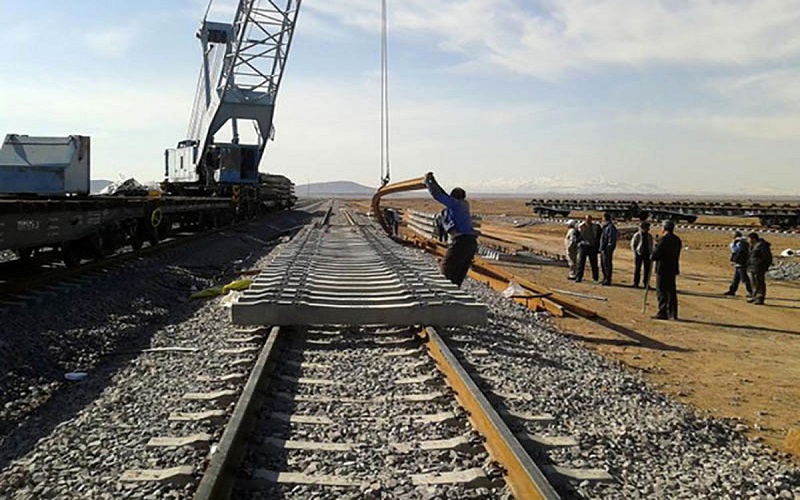

In a controversial development, the CEO of Avan Rail has indirectly confirmed that the company is being funded by assets linked to Babak Zanjani, a billionaire businessman convicted of massive financial corruption. This revelation follows the signing of a major contract worth over 64 trillion tomans (approximately $750 million) between Avan Rail and the Islamic Republic of Iran Railways.
On Sunday, April 20, Iranian media reported that Iran Railways had signed an agreement with Avan Rail—a subsidiary of Dot One Holding—to purchase 300 diesel self-propelled passenger trains, 50 freight locomotives, and 600 freight wagons. Avan Rail later announced on its website that the deal involves the production and supply of 2,000 freight and passenger wagons and locomotives.
However, multiple news outlets, including the ILNA news agency, have reported that Avan Rail is closely linked to Babak Zanjani, who was once one of Iran’s most prominent businessmen. On Sunday, Avan Rail CEO Mehdi Ebrahimi acknowledged that the company is utilizing funds from Zanjani’s overseas assets and former companies, although he denied that Zanjani is formally involved in Avan Holding.
Babak Zanjani rose to prominence in the late 2000s for his role in circumventing international sanctions to sell Iranian oil. He was arrested in 2013 and later sentenced to death on charges including “corruption on earth,” disruption of the national economy, and defrauding the National Iranian Oil Company. The Supreme Court upheld the verdict in 2016. However, in May 2024, his sentence was commuted to 20 years in prison with the personal approval of Supreme Leader Ali Khamenei.
Despite the commutation, reports emerged last winter suggesting that Zanjani had been released from prison. Judicial authorities stated that he had been given an opportunity to “take reparative measures” in cooperation with state institutions. Around the same time, the head of Iran’s judiciary claimed that Zanjani’s foreign assets had been identified and repatriated, while the Central Bank governor confirmed that the recovered funds had been transferred to the bank’s treasury.
Following the rail contract’s announcement, CEO Ebrahimi clarified that although Zanjani is not officially part of Avan Holding, the company is benefiting from capital originating from Zanjani’s past enterprises and foreign holdings.
Further scrutiny has revealed that several current managers at Dot One Holding previously held executive roles in Zanjani-linked companies. Notably, Hossein Ali Zaker Hossein and Mohammad Mehdi Zaker Hossein, now managers within the holding, were previously associated with Satsa Company—one of Zanjani’s former enterprises.
Satsa gained notoriety in 2013 after a massive land subsidence on Iranzamin Street in western Tehran was linked to the company’s construction of a large commercial complex.
Adding to the intrigue, Zanjani has recently re-emerged in the public eye through a personal website and renewed activity on social media platforms.
In a striking statement, Avan Rail’s CEO quoted Judiciary Chief Gholamhossein Mohseni-Eje’i as saying in March 2024 that Zanjani had not only repaid all his debts to the government but had even become one of its creditors.
The resurfacing of Babak Zanjani and his apparent financial involvement in major infrastructure projects raises fresh questions about transparency, accountability, and the blurred lines between justice and power in Iran’s political economy.