



Frankfurt’s cultural affairs chief Ina Hartwig will not attend the November 7 ceremony at the Paulskirche, joining growing criticism from local politicians, Iranian activists, and former political prisoners who reject the attempt to present the son of the former shah as a representative of the Iranian people.
Opposition to the planned presentation of the Friedrich Naumann Foundation’s 2026 Freedom Prize to Reza Pahlavi in Frankfurt is gaining momentum, with the city’s cultural affairs chief announcing that she will boycott the November 7 ceremony at the historic Paulskirche.
Ina Hartwig, a Social Democratic Party (SPD) politician responsible for cultural affairs in Frankfurt, described the foundation’s decision as “very unfortunate” and confirmed that she would not attend the event. Her announcement adds to growing criticism from political representatives, Iranian human rights activists, and members of the Iranian diaspora who reject the attempt to portray the son of Iran’s former shah as a representative of the Iranian people.
The controversy centers not simply on the choice of an individual recipient, but on the political implications of presenting a hereditary claimant associated with Iran’s former monarchy as the symbolic representative of an entire population struggling for freedom and democracy.
Frankfurt officials distance themselves from the award decision
Speaking during a meeting of Frankfurt’s municipal committees, Hartwig explained that the city had rented the Paulskirche for an award ceremony without initially knowing who would receive the distinction on behalf of the Iranian people.
She criticized the foundation’s selection and made clear that her personal attendance was out of the question.
The criticism was echoed by representatives of several political parties.
Wolfgang Strengmann-Kuhn of the Greens, who had signed a protest petition, stated unequivocally: “The son of the Shah is not a representative of the Iranian people.”
Mona Waissi of the Left Party similarly rejected Pahlavi’s claimed representative role, declaring that he did not represent the Iranian people.
Representatives of the SPD, Greens, Left Party, and Volt also expressed opposition to the decision, emphasizing that their solidarity lies with the Iranian people rather than with a particular political figure claiming to speak for them.
The SPD and Volt parliamentary groups subsequently reiterated their objections in separate statements.
Iranian activists challenge the rehabilitation of the former monarchy
The controversy also reached Frankfurt’s Diversity Committee, where Iranian human rights activists challenged the political legitimacy of presenting Pahlavi as the representative of Iran’s population.
Sahar Sanaie, spokesperson for the Society of German-Iranians in Frankfurt and a human and women’s rights activist, criticized Pahlavi for failing to distance himself from the crimes committed under his father’s rule.
She described his political legacy as representing the inheritance of a monarchical dictatorship and appealed to the city’s representatives to reconsider their involvement in the ceremony.
The historical background is central to the opposition.
Mohammad Reza Shah Pahlavi’s rule was characterized by authoritarian government, political repression, and the activities of SAVAK, the secret police responsible for the persecution and torture of political opponents.
For former political prisoners and families of victims of the former monarchy, the attempt to elevate the shah’s son as a symbol of freedom without an unequivocal reckoning with that history is deeply objectionable.
The issue is not simply the restoration of a historical memory. It concerns the political future of a country whose people have experienced both monarchical and clerical dictatorship.
The Iranian people cannot be represented by hereditary political claims
The Friedrich Naumann Foundation has presented its 2026 Freedom Prize as an award to the Iranian people, recognizing those who risk their lives for democracy and civil rights and those who have been killed, persecuted, or imprisoned.
The foundation’s decision is to have Pahlavi accept the distinction on their behalf, describing him as one of the best-known figures in the Iranian opposition. It has argued that the award is intended for the people rather than for Pahlavi personally, and that he will hold it until freely elected representatives can receive it.
However, this arrangement has itself become a source of controversy.
A public mandate cannot be established through international recognition, family lineage, or an organization’s unilateral selection. Nor does prominence in the media establish the right to represent a politically diverse population.
A separate protest letter signed by 306 Iranian associations worldwide has challenged the decision, arguing against granting Pahlavi the authority to receive the award in the name of the Iranian people. The opposition has also included former political prisoners from the shah’s era and individuals associated with victims of Iran’s subsequent dictatorship.
The criticism therefore extends beyond the immediate dispute over a ceremony in Frankfurt. It raises the fundamental question of who has the democratic legitimacy to speak for Iran’s future.
Paulskirche ceremony exposes divisions over Iran’s democratic future
The planned ceremony has also generated debate over the city’s responsibility for hosting the event.
While several political representatives have criticized the foundation’s choice, they have acknowledged that the city cannot simply cancel the booking because the established conditions for using the Paulskirche have been met.
The controversy has consequently developed into a broader public debate about the distinction between protecting freedom of expression and endorsing a particular political figure.
The event is scheduled for November 7, from 11 a.m. to 12:30 p.m. Both supporters and opponents of Pahlavi have registered to attend. Around 140 supporters had already gathered at Frankfurt’s Bockenheimer Warte on October 29, singing hymns in his honor and referring to him as their crown prince.
The growing opposition, however, demonstrates that the attempt to associate Pahlavi with the collective struggle of Iranians for freedom is far from universally accepted.
No return to monarchy, no continuation of clerical dictatorship
Iran’s struggle for democracy cannot be reduced to a choice between the current ruling establishment and the restoration of the monarchy.
The experience of successive dictatorships has made the question of political legitimacy central to the country’s future. Iranians who reject the ruling clerical establishment are not thereby endorsing the restoration of hereditary rule.
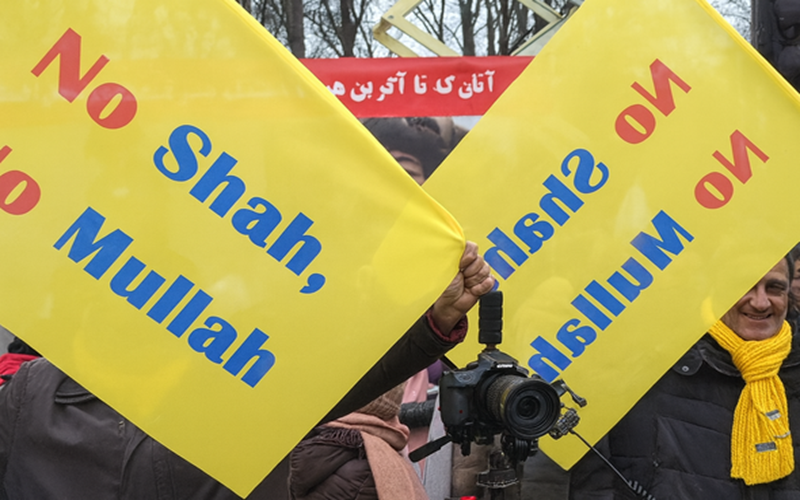
The principle of “No Shah, No Mullahs” expresses this rejection of both forms of dictatorship and the demand for a democratic republic based on popular sovereignty, free elections, and the separation of religion and state.
The Frankfurt controversy illustrates why presenting Reza Pahlavi as a representative of the Iranian people is politically contentious. An award ostensibly dedicated to the collective struggle of millions should not become a vehicle for conferring political legitimacy on an unelected individual or reviving hereditary claims to power.
The people of Iran, not foreign foundations, political patrons, or dynastic succession, must determine their country’s future through a genuinely democratic process.