


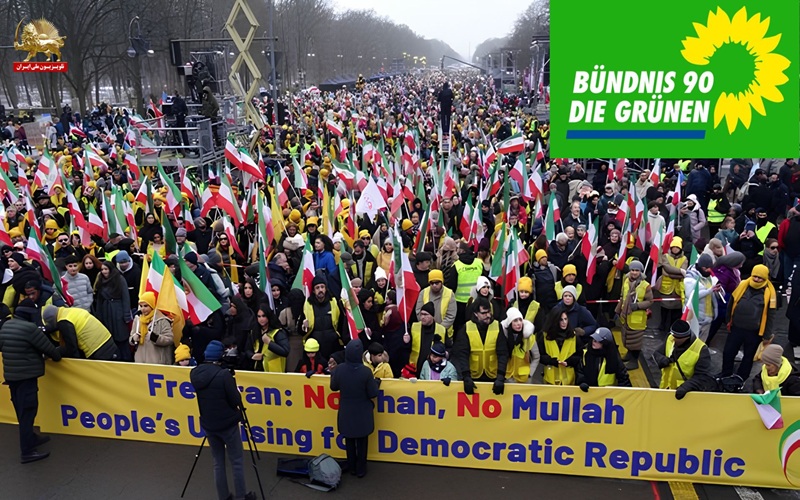

The Green Party’s Frankfurt chapter welcomes recognition of Iran’s struggle for freedom but condemns the decision to entrust the 2026 Friedrich Naumann Foundation award to the son of the former shah, rather than to representatives of Iran’s democratic protests.
The Frankfurt chapter of Germany’s Green Party has criticized the Friedrich Naumann Foundation’s decision to entrust its 2026 Freedom Prize, dedicated to the people of Iran, to Reza Pahlavi, the son of Iran’s former shah. In a statement published on October 29, the party welcomed international recognition of the Iranian people’s struggle for freedom but argued that the award should have gone to representatives of the democratic movement inside Iran rather than to a figure associated with the former monarchy.
The award ceremony is scheduled for November 7 at Frankfurt’s historic Paulskirche, a landmark of Germany’s democratic tradition. The foundation has designated the Iranian people as the recipients of the 2026 prize, with Pahlavi accepting it in a representative capacity.
The Frankfurt Greens said the decision risks overshadowing the people whose courage and sacrifices the award is supposed to recognize, particularly women and those who have actively participated in successive protest movements.
Burkhard Schwetje, spokesperson for the Frankfurt Greens, praised the determination of Iranians fighting for democracy and freedom, highlighting the role of women and the significance of the Jin, Jiyan, Azadi (Woman, Life, Freedom) movement.
The party argued that the foundation should instead have selected someone who had personally participated in the protests of 2022–2023 or the January 2026 uprising. Such individuals, it said, embody the struggle far more directly than an internationally based political figure.
Tara Moradi, another spokesperson for the Frankfurt Greens, directly challenged Pahlavi’s suitability to receive an award intended to honor the Iranian people’s democratic aspirations.
“Presenting the Freedom Prize to a representative of the throne rather than to a representative of Iran’s democratic protests rightly leaves many people in Frankfurt dissatisfied,” Moradi said.
She questioned Pahlavi’s failure to credibly distance himself from the repression, executions, and dictatorship associated with his father’s monarchy. According to Moradi, treating him separately from that historical legacy while granting him such recognition raises fundamental questions about why this controversial figure should be considered entitled to accept a freedom award on behalf of a diverse people seeking a democratic future.
The statement warned that the foundation’s decision shifts attention away from the achievements of ordinary Iranians and toward a self-proclaimed monarch.
“That is not how one honors a people, but rather their former ruler,” Moradi emphasized.
Iranian exiles warn against erasing the history of repression
The Frankfurt Greens also highlighted the experiences of the city’s Iranian diaspora, noting that many exiled Iranians have personally endured persecution and continue to advocate for democracy and women’s rights in Germany.
Their histories, the party stressed, reflect experiences of state violence under both the Pahlavi monarchy before 1979 and the clerical dictatorship that followed. Many have paid a heavy price in their struggle against both systems.
The statement called on the foundation to ensure that these voices are not rendered invisible in the effort to recognize Iran’s struggle for freedom. It emphasized that honoring the Iranian people requires acknowledging the diversity of their political experiences and their opposition to dictatorship in all its forms.
The Greens also questioned the appropriateness of the award ceremony’s location. The Paulskirche holds particular significance in German history as the site of the 1848 Frankfurt National Assembly, a landmark in the country’s struggle for parliamentary democracy and the transition away from feudal political structures.
Against this historical background, the party described the decision to place Pahlavi at the center of the ceremony, rather than Iran’s actual freedom fighters, as deeply contradictory.
Growing criticism of the decision to honor Pahlavi
The Frankfurt Greens’ intervention adds to growing criticism in Germany and elsewhere in Europe over the foundation’s decision to entrust the award to Pahlavi.
The central issue raised by these objections is the distinction between recognizing the Iranian people’s struggle for democracy and granting political legitimacy to an individual whose political project is associated with restoring the monarchy.
The Frankfurt statement makes clear that opposition to Iran’s clerical dictatorship does not automatically translate into support for the return of hereditary rule. For the Greens, the people risking their lives inside Iran, including women, protesters, political activists, and opponents of both past and present dictatorships, should remain at the center of international recognition.
Their message is particularly significant given the symbolism of the Paulskirche: a freedom prize dedicated to the Iranian people should honor their struggle for a democratic republic, not elevate a representative of a former ruling dynasty.