


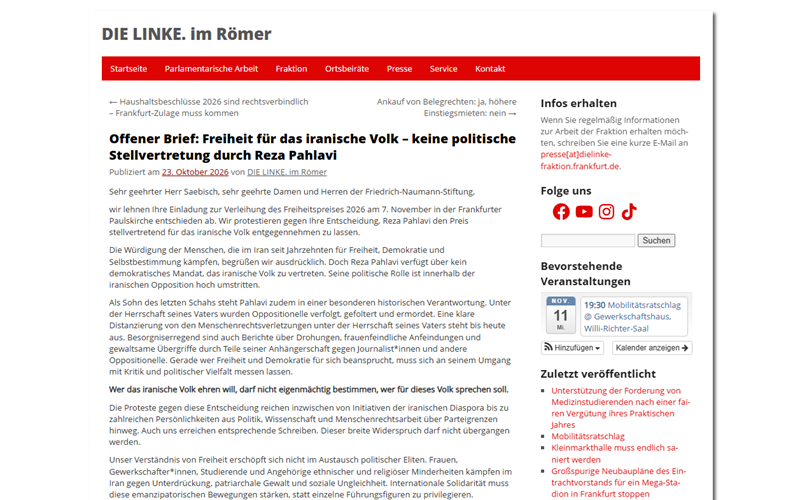

In an open letter to the Friedrich Naumann Foundation, elected representatives of Die Linke in Frankfurt condemn the decision to let the son of Iran’s last shah receive the 2026 Freedom Prize on behalf of the Iranian people and announce a boycott of the November 7 ceremony.
Elected representatives of Die Linke in Frankfurt have joined growing opposition to the Friedrich Naumann Foundation’s decision to let Reza Pahlavi receive its 2026 Freedom Prize on behalf of the Iranian people. In an open letter published on October 23, the party’s municipal parliamentary group rejected the invitation to the November 7 ceremony at Frankfurt’s historic Paulskirche, arguing that Pahlavi has no democratic mandate to represent Iran’s population.
The letter, addressed to the foundation’s leadership, makes a clear distinction between recognizing the Iranian people’s decades-long struggle for freedom, democracy, and self-determination and granting political representation to an individual whose role remains highly controversial within the Iranian opposition.
“We firmly reject your invitation to the presentation of the 2026 Freedom Prize on November 7 at Frankfurt’s Paulskirche. We protest your decision to have Reza Pahlavi accept the award on behalf of the Iranian people,” the representatives wrote.
They stressed that Pahlavi, as the son of Iran’s last shah, carries a particular historical responsibility for the record of his father’s monarchy. Under Mohammad Reza Shah Pahlavi, political opponents were persecuted, tortured, and murdered. The letter noted that Reza Pahlavi has yet to offer a clear repudiation of the human rights violations committed under his father’s rule.
The representatives also raised concerns about reports of threats, misogynistic attacks, and violent assaults by sections of Pahlavi’s supporters against journalists and other opposition figures.
They argued that anyone claiming to stand for freedom and democracy must demonstrate respect for criticism and political pluralism, rather than tolerate intimidation of political opponents.
“Anyone who wants to honor the Iranian people must not unilaterally decide who should speak for them,” the letter stated.
Opposition extends beyond the Iranian diaspora
The Frankfurt representatives pointed out that resistance to the foundation’s decision has spread beyond Iranian diaspora initiatives, involving figures from politics, academia, and human rights organizations across party lines.
They said their own offices had also received letters expressing opposition to the arrangement and warned the foundation against disregarding this broad-based criticism.
The letter further emphasized that Iran’s struggle for freedom cannot be reduced to a contest between political elites or competing leadership figures. Women, trade unionists, students, and members of ethnic and religious minorities are fighting against repression, patriarchal violence, and social inequality.
International solidarity, they argued, should strengthen these emancipatory movements rather than privilege individual political figures.
This position also informed their criticism of the ceremony’s location. The Paulskirche, where Germany’s first freely elected national parliament convened in 1848, represents popular sovereignty, democratic participation, and the rejection of hereditary political authority.
The letter described the decision to assign an unelected political figure the role of representative of an entire nation at such a venue as fundamentally contradictory to these principles.
Frankfurt representatives announce boycott and demand award be withheld
The signatories announced that they would not attend the November 7 ceremony, refusing to lend their presence and political legitimacy to what they described as a political staging.
They called on the Friedrich Naumann Foundation to abandon its plan to hand the award to Pahlavi and instead follow the demand emerging from Iranian civil society: keep the prize in safekeeping until it can be presented to democratically legitimate representatives of the Iranian people themselves.
The letter concluded with an unequivocal rejection of both forms of dictatorship:
“The future of Iran belongs to the people who live there and fight for their freedom. Not to the mullahs, not to a shah, and not to a German foundation.”
The representatives closed with the slogan “Nah Pahlavi, nah Rahbari. Jin, Jiyan, Azadî” — “Neither Pahlavi nor Rahbari. Woman, Life, Freedom.”
The open letter was signed by Dr. Daniela Mehler-Würzbach, chair of Die Linke’s parliamentary group in Frankfurt; Ayse Dalhoff, member of the presidium of the Frankfurt City Council; and Margarete Wiemer, city councillor.
Their intervention adds another significant voice from Frankfurt’s political establishment to the growing criticism of the planned award ceremony. It reinforces a central question surrounding the November 7 event: whether international recognition of Iran’s freedom struggle should be used to elevate an individual political figure without a democratic mandate, rather than recognize the diverse forces fighting for a future free from dictatorship.