


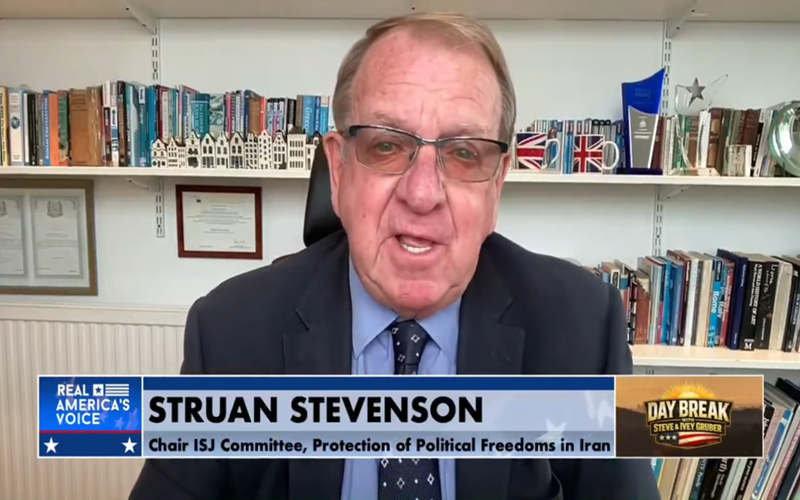

With Iran’s clerical regime reeling from military conflict, economic collapse, and the aftermath of the February death of Supreme Leader Ali Khamenei, former senior European Parliament official Struan Stevenson predicts that another massive nationwide uprising is imminent—and stresses that the Iranian people are determined to establish a democratic republic rather than return to royal dictatorship.
Appearing on The Steve Gruber Show, Stevenson—Chair of the International Committee in Search of Justice (ISJ) on the Protection of Political Freedoms in Iran and former President of the European Parliament’s Delegation for Relations with Iraq—warned Western policymakers against falling for diaspora lobbying efforts that promote the son of the deposed Shah as a transitional leader.
A Regime in Crisis Resorting to Mass Executions
The broadcast highlighted the escalating volatility inside Iran throughout 2026. In January, Iran experienced its fourth major nationwide uprising since 2018, with millions marching across all 31 provinces. The regime responded with brute force, killing thousands and arresting roughly 50,000 demonstrators.
Following the outbreak of war on February 28—which resulted in the deaths of Khamenei and several top officials—the surviving clerical apparatus has turned to a wave of state-sanctioned executions to maintain its grip on power. Since March, at least 45 political prisoners, including activists from the People’s Mojahedin Organization of Iran (PMOI/MEK) and detained protesters, have been executed, while at least 100 more dissidents remain on death row.
Yet rather than quelling dissent, economic ruin and political terror have only primed the country for another explosion.
“The next uprising is bound to happen, and it’s bound to happen soon,” Stevenson said. “There are 90 million Iranians who are sick to death of the theocratic regime.”
Rejecting Both the Mullahs and the Monarchy
As Washington and European capitals debate what follows the potential collapse of the clerical establishment, Stevenson pointed to the defining slogan chanted by protesters inside Iran: “Down with the oppressor, whether the Shah or the Supreme Leader.”
“They got rid of the Shah in 1979, [and] they don’t want to replace the turban with the crown,” Stevenson emphasized.
The segment examined the track record of Reza Pahlavi, the exiled son of the former monarch, noting that despite extensive media and lobbying campaigns, he lacks a viable base inside the country. The report pointed to Pahlavi’s refusal to disavow the atrocities committed by SAVAK, his father’s notorious secret police force responsible for widespread imprisonment and torture prior to the 1979 revolution, as well as decades of controversy surrounding Pahlavi’s overtures to members of the Islamic Revolutionary Guard Corps (IRGC).
Stevenson did not mince words regarding Pahlavi’s political viability:
“When [change] happens, it’s the people of Iran who will choose their democratic future. It’s not up to Reza Pahlavi, the son of the deposed Shah,” Stevenson said. “That guy has not been back in Iran for 50 years. He’s never done a day’s work in his life. He has lived off the billions of dollars that his father stole from the Iranian people. He swans around the world pretending that he is the obvious successor to the overthrow of the mullahs. It is utter fake news. It’s nonsense. The guy has no support on the ground inside Iran.”
Self-Determination Through Organized Resistance
For Stevenson and human rights observers, the lesson of recent months is that Iran’s political transition cannot be engineered from abroad or handed over based on dynastic claims.
With thousands of resistance units and pro-democracy dissidents risking execution on the ground every day, Stevenson argued that true legitimacy belongs solely to the Iranian citizenry and the organized opposition fighting inside the country to establish a secular, democratic republic.