


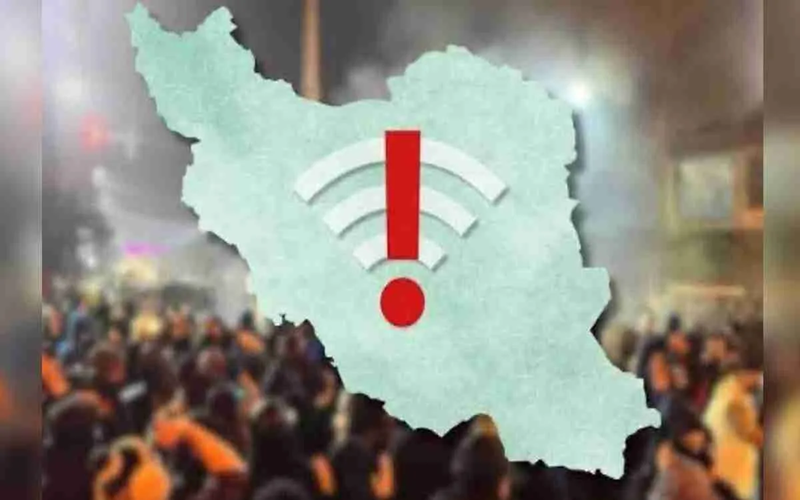

Former IRIB chief Mohammad Sarafraz says Tehran has imported Chinese equipment for “permanent internet shutdowns” while authorities push toward selective and state-controlled internet access.
New revelations from a former senior regime official have intensified concerns over the Iranian regime’s accelerating efforts to impose sweeping internet restrictions modeled on China’s system of digital control.
Mohammad Sarafraz, the former head of the regime’s state broadcasting organization (IRIB) and a current member of the Supreme Council of Cyberspace, disclosed that parts of the regime are seeking to implement a heavily restricted internet structure in which access to the global web would be limited to select, state-approved groups.
Speaking on Sunday, May 24, in an interview with the online newspaper Faraz, Sarafraz said the regime had already purchased and imported equipment from China designed for the “permanent shutdown of the internet.”
According to Sarafraz, the model being pursued mirrors China’s tightly controlled digital infrastructure, where ordinary citizens face significant limitations in accessing the global internet while certain privileged groups are granted monitored and selective access. He stated that the primary objective of such a system is to ensure the dominance of the regime’s “official narrative” over the country’s information space.
Sarafraz also accused telecommunications operators linked to the Supreme Council of Cyberspace of playing a central role in advancing the controversial “Pro Internet” project. He alleged that many beneficiaries of internet restrictions simultaneously profit from the sale of VPNs and privileged internet services.
“The same people who one day sell VPNs are the next day providers of special internet access,” he said, highlighting what critics describe as a growing system of digital inequality inside Iran.
The former IRIB chief further described the Supreme Council of Cyberspace as an ineffective institution, arguing that repeated internet shutdowns have failed to prevent cyberattacks or protect regime officials from security threats. Instead, he said, the restrictions have severely damaged businesses, disrupted economic activity, and increased social discrimination by creating unequal access to information.
At the same time, internet monitoring organization NetBlocks reported that internet disruptions and restrictions in Iran have now entered their 86th consecutive day. According to the group, after more than 2,040 hours of ongoing limitations, a large portion of the Iranian population remains cut off from free access to the global internet.
⬇️ #Iran's internet blackout is now in its 86th day as the population remains in digital darkness after 2040 hours.
While access to the global internet remains largely cut during peace talks, select whitelisted users project a synthetic view of Iranian life to the outside world. pic.twitter.com/CVJoBbbb8e
— NetBlocks (@netblocks) May 24, 2026
In its latest assessment, NetBlocks warned that while most citizens face severe online restrictions, a select group with privileged access continues to present a controlled and misleading image of daily life in Iran to the outside world.
The revelations come amid continuing efforts by regime officials to justify tighter digital controls. Earlier, Ali Yazdikhah claimed there was currently no need to restore unrestricted internet access in Iran. Without presenting evidence or verifiable statistics, he asserted that more than 90 percent of public needs are already being met through the regime’s so-called “National Information Network,” Iran’s domestic internet system designed to reduce reliance on the global web.
China’s role in supplying surveillance and censorship technology to the Iranian regime had already drawn attention during the nationwide protests of January 2026, when authorities imposed widespread internet blackouts and repeated disruptions to digital communications in an effort to suppress dissent.
Meanwhile, new reports indicate that the regime is moving toward even greater centralization of cyberspace control through the creation of a new body called the “Headquarters for Organizing and Guiding Cyberspace.”
On Tuesday, May 19, 2026, the state-run newspaper Shargh revealed details about the formation of the new structure. According to the report, government officials and cabinet members have been prohibited from discussing the body publicly with the media, further increasing speculation about its true mandate and powers.
Reports suggest the new headquarters includes representatives from a wide range of governmental, intelligence, and military institutions. Among the bodies involved are the Attorney General’s Office, parliamentary representatives, the ministries of communications, intelligence, culture, and science, the vice presidency for science and technology, the Supreme Council of Cyberspace, the Supreme National Security Council, the intelligence arm of the Islamic Revolutionary Guard Corps, and several private-sector representatives.
The expansion of this structure underscores the regime’s growing focus on digital repression as authorities seek tighter control over information flows, public communication, and online dissent amid continuing political and social unrest across Iran.