


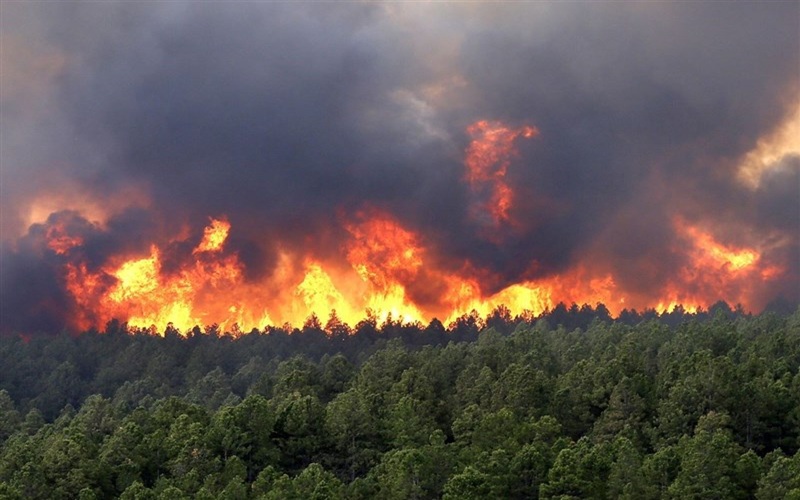

As wildfires spread across multiple provinces, experts say decades of mismanagement, land grabbing, underfunded conservation, and climate pressures have turned Iran’s forests into recurring victims of a preventable crisis.
Wildfires Spread Across Iran as Summer Begins
Although the summer of 2026 has not yet reached its midpoint, vast areas of Iran are once again engulfed in flames.
From the forests and rangelands of Morki village in Mamasani County, Fars Province, to the woodlands of Baneh in Kurdistan Province and the forests of Kuh Mareh Sorkhi, wildfires have erupted across multiple regions, destroying some of Iran’s most valuable natural ecosystems.
In Baneh alone, three separate fires broke out within a single day. Environmental activists note that such patterns have become increasingly common in recent years, with many incidents showing signs of deliberate human involvement. Meanwhile, aerial footage from Kuh Mareh Sorkhi reveals extensive destruction, with large sections of forest reduced to ash within hours.
While extreme heat, prolonged drought, and strong winds have accelerated the spread of the fires, experts argue that climate alone cannot explain why the crisis returns year after year.
A Crisis Decades in the Making
Specialists in natural resource management have long warned that Iran’s recurring wildfire disasters are rooted in structural failures rather than seasonal weather alone.
A combination of poor governance, inadequate funding, aging firefighting equipment, deforestation, illegal land seizures, and systemic corruption has steadily weakened the country’s ability to protect its forests.
The ancient Zagros and Hyrcanian forests—among the Middle East’s most important ecological treasures—have endured repeated wildfire seasons with little improvement in prevention or emergency response.
Instead of relying on modern aerial firefighting capabilities, local residents and volunteers are often left to battle advancing flames with shovels, tree branches, and rudimentary tools.
In several cases over recent years, volunteers have lost their lives while attempting to contain fires that overwhelmed available resources.
Land Grabbing Behind Many Fires
One of the most persistent concerns raised by environmental experts is the connection between wildfires and illegal land conversion.
For years, specialists have warned that some fires occur shortly before protected forests or rangelands are converted into commercial properties, agricultural land, villas, or mining sites.
Once forest cover is destroyed, the economic value of the land often increases dramatically, creating incentives for illegal occupation and development.
Environmental advocates argue that weak oversight and the failure to prosecute those responsible have encouraged further encroachment on protected lands.
Critics have also accused politically connected individuals and regime-affiliated foundations of benefiting from land seizures, undermining conservation efforts and weakening public confidence in environmental enforcement.
Weak Institutions, Limited Resources
Iran’s forest protection agencies have faced chronic shortages of funding, personnel, and modern equipment for years.
Many firefighting units operate with aging vehicles and limited infrastructure, while access to water-dropping helicopters, specialized aircraft, and advanced detection systems remains severely restricted.
As a result, villagers, environmental volunteers, and local communities are frequently the first—and sometimes the only—line of defense when fires break out.
Their dedication has prevented even greater destruction, but experts say volunteer efforts cannot substitute for a comprehensive national wildfire management strategy.
Economic Pressures Deepen Environmental Damage
Iran’s worsening economic crisis has also increased pressure on natural resources.
Rising poverty, unemployment, and declining rural incomes have forced many communities to rely more heavily on forests and rangelands for survival.
Activities such as excessive wood harvesting, charcoal production, uncontrolled grazing, and the expansion of agricultural land have intensified environmental degradation in some regions.
Environmental experts emphasize that most rural residents are committed to protecting their forests. However, prolonged economic hardship has made sustainable resource management increasingly difficult.
Climate Change Magnifies Existing Failures
Climate change has unquestionably intensified wildfire risks.
Declining rainfall, rising temperatures, and longer periods of drought have left forests increasingly vulnerable, allowing even small sparks to develop rapidly into large-scale fires.
Nevertheless, specialists stress that climate change acts primarily as a threat multiplier.
Without stronger prevention systems, improved monitoring, and faster emergency response, increasingly severe weather conditions will continue to produce catastrophic outcomes.
Prevention Remains the Missing Priority
Countries facing similar climatic conditions have increasingly invested in wildfire prevention through satellite monitoring, firebreak construction, observation towers, rapid-response teams, community education, and modern aerial firefighting fleets.
Iran, however, has failed to develop many of these essential capabilities.
Environmental activists argue that the regime’s spending priorities have contributed significantly to this gap. While vast financial resources have been directed toward military, security, and regional objectives, investment in environmental protection and firefighting infrastructure has remained insufficient.
The result is a recurring cycle in which forests burn each summer while authorities struggle to respond effectively.
An Environmental Disaster with Lasting Consequences
The fires now affecting Mazandaran, Gilan, Golestan, Fars, Kurdistan, Kohgiluyeh and Boyer-Ahmad, and other provinces are not isolated incidents.
They reflect decades of declining environmental governance, inadequate oversight, limited firefighting capacity, mounting economic pressures on rural communities, and allegations of profiteering through illegal land appropriation.
Forests that took thousands of years to develop can disappear within a matter of hours.
Their loss extends far beyond scorched trees. These ecosystems regulate water supplies, preserve biodiversity, prevent soil erosion, and sustain local livelihoods. Once destroyed, they cannot be restored through development budgets or short-term reconstruction projects. For many of Iran’s ancient forests, recovery—if it is possible at all—will take generations.