


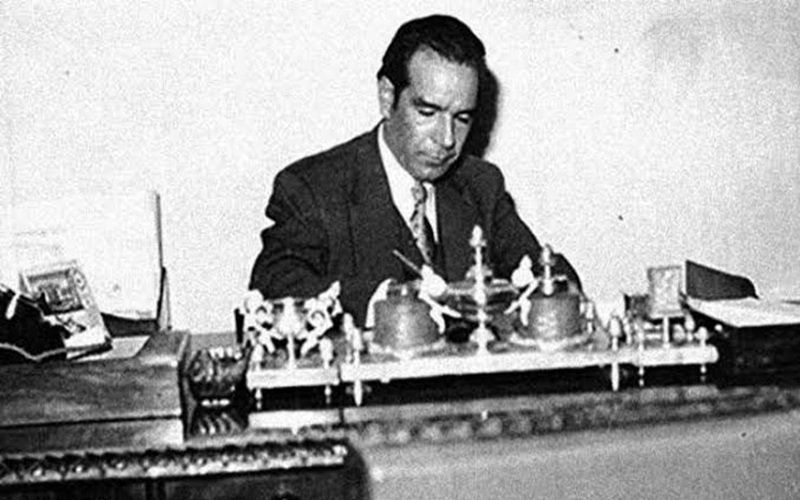

Seventy-two years after the execution of Mohammad Mossadegh’s foreign minister, the circumstances of his arrest, stabbing, secret military trial, and execution expose the violence used to consolidate Mohammad Reza Shah Pahlavi’s rule. As Reza Pahlavi is promoted as a political alternative for Iran, the history of his father’s dictatorship deserves renewed scrutiny.
The execution of a national figure and the price of opposing the Shah
On November 10, 1954, Dr. Hossein Fatemi, foreign minister in the government of Mohammad Mossadegh, was executed by firing squad in Tehran. He was 37 years old. His death marked one of the most significant acts of political repression following the August 1953 coup that overthrew Mossadegh’s government and restored Mohammad Reza Shah Pahlavi’s authority.
Fatemi’s execution was not an isolated incident or simply the punishment of a former government official. It was part of the systematic persecution of those who had opposed the restoration of royal power and defended Iran’s national sovereignty.
Today, as Reza Pahlavi, the son of Mohammad Reza Shah, is increasingly promoted by monarchist supporters as a political alternative for Iran, the historical record of his father’s rule is particularly relevant. Attempts to present the Pahlavi monarchy as a period of freedom, stability, and national dignity cannot be reconciled with the documented persecution, torture, political imprisonment, and executions of its opponents.
The fate of Hossein Fatemi offers a particularly revealing account of what happened to those who challenged the Shah’s authority.
From the nationalization of oil to confrontation with the royal court
Born in Naein in 1917, Hossein Fatemi was a journalist, political activist, and prominent figure in Iran’s National Front. He became one of Mohammad Mossadegh’s closest political allies and served as foreign minister from 1951 until the overthrow of the government in August 1953.
Fatemi supported the nationalization of Iran’s oil industry and opposed foreign interference in the country’s political and economic affairs. As foreign minister, he worked to reduce the influence of the royal court over the country’s diplomatic affairs and took a firm position against British interference.
He was also a supporter of equal rights for women and men and increasingly advocated the abolition of the monarchy and the establishment of a republic.
His political positions brought him into direct confrontation with the royal court and its supporters.
The 1953 coup and the persecution of Mossadegh’s supporters
On August 19, 1953, a coup backed by the United States and Britain overthrew Mossadegh’s government. The operation restored the Shah’s position after he had fled Iran following the failure of an earlier attempt to remove the prime minister.
The consequences extended far beyond the removal of one government. Mossadegh’s political movement was crushed, its supporters were persecuted, and the monarchy consolidated its authority through military and security institutions.
Mossadegh was arrested, tried, and sentenced to three years in prison. He subsequently remained under house arrest until his death in 1967.
Fatemi went into hiding after the coup. His outspoken opposition to the Shah and the royal court had made him a particular target.
His fate had effectively been decided at the highest levels of the restored monarchy. According to the historical account of the period, the Shah had declared that Fatemi would be executed once captured.
Arrest, attempted assassination, and violence outside police headquarters
On February 25, 1954, Fatemi was arrested at a house in Tehran’s Tajrish district after months in hiding.
His arrest did not end the violence against him. While under police custody, he was attacked by a group of men armed with knives and other weapons. The attackers included members of a pro-Shah street group associated with Shaban Jafari, known as Shaban Bimokh.
Fatemi suffered severe injuries. His sister, Soltan Fatemi, intervened during the attack and was also wounded while attempting to protect her brother.
The attack took place in the presence of the authorities responsible for his custody. Fatemi survived, but his injuries were so serious that he required prolonged hospitalization.
After spending months in a military hospital, he was transferred to a military prison despite his continuing medical problems.
The episode demonstrated the dangers faced by political opponents of the restored monarchy, even when they were already in state custody.
A secret military trial against a gravely injured prisoner
In August 1954, Fatemi was brought before a military tribunal. His physical condition was extremely poor, and he had to be transported to court on a stretcher.
The proceedings were held behind closed doors. He was charged with attempting to overthrow the constitutional monarchy and was sentenced to death after twelve days of hearings. His appeal failed.
The circumstances of the trial raise fundamental questions about judicial independence and the treatment of political prisoners under the restored monarchy. A former government minister, arrested after a coup and subjected to a violent attack while in police custody, was tried by a military court in proceedings closed to the public.
Fatemi refused to seek clemency by abandoning his political convictions. In a letter to Mossadegh, he expressed his determination to defend the national movement and use the trial to expose the circumstances surrounding the coup and the oil consortium.
His execution would silence one of the most outspoken opponents of the restored Shah.
November 10, 1954: A political execution
At dawn on November 10, 1954, prison authorities informed Fatemi that his execution was about to be carried out.
When asked whether he had a final wish, he reportedly answered that he did not fear death and wanted his fate to serve as a lesson to Iran’s younger generation.
As he was taken to the execution post, he shouted three times:
“Long live Dr. Mossadegh! Long live Iran!”
He was shot by firing squad with eight bullets.
Fatemi was subsequently buried at Ibn Babawayh Cemetery, in the section associated with those killed in the July 1952 national uprising.
His execution became a lasting symbol of the persecution of the national movement and those who refused to accept the restoration of royal dictatorship.
Fatemi’s execution was part of a wider system of repression
The persecution of Fatemi must also be understood within the broader history of political repression under Mohammad Reza Shah.
After the 1953 coup, martial law remained in force until 1957. The monarchy increasingly relied on the military and security apparatus to suppress political opposition.
In 1957, SAVAK, the Shah’s intelligence and security organization, was established. It became a central instrument for monitoring, arresting, and suppressing opponents of the monarchy.
Reports by international human rights organizations documented arbitrary detention, torture, restrictions on freedom of expression, and the use of military tribunals against political opponents.
Amnesty International reported in 1972 that prisoners in Tehran’s Evin Prison were being tortured, including through the use of heated metal surfaces. The organization subsequently campaigned throughout the 1970s against human rights violations committed by SAVAK.
The International Commission of Jurists also documented the expansion of the Shah’s authoritarian system, including the role of SAVAK, military repression, arrests, and the suppression of political activity.
These records are important because they establish that Fatemi’s fate was not merely an episode from the early years of the Shah’s restoration. Political repression continued and developed into an institutionalized system during the following decades.
Rewriting the Shah’s history does not erase its victims
The historical record of the Pahlavi monarchy cannot be separated from the 1953 coup, the execution of political opponents, the imprisonment of nationalists, the suppression of political organizations, and the torture of prisoners by SAVAK.
The promotion of Reza Pahlavi as a future political figure does not change these historical facts. Nor does opposition to the current ruling establishment in Iran justify overlooking the crimes committed under the previous monarchy.
Iran’s political future should be discussed with full awareness of its history. The Iranian people have experienced two authoritarian systems, and the suffering inflicted by one must never be used to excuse or whitewash the crimes of the other.
The execution of Dr. Hossein Fatemi on November 10, 1954, remains a reminder of the price paid by those who defended political independence and challenged authoritarian rule. Remembering him means remembering not only an individual victim, but also the broader history of repression under the Shah.
That history belongs to the Iranian people. It cannot be rewritten to serve the political ambitions of the former ruling dynasty or its present-day advocates.