


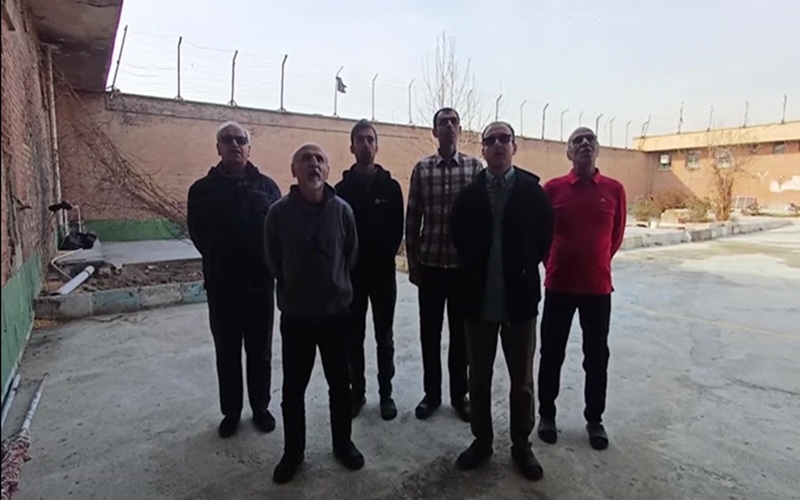

The execution of six political prisoners underscores a regime increasingly reliant on repression, war, and fear to maintain its grip on power
The ruling system of Velayat-e Faqih, long sustained through coercion and ideological control, has once again exposed the depths of its fragility. By exacting revenge on the Iranian people and their organized resistance, the regime demonstrates a stark reality: its survival increasingly depends on the systematic deployment of violence, even at the cost of escalating crimes against humanity.
The recent executions of six political prisoners—Mohammad Taghavi, Akbar Daneshvar Kar, Pouya Ghabadi, Babak Alipour, Vahid Bani Amerian and Abolhassan Montazer—must be understood within this broader strategic framework. These individuals, described by supporters as symbols of defiance, reportedly maintained unwavering resolve in the face of repression. Their final messages, imbued with calls for resistance, reflect not only personal conviction but also the persistence of a broader oppositional current within Iranian society.
For the ruling establishment, such figures represent more than isolated dissent; they embody a narrative that challenges the regime’s foundational legitimacy. Consequently, their elimination serves a dual purpose: removing perceived threats while attempting to deter future mobilization. Yet historically, executions of this nature have often produced the opposite effect—fueling anger, deepening societal fractures, and reinforcing the very movements they aim to suppress.
Tehran’s calculus appears to be shaped by a belief that external crises—particularly war—can provide cover for intensified domestic repression. Under the shadow of geopolitical conflict and the relative silence of appeasement-oriented actors, the regime’s authorities seem to assume that acts of brutality will draw limited international consequence. This assumption has precedent. From the mass executions of the late 1980s to more recent crackdowns during periods of unrest, the regime has repeatedly leveraged moments of crisis to consolidate control.
Today, similar patterns are emerging. Reports point to an expanding security apparatus across the country: the proliferation of checkpoints, increased militarization of urban spaces, widespread surveillance, and severe restrictions on communication channels, including internet shutdowns. These measures are not merely reactive; they are indicative of a preemptive strategy designed to neutralize potential uprisings before they can fully materialize.
At the same time, Iran’s prisons remain overcrowded with political detainees—many of them arrested during recent protests. This raises credible concerns that the current wave of executions may be only the beginning of a broader campaign. The structural logic is clear: when a regime perceives existential threat, repression escalates from targeted punishment to systemic intimidation.
However, this strategy is not without risk. The nationwide protests that have erupted in recent years, despite severe crackdowns, suggest that the social contract between the state and its citizens has eroded significantly. Grassroots networks and organized resistance units continue to challenge the state’s monopoly on power, indicating that the internal dynamics of dissent remain active, even under extreme pressure.
The ongoing war has undoubtedly disrupted the trajectory of these movements, shifting public attention and complicating mobilization efforts. Yet it has also revealed the regime’s reliance on perpetual crisis as a governing tool. Whether through foreign confrontation, nuclear brinkmanship, or internal security campaigns, the objective remains consistent: to fragment opposition and prolong authoritarian rule.
Equally notable is the regime’s exploitation of political divisions within the broader opposition landscape. Competing narratives, particularly among exile groups and legacy political factions, risk diluting the coherence of resistance efforts. In this environment, disinformation and strategic fragmentation become tools that indirectly serve the state’s interests.
Against this backdrop, the responsibility of the international community becomes increasingly urgent. Diplomatic caution and incremental engagement have repeatedly failed to deter Tehran’s human rights violations. What is required instead is a shift toward accountability: the referral of Iran regime’s human rights case to the United Nations Security Council, the pursuit of legal action against those responsible for executions and torture, and the explicit recognition of the Iranian people’s right to resist authoritarian rule.
The moral dimension of this crisis cannot be overstated. As the Iranian poet Nima Yooshij once wrote, “O people who sit happily on the shore, one person is dying in the water.” Today, that metaphor resonates with unsettling clarity. The suffering within Iran is not abstract; it is immediate, tangible, and escalating.
The question, ultimately, is whether the world will continue to observe from a distance—or choose to act before the tide of repression claims even more lives.