


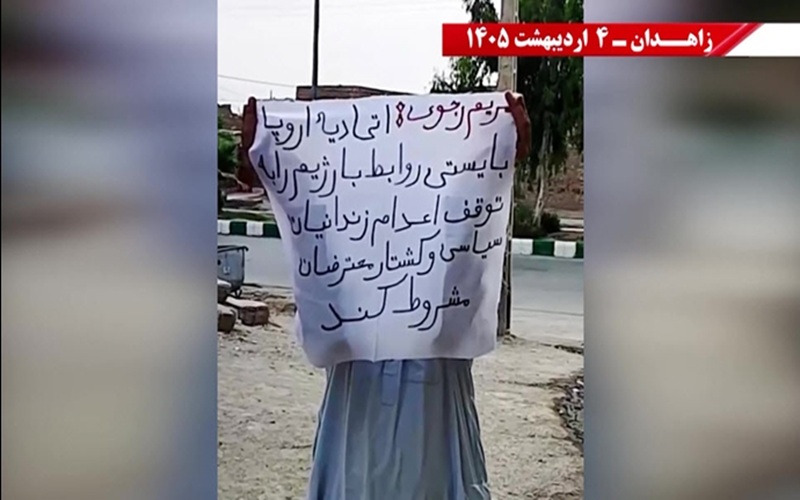

A surge in executions reveals a strategy not of strength, but of fear—aimed at preempting dissent and silencing a generation
Look closely at the pattern. This is not an isolated sequence of judicial acts—it is a coordinated policy.
Within days: Amer Ramesh executed on April 26. Erfan Kiani on April 25. Hamed Validi and Mohammad Masoum-Shahi—identified as members of resistance units—on April 20. Before them, at least sixteen more young individuals and alleged dissidents executed in mid-April.
This is not a list. It is a roadmap.
What emerges is the operational logic of the Iran regime under pressure: a system that, confronted with the specter of internal uprising, has turned to executions as an instrument of anticipatory repression. Under the shadow of war, the regime is not merely reacting—it is preempting.
The case of Amer Ramesh is illustrative. Born in 2004, he was arrested three years ago on charges of bomb placement and ambush against security forces. His execution now, in the midst of heightened military tensions, is not incidental timing. It reflects a deliberate convergence of wartime conditions and domestic control strategy. Similarly, Erfan Kiani was executed on charges the regime frames as “leading uprisings”—a label that effectively criminalizes dissent itself.
This pattern has not gone unnoticed internationally. The German publication Frankfurter Rundschau explicitly noted that the Iran regime is exploiting wartime conditions to accelerate the execution of political prisoners. It cited Franz Josef Jung, who warned that these executions serve a preventive function: eliminating individuals perceived as future threats once the war subsides.
Even more telling is the regime’s own implicit acknowledgment of its vulnerability. Despite internet shutdowns and heavy censorship, reports continue to surface of armed opposition activities targeting facilities linked to the Islamic Revolutionary Guard Corps and intelligence services. According to the same reporting, just one week prior to the outbreak of war, hundreds of opposition members reportedly attacked a key regime site in Tehran.
This is the crux of the matter: the executions are not about the present—they are about the future.
The Iran regime is attempting to neutralize what it perceives as the next wave of organized resistance. Each execution serves a dual function within its coercive apparatus: first, to instill fear and suppress societal mobilization; second, to reinforce morale among its own increasingly strained security forces.
Yet this strategy reveals more fragility than power. A state confident in its legitimacy does not need to execute its youth en masse under the cover of war. What we are witnessing is not the projection of strength, but the manifestation of systemic insecurity—an acknowledgment that the regime’s primary battlefield is not external, but domestic.
For years, waves of protests and organized resistance have pushed the system to the brink. The current escalation suggests that the regime has internalized a key lesson: that its most serious threat does not come from foreign adversaries, but from a politically awakened and defiant population.
The message behind these executions is stark. The regime is attempting to wage war against its own future—to extinguish the very forces that could reshape Iran’s political trajectory.
History, however, offers a consistent counterpoint: futures are not so easily erased.
You can imprison individuals, suppress movements, and execute dissenters—but you cannot eliminate the underlying conditions that produce them.
The Iran regime may continue to escalate its use of capital punishment as a tool of governance. But in doing so, it underscores a fundamental truth: it is not eliminating threats—it is confirming them.