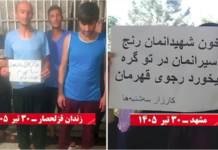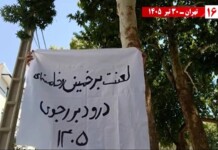
From Qezel Hesar Prison, veteran dissident Ali Moezi declares that the announcement of a provisional government marks the beginning of the end of a century of dictatorship in Iran.
In a defiant message from Qezel Hesar Prison dated March 2026, veteran political prisoner Ali Moezi declared that Iran has entered a decisive new chapter in its modern history.
Moezi links this turning point to the announcement of a provisional government by the National Council of Resistance of Iran (NCRI), aimed at transferring sovereignty to the Iranian people and establishing a democratic republic based on the Ten-Point Plan of Maryam Rajavi.
“With the announcement of the provisional government… we have entered a new stage in Iran’s history,” Moezi writes. “A stage in which we can and must bring an end to a hundred years of dictatorship—of Shah and Sheikh—once and for all.”
A Century of “Shah and Mullah”
Moezi frames Iran’s contemporary struggle as the culmination of a century-long cycle of autocracy, encompassing both monarchical and clerical rule. In a striking metaphor, he declares: “The head of the snake has been struck, and soon the volcano of the people’s anger will erupt.”
From inside what he calls “the prisons of this futureless and decrepit regime,” he addresses bereaved families and supporters across the country, praising those who, in commemorating their loved ones, “placed the brand of ‘no surrender’ and ‘no bowing’ on the heart of the clerical dictatorship.”
Four Decades of Prison Resistance
Moezi’s testimony spans multiple generations of political prisoners. He recalls figures from the 1980s, including Mohsen Vazin, transferred from Qezel Hesar to solitary confinement in Gohardasht; his former university colleague Sadegh Rezvani, who sent word: “Do not fear execution”; and Morteza Emami, about whom the notorious prosecutor said, “This is an influential individual—he will not give you a single word,” and who reportedly demanded, “Take me to the hills of Evin and execute me.”
He also remembers Ali Darzi, re-arrested and executed in 1988 after previously being released, as well as dissidents from later decades such as Ali Saremi, Jafar Kazemi, and Gholamreza Khosravi, the latter enduring “40 months in solitary confinement and two years under a final death sentence.”
From the 2010s, he names Kurdish prisoners Zanyar and Loghman Moradi as examples of resilience. Each, he writes, “revived their environment,” embodying “courage, faith, perseverance, and humanity.”
A New Generation: The “Resistance Units”
According to Moezi, a qualitative shift occurred after 2022, with the rise of what he calls “a new phenomenon of courage and uncompromising resistance”—organized “Resistance Units.” He highlights individuals such as Mehdi Hassani and Behrouz Ehsani, who, he writes, “considered solitary confinement, prison, torture, and execution as nothing.”
Here, Moezi invokes the words of Mousa Khiabani: “The banner of the Mojahedin’s ideals passed from hand to hand, but it never fell to the ground; each time it was raised higher on a loftier summit in the hands of the next generation.”
He describes sharing prison wards with “educated and extraordinarily brave young men” from these units—many currently under death sentences. Their defiance in court, he suggests, reflects a conscious political commitment rather than youthful impulsiveness.
When asked, “Do you regret it?” one reportedly replied: “No, I am not regretful at all—I am proud.”
“Was it youthful excitement?”
“No, it was deliberate and conscious, with determination and will.”
“If you are freed, what will you do?”
“Even if I die and come back to life a hundred times, I will continue this path.”
“Do you accept the organization?”
“I have been, am, and will be a supporter of the proud Mojahedin Organization of Iran.”
“Neither Monarchy nor Theocracy”
Moezi recounts a recent episode in which a young political prisoner, transferred to a hospital under guard, was surrounded by patients and staff once they learned he faced execution.
“What did you do?” someone asked.
“I was in a Resistance Unit.”
“What does that mean?”
“Those who go and set fire to symbols of dictatorship—right?” another person interjected.
“Yes.”
“What centers do you target?”
“Repressive centers of the IRGC and Basij.”
“What sentence did you receive?”
“Execution.”
“They dare not,” someone responded.
“What are you seeking?”
“Freedom for the people and a democratic republic. We want neither monarchy nor velayat-e faqih.”
Before returning to the ward, the young prisoner reportedly chanted aloud three times:
“Death to the oppressor, whether Shah or Leader—Hail to Rajavi.”
“Victory Is Ours”
For Moezi, the nationwide protests of recent months confirm that this new generation has multiplied beyond the prisons’ walls. He describes a movement determined “to bring freedom to our afflicted homeland, to the blindness of Shah and Sheikh alike.”
His conclusion is unequivocal: “Through companionship with this steely and mostly young generation, my faith has turned into certainty—that victory is ours, that tomorrow belongs to us.”
From behind the walls of Qezel Hesar, Moezi’s message seeks to portray continuity rather than rupture: a struggle carried across decades, from execution grounds in the 1980s to courtrooms and protest squares today. Whether his prediction of imminent transformation proves accurate remains to be seen. But his declaration leaves no doubt about his conviction that Iran stands at a historic crossroads—and that, in his words, “we have entered a new stage in Iran’s history.”