Mai Sato’s report to the UN General Assembly describes thousands killed, at least 29 executions linked to January’s protests, more than 4,000 reported arrests on national-security charges, and worsening economic hardship as the regime intensifies its crackdown.
UN Report: War Has Intensified the Iranian Regime’s Repression
A new report submitted to the United Nations General Assembly documents a deepening human rights crisis in Iran, where military conflict has coincided with continued executions, mass arrests, restrictions on civil society, and worsening living conditions.
In her report covering February 1 to August 31, 2026, Mai Sato, the UN Special Rapporteur on the situation of human rights in Iran, describes a population caught between external military attacks and internal repression. The report concludes that the two sources of harm have compounded one another, while the Iranian regime has used wartime conditions to intensify its crackdown on dissent.
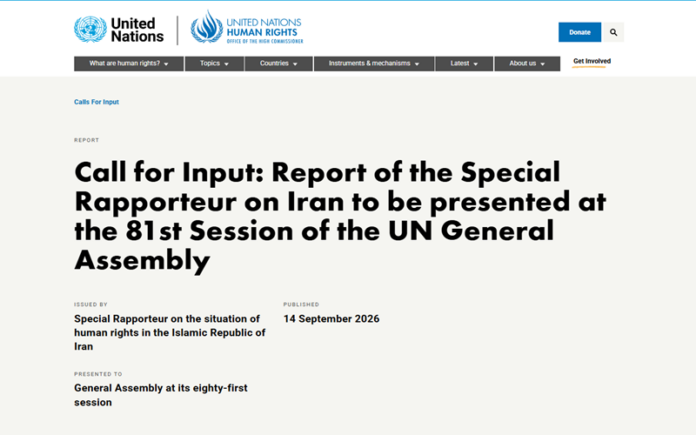
Presented in document A/81/371 and transmitted by the UN Secretary-General on September 14, the report documents killings during the December 2025–January 2026 protests, executions that continued during the war, arrests on national-security charges, secret detention, and serious restrictions on access to information.
“The war has not loosened the Iranian authorities’ repression of its own population; it has tightened it,” Sato writes in the report’s conclusion.
The report also stresses that the documented cases represent only part of the abuses that have occurred. Internet shutdowns obstructed the transmission of information, while some witnesses withdrew their consent to provide information because they feared consequences for themselves or their families.
At Least 29 Protest-Related Executions as Capital Punishment Continues
The report states that at least 29 people were executed in connection with their participation in the January 2026 protests, including at least five in public. Executions continued during the armed conflict rather than being suspended in response to the crisis.
Authorities increasingly used national-security legislation concerning espionage and cooperation with hostile states to prosecute people accused of dissent. The report warns that wartime provisions have been applied to domestic opposition, recasting protesters as agents of the United States and Israel.
However, protest-related executions account for only a fraction of the overall use of capital punishment. Independent human rights organizations recorded hundreds of executions during the reporting period, although their totals differ because of limited information and difficulties documenting cases.
The report cites figures ranging from 444 executions recorded by Iran Human Rights between January and July to 950 recorded by the Abdorrahman Boroumand Center for Human Rights in Iran between January and August.
More than 80 percent of known executions involved qisas, or retribution in kind, and drug-related offenses. Sato emphasizes that international human rights law restricts capital punishment to crimes involving intentional killing and reiterates that the application of qisas is incompatible with the International Covenant on Civil and Political Rights.
The report also highlights the execution of an 18-year-old for a murder allegedly committed when he was 14, in violation of the international prohibition on executing people for offenses committed as children.
Kurds and Baluch people continued to face disproportionate execution rates. The report records at least 56 executions of Kurds between January and early August and at least 41 executions of Baluch people during the same period, according to figures supplied by Hengaw Organization for Human Rights.
Resistance to executions has continued inside and outside prisons. The report notes that a 16-day strike at Ghezel Hesar Prison reportedly led to the suspension of drug-related executions there, while the weekly “No Death Penalty Tuesdays” campaign persisted.
Sato calls on the Iranian authorities to establish a moratorium on executions with a view to abolishing capital punishment altogether and to end public executions immediately.
More Than 4,000 Arrests and Secret Detention
The crackdown extended well beyond people directly involved in demonstrations.
According to information cited in the report, more than 4,000 arrests on national-security charges were reported between February 28 and May 9, 2026. Those detained included protesters, perceived dissidents, human rights defenders, lawyers, journalists, teachers, artists, children, and members of ethnic and religious minorities.
Authorities accused detainees of collusion against the state and cooperation with the United States and Israel. Religious minorities were also targeted: Baha’is were accused of links to Israel, Christian converts were arrested under labels such as “Mossad mercenaries,” and Afghans were portrayed as Israeli spies.
The report expresses particular concern about people held in unofficial or undisclosed detention facilities. Some detainees were reportedly held incommunicado, without being informed of the reasons for their arrest or being granted access to legal counsel. Their families were left without information about their fate or whereabouts.
Sato warns that refusing to acknowledge detention or disclose a detainee’s location can amount to enforced disappearance, exposing people to heightened risks of torture, death in custody, or secret execution.
The report also describes a deterioration in fair-trial guarantees. Lawyers have faced restrictions on access to case files and confidential communication with clients, while Revolutionary Court proceedings have been conducted behind closed doors.
In some cases, hearings lasted only minutes, proceedings concluded within days, and confessions widely regarded as forced were broadcast on state media shortly after arrests. Such broadcasts undermine the presumption of innocence, the report says.
Collective trials have raised further concerns. In the Alikhani Square case in Isfahan, 12 of 34 adult defendants were sentenced to death, and five were executed. The hearings for all 34 adults lasted five days in total, leaving only a few hours at most for each defendant facing capital charges.
Sato argues that such compressed proceedings cannot adequately establish individual criminal responsibility and render death sentences arbitrary.
Families of Protest Victims Face Intimidation
The aftermath of the January protests continues to affect families of those killed by security forces.
According to the report, relatives have faced pressure not to disclose that security forces killed their family members. Some families were prohibited from holding public funerals, while others reportedly faced dismissal from public-sector jobs after a relative’s participation in protests became known.
The report notes that the UN Independent International Fact-Finding Mission on Iran found reasonable grounds to believe that many violations committed during the crackdown amounted to crimes against humanity, including murder, imprisonment, torture, and other inhumane acts as part of a widespread and systematic attack against a civilian population.
Sato also documents reports of unlawful killings beyond the protests, including the shooting of Kurdish border couriers and Baluch fuel porters by security forces. In some cases, families were given explanations contradicted by forensic evidence.
The report states that the Special Rapporteur had not been informed of investigations into these cases or the other reported killings brought to her attention since she assumed the mandate.
It calls for prompt, independent, and impartial investigations into deaths caused by state forces, the publication of findings, and prosecution of those responsible.
Internet Shutdowns Conceal Abuses and Deepen Economic Hardship
The report identifies telecommunications shutdowns as a central instrument of repression, with consequences extending into employment, household finances, and access to information.
Internet connectivity was cut for 21 days after the protests began and for a further 88 days after the military strikes began, falling to between 1 and 4 percent of normal levels during the latter shutdown.
The restrictions impeded the documentation of human rights violations while also disrupting businesses, employment, banking, and communications between prisoners and their families.
Access was not restored equally. The report says the number of “White SIM cards” exempt from filtering rose from fewer than 3,000 to approximately 50,000, while a paid “Internet Pro” tier was introduced for selected occupations. Other users were left dependent on costly and unstable virtual private networks.
Sato concludes that connectivity was treated as a privilege and a means of controlling public information rather than as an essential service. She states that the restrictions violated the rights to work and to an adequate standard of living.
The economic consequences have been severe. Preliminary estimates cited in the report put losses from US and Israeli strikes at more than $270 billion, equivalent to around 90 percent of Iran’s gross domestic product. The UN Development Programme projected that an additional 3.5 million to 4.1 million people could fall below the $8.30-a-day poverty line, pushing the poverty rate toward 41 percent.
But the report also points to years of policy decisions that had left households vulnerable before the first strikes. It rejects the idea that external military attacks and sanctions alone explain the crisis.
Food and beverage prices rose 134 percent in the year to June 2026, according to information cited in the report. Prices increased for approximately 80 percent of medicines, while out-of-pocket payments accounted for 55 percent of health expenditure.
A household consumption basket was estimated to cost 70 million tomans a month. In a survey of 56 households, mostly in Kurdistan, nearly four in five had postponed medical treatment or the purchase of medicines, three in four had taken on debt, and almost none had received state assistance.
Informal workers, women-headed households, and small businesses were particularly vulnerable. The report says that approximately 39 percent of the workforce was employed informally or on contracts, leaving many outside wartime employment protections. Women who depended on home-based businesses and online work also suffered disproportionately from the loss of connectivity.
Human Rights Defenders and Independent Lawyers Under Pressure
The crackdown has also targeted those attempting to document abuses or defend people facing prosecution.
At least 60 teachers and teachers’ union activists were reportedly arbitrarily detained in 2026 in connection with protests or peaceful civic activity. At least 32 lawyers had reportedly been detained, prosecuted, convicted, or imprisoned since the protests.
Lawyers representing protesters faced threats of arrest, prosecution, or the loss of their professional licenses. Those who continued their work encountered restrictions on access to case files, confidential communication with clients, and effective participation in court proceedings.
The report further states that judicial authorities initiated measures to identify, freeze, and confiscate the assets of at least 400 people, including Iranians living abroad, among them journalists, media workers, cultural figures, and political activists.
Sato describes these measures as part of a broader effort to make defending human rights, documenting abuses, and mobilizing civic activity too costly to continue.
She calls for the immediate and unconditional release of people detained for peacefully exercising their rights, including protesters, lawyers, journalists, teachers, artists, and human rights defenders. She also urges the authorities to repeal legislation that unduly restricts civic space and to end reprisals against those who represent defendants.
UN Calls for Accountability by Iranian Authorities and Military Powers
The report addresses violations by both the Iranian authorities and the United States and Israel, calling for accountability from all parties.
It records more than 3,000 reported fatalities from US and Israeli strikes as of March 31, with Iranian authorities identifying 1,574 as civilians, including 236 children. The report highlights the strike on the Shajareh Tayyebeh primary school in Minab, which killed at least 156 people, including approximately 120 schoolchildren, teachers, staff, and parents.
The UN Independent International Fact-Finding Mission found reasonable grounds to believe that the US strike on the school constituted the war crime of launching an indiscriminate attack. The Special Rapporteur said she saw no reason to depart from that finding. The United States had not published the findings of its acknowledged investigation by the time the report was prepared.
The report also describes strikes on water infrastructure, industrial facilities, and areas near a children’s cancer hospital, with consequences for access to drinking water, healthcare, employment, and the environment.
Sato calls on the United States and Israel to cease military strikes, investigate their legality and targeting, publish their findings, and provide accountability and reparations where violations are established.
At the same time, she urges the Iranian authorities to stop executions, investigate killings by security forces, release people detained for peaceful dissent, end enforced disappearances, restore unrestricted internet access, and protect civilians and prisoners during armed conflict.
She also calls on all states to preserve evidence of violations, support accountability mechanisms, protect human rights defenders at risk, and ensure that sanctions include effective humanitarian exemptions for medicines, medical equipment, and essential goods.
A Crisis That Cannot Be Resolved Without Accountability
The central finding of the report is that the war did not suspend the Iranian regime’s domestic repression. Instead, wartime measures were used to intensify the criminalization of dissent, conceal executions and disappearances, and restrict the flow of information.
At the same time, military attacks deepened an economic crisis that had already left millions vulnerable to poverty, rising food prices, and unaffordable healthcare.
The report warns that the absence of investigations into unlawful killings and other serious violations allows impunity to become entrenched. It emphasizes the importance of evidence collected by survivors, families, and civil society organizations, often at considerable personal risk.
Its findings present a stark picture of a population facing multiple forms of harm simultaneously: bombardment, executions, arbitrary detention, economic insecurity, and restrictions on basic freedoms.
The report’s recommendations make clear that protecting civilians and addressing human rights violations require action by all parties. For Iran’s population, however, ending the regime’s repression, securing accountability for past abuses, and restoring fundamental freedoms remain urgent priorities.