


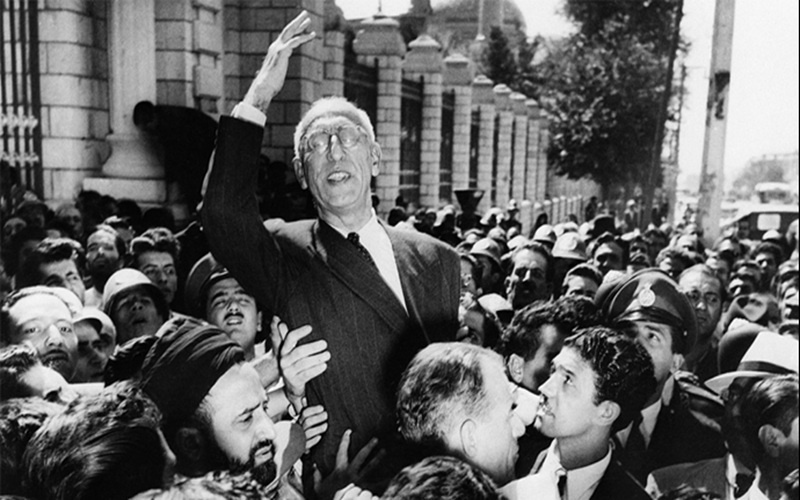

The 1952 popular uprising in defense of Prime Minister Mohammad Mosaddeq demonstrated the Iranian people’s determination to defeat royal dictatorship—a legacy that continues to shape their rejection of all forms of authoritarian rule.
A Turning Point in Iran’s Democratic Struggle
The 30 Tir Uprising of July 21, 1952, stands as one of the defining moments in Iran’s modern history. On that day, hundreds of thousands of Iranians took to the streets under the slogan “Either Death or Mosaddeq”, confronting the armed forces of the Pahlavi monarchy in defense of constitutional government, national sovereignty, and democratic rule.
The uprising was more than a protest against a change of government. It represented a national rejection of royal absolutism and foreign interference, proving that the Iranian people were prepared to pay the highest price to defend their right to determine their own future.
Today, more than seven decades later, the events of 30 Tir remain a powerful reminder that Iran’s struggle has never been between one ruling elite and another. It has been a struggle against dictatorship itself.
The Road to 30 Tir
The roots of the uprising lay in Iran’s long campaign to reclaim control over its natural resources and political independence.
For decades, Iran’s oil wealth had been dominated by unequal agreements with foreign powers. The concessions granted under the 1901 D’Arcy Agreement and later reinforced during the reign of Reza Shah left Iran’s vast petroleum resources largely under foreign control while much of the population lived in poverty.
Prime Minister Mohammad Mosaddeq emerged as the leading figure challenging this system. Through his efforts in parliament and his leadership of the national movement, Iran nationalized its oil industry in March 1951, ending the monopoly of foreign oil interests and asserting the country’s sovereign rights.
His government quickly came under pressure from both external powers and the royal court, which viewed his reforms as a direct challenge to the Shah’s authority.
The People Stand Against the Shah
The immediate crisis began when Mosaddeq resigned after Shah Mohammad Reza Pahlavi refused his request to place the armed forces under civilian authority by allowing him to appoint the minister of war.
The Shah replaced him with Ahmad Qavam, whose government threatened severe repression against any opposition.
Instead of intimidating the population, the threats ignited nationwide resistance.
On 30 Tir 1331 (July 21, 1952), businesses closed across Tehran and other cities. Workers, merchants, students, drivers, and citizens from all walks of life flooded the streets chanting:
- “Either Death or Mosaddeq”
- “Mosaddeq Will Prevail”
- “Death to Qavam”
The monarchy responded with military force. Soldiers opened fire on unarmed demonstrators, killing and wounding hundreds.
Despite the bloodshed, the uprising succeeded.
Facing overwhelming public resistance, the Shah was forced to dismiss Qavam and restore Mosaddeq as prime minister.
The victory demonstrated that organized popular resistance could compel even an entrenched dictatorship to retreat.
A Lasting Rejection of Dictatorship
Mosaddeq never forgot the sacrifice of those who lost their lives during the uprising. He wished to be buried alongside the victims of 30 Tir and later described the day as unforgettable because Iranians from every social class united in defense of national independence.
The events of 30 Tir carry another important historical lesson.
The uprising showed that the Iranian people rejected the concentration of power in the monarchy and demanded accountable government based on the will of the people.
That legacy remains highly relevant today.
As various political figures seek to revive or rehabilitate the image of the former monarchy—including efforts by Reza Pahlavi to present himself as an alternative to the current regime—the historical record tells a different story. The people who filled Iran’s streets in July 1952 were not fighting to preserve royal rule; they were risking their lives to curb the Shah’s authority and defend democratic governance.
The 30 Tir Uprising stands as enduring evidence that Iran’s democratic aspirations have long been incompatible with authoritarian monarchy.
Lessons from History
While the uprising achieved a major victory, the military coup of August 1953 exposed the vulnerabilities of a popular movement lacking sufficient organizational structures to withstand coordinated domestic and foreign intervention.
The overthrow of Mosaddeq underscored the importance of organized political resistance capable of protecting democratic gains against authoritarian restoration.
Mosaddeq himself recognized this challenge in later years. Reflecting on liberation movements elsewhere, including Algeria’s struggle for independence, he emphasized that nations seeking freedom must be prepared to make sustained sacrifices in pursuit of liberty and sovereignty.
The Democratic Aspirations Continue
The legacy of 30 Tir extends far beyond a single historical event.
It embodies the Iranian people’s enduring commitment to freedom, national independence, and representative government.
Over the decades, Iranians have repeatedly demonstrated that their opposition is not merely directed at one particular regime but at dictatorship in all its forms—whether exercised in the name of monarchy or theocracy.
This consistent demand has echoed through successive generations, from the Constitutional Revolution to the National Movement, from the struggle against the Shah’s dictatorship to contemporary calls for a democratic republic based on popular sovereignty, political pluralism, and respect for fundamental human rights.
The Enduring Meaning of 30 Tir
The 30 Tir Uprising remains one of the clearest expressions of the Iranian people’s determination to shape their own destiny.
Its legacy is not simply the restoration of a prime minister, but the affirmation of a principle: no ruler stands above the will of the people.
More than seventy years later, that principle continues to resonate. The events of July 1952 remind the world that the Iranian people have repeatedly rejected authoritarian rule and continue to aspire to a future founded on democracy, the rule of law, and popular sovereignty rather than the return of any form of dictatorship, whether monarchical or religious.