


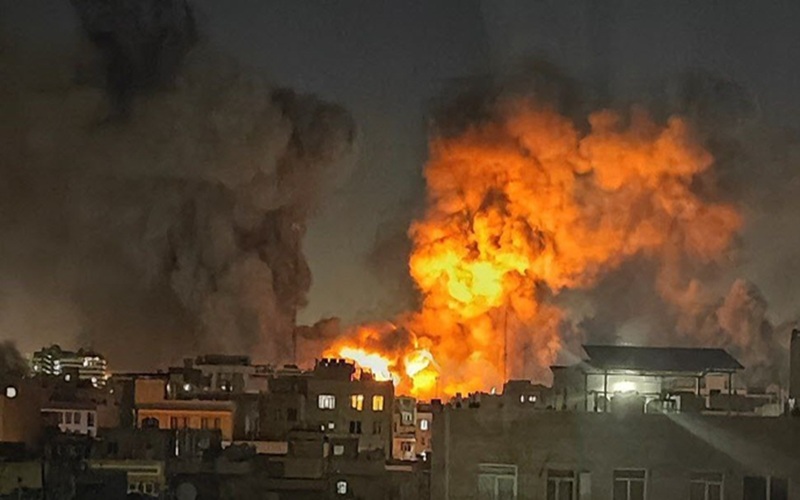

A long-standing policy aimed at avoiding war ultimately strengthened authoritarian rule in Tehran and helped pave the way for deeper regional conflict.
For more than four decades, the Iranian Resistance has warned that the ultimate outcome of the international policy of appeasement toward Iran’s clerical regime would not be stability or peace, but rather the eruption of broader conflict. Today, the unfolding realities in the region appear to confirm those warnings.
In political science, appeasement refers to the strategy of making concessions to an authoritarian or aggressive power in the hope of moderating its behavior and preventing escalation. The underlying assumption is that accommodating such regimes—by reducing pressure or offering incentives—will persuade them to abandon destabilizing policies.
In the case of Iran’s ruling clerical establishment, however, this doctrine has repeatedly failed. Since the establishment of the Islamic Republic in 1979 under Ruhollah Khomeini, appeasement gradually became a central component of international engagement with Tehran. The expectation among many policymakers was that dialogue, concessions, and economic incentives would gradually “tame” the revolutionary regime.
Instead, critics argue, the policy often obscured the regime’s core ideological foundations and strategic objectives.
Appeasement as a Strategy to Avoid War
Supporters of appeasement frequently justified the policy as a pragmatic means of preventing war at the lowest possible cost. The belief was that compromise could defuse tensions and encourage moderation within the Iranian leadership.
Yet appeasement, by its nature, is inherently unstable. Like a fragile bubble, it can collapse the moment the underlying assumptions prove false. The emergence of open conflict involving Iran’s ruling establishment has now forced many observers to reconsider whether decades of concessions merely postponed—and ultimately worsened—the crisis.
Over the years, critics say the policy effectively prolonged the survival of a system that relies heavily on repression at home and confrontation abroad. Iran’s regional strategy—characterized by the support of proxy militias, missile programs, and armed interventions—has imposed heavy costs not only on Iranians but also on numerous countries across the Middle East.
Early Roots of the Policy
The origins of appeasement toward Tehran can be traced back to the early years of the Islamic Republic. Following the 1979 revolution and the seizure of the U.S. embassy in Tehran, many Western governments adopted cautious engagement in hopes of stabilizing relations.
This approach continued through the Iran–Iraq war of the 1980s, when controversial episodes such as covert arms transfers—later associated with the Iran-Contra affair—reflected attempts to influence internal dynamics within the regime.
At the time, some policymakers believed that strengthening so-called “moderate” factions inside the system could gradually reshape its behavior. Figures such as Akbar Hashemi Rafsanjani were often portrayed as pragmatic actors capable of steering the regime toward moderation.
In practice, however, these assumptions often proved overly optimistic.
The “Moderation” Narrative
The same pattern continued during the presidencies of Mohammad Khatami and later Hassan Rouhani. Both leaders were widely presented internationally as reformist or moderate alternatives within the Islamic Republic.
Their administrations became focal points for renewed diplomatic engagement, culminating in the 2015 nuclear agreement known as the Joint Comprehensive Plan of Action.
Following that agreement, Iran gained access to significant financial resources through sanctions relief and renewed economic cooperation. Estimates suggested that tens of billions of dollars flowed back into the country’s economy.
Critics argue that much of this revenue did not translate into improved living conditions, expanded civil liberties, or structural economic reforms. Instead, they contend, substantial resources were directed toward strategic programs prioritized by Supreme Leader Ali Khamenei, including missile development, nuclear infrastructure, and support for regional proxy networks.
The Strategic Costs of Appeasement
From this perspective, appeasement did not moderate the regime’s conduct but rather emboldened it. When authoritarian systems face limited consequences for coercive tactics—whether hostage-taking, regional militancy, or domestic repression—they may interpret concessions as signs of weakness rather than goodwill.
As a result, demands tend to escalate. Each round of concessions can encourage further pressure tactics designed to extract additional gains.
The current crisis surrounding Iran’s military ambitions and regional activities illustrates this dynamic. Critics maintain that decades of accommodation allowed Tehran to expand its strategic capabilities while avoiding decisive international pressure.
A Different Path Forward
The lesson drawn by opponents of appeasement is not merely historical but strategic. In their view, sustainable stability in Iran cannot be achieved through concessions to authoritarian rule but through support for democratic change and respect for the will of the Iranian people.
Advocates of what they describe as a “third option” argue that neither foreign military intervention nor accommodation with the ruling system offers a viable solution. Instead, they emphasize political transformation driven by Iranian society itself and supported by democratic principles.
This perspective has long been articulated by leaders of the Iranian Resistance, including Massoud Rajavi, who has argued that the ideological structure of the clerical system leaves little room for genuine reform. According to this view, attempts to negotiate fundamental change within the framework of the current regime are unlikely to succeed.
Whether or not one accepts that conclusion, the experience of the past four decades raises an unavoidable question: can a policy designed to contain authoritarian power succeed when that very power depends on confrontation and expansion to sustain itself?
For many observers, the unfolding events in Iran and the wider region suggest that this question can no longer be avoided.