


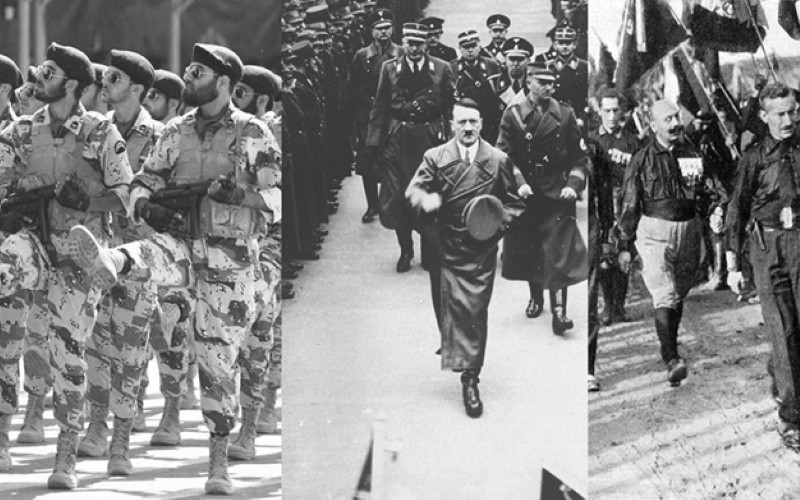

In Iran’s contemporary political geography, the Islamic Revolutionary Guard Corps (IRGC) is not a conventional military force tasked with defending national borders. It is the structural backbone of a totalitarian system whose survival depends on two pillars: internal repression and exported terrorism. This raises a fundamental question that Western diplomacy continues to evade: Is designating the IRGC as a terrorist organization the endgame—or merely the prelude to a far more consequential historical step?
At the heart of this question lies a deeper demand increasingly voiced by Iran’s resistance movement and protest generation alike: the complete dissolution of the IRGC. This is not a radical slogan born of emotion, but a political necessity rooted in history, structure, and lived experience. Iran’s transition to democracy does not pass through reforming this institution, but through dismantling it entirely.
A Fascist DNA, Not a National Army
To understand the IRGC’s true nature, one must examine its structural resemblance to the ideological guard units of 20th-century fascist regimes. The IRGC plays in Iran precisely the role once occupied by the SS under Heinrich Himmler in Nazi Germany, or the Blackshirts in Mussolini’s Italy. These forces were never meant to protect a nation; they existed to safeguard an ideology and the person of the supreme leader.
Ruhollah Khomeini, the regime’s founder, understood that a conventional army might, at a decisive historical moment, side with the people. The IRGC was therefore created as a praetorian guard of clerical absolutism—an ideologically purified force designed to suppress society, not defend it. Even its emblem, conspicuously devoid of Iran’s name or any national symbol, testifies to its transnational, doctrinal identity.
From its earliest days, the IRGC proved its loyalty not to the Iranian people but to religious fascism, through bloody crackdowns in Kurdistan, Turkmen Sahra, and Khuzestan. Repression was not an aberration; it was the mission.
A Military-Economic Octopus Occupying the State
The IRGC is not merely a killing machine. It is a vast mafia cartel that has seized Iran’s economic arteries. From monopolizing imports and exports to large-scale money laundering, from controlling banks to involvement in narcotics trafficking, its operations function under the direct patronage of the Supreme Leader’s office.
Environmentally, the IRGC has acted as an internal occupier of Iran’s natural resources—devastating ecosystems through reckless dam projects, deforestation, and predatory contracting schemes. National wealth that should alleviate poverty is instead funneled into sustaining regional mercenaries and insulating the regime from overthrow.
In this sense, the IRGC is not only the enemy of political freedom, but of economic justice, environmental survival, and national sovereignty.
Terrorist Designation: Necessary, but Not Sufficient
The designation of the IRGC as a terrorist organization by the United States, Canada, and—partially—by the European Union is the result of decades of exposure and documentation by Iran’s resistance and freedom-seeking activists. It represents a severe blow to the regime’s diplomatic façade.
But political realism demands honesty: this step alone is not enough.
The first explicit call for the dissolution of the IRGC was articulated on August 15, 2020, by Massoud Rajavi, opening a new horizon in Iran’s political struggle. In a subsequent message on May 24, 2022, he emphasized that the IRGC is the regime’s central organ of coercion and that its massive budget must be returned to the empty tables of the Iranian people.
This demand has since been codified as a non-negotiable principle—Article 2 of Maryam Rajavi’s Ten-Point Plan—underscoring a simple truth: freedom in Iran is impossible without dismantling the entire apparatus of repression, including the IRGC, the Basij, plainclothes enforcers, and the Quds Force.
History Offers No Shortcuts
No fascist system has ever surrendered freedom voluntarily. Institutions whose raison d’être is torture, judicial terror, and the violent suppression of uprisings do not dissolve themselves through dialogue or diplomacy.
The force that will bring about the IRGC’s dissolution is not goodwill, but the organized will of resistance—the uprising youth, the resistance units, and the National Liberation Army of Iran. History is instructive: the Shah’s Imperial Guard collapsed in February 1979 under popular fury; Hitler’s war machine ultimately crumbled under the combined pressure of resistance and external confrontation.
The IRGC will meet the same fate.
Dissolution Is Not an Option—It Is a Condition for Survival
The dissolution of the IRGC is not a political choice among many. It is the only path to breathing life back into Iran’s half-strangled society. This process has already begun—not in negotiating rooms, but in the fires of uprising—and it will culminate in the establishment of a democratic republic grounded in popular sovereignty, not clerical terror.
Anything less is an illusion.