


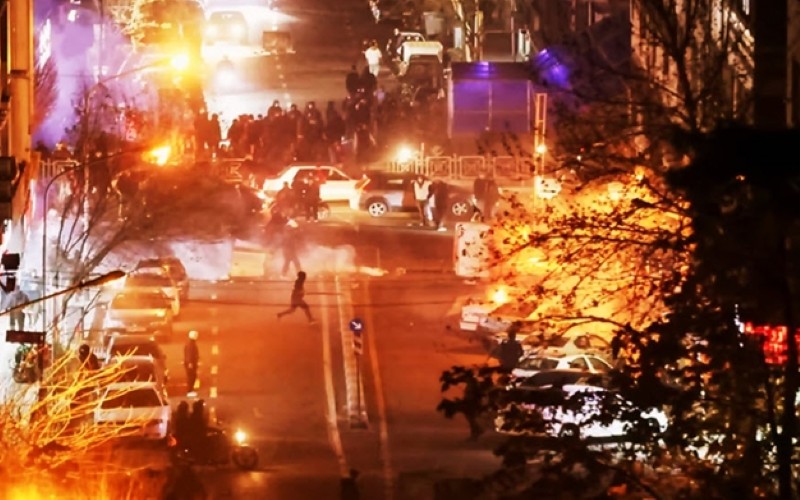

From Arak to Mashhad, Popular Uprisings Challenge the Regime’s Killing Machine (January 8–10, 2026)
A Nation in Revolt: Three Days of Fire and Resistance
From January 8 to January 10, 2026, Iran witnessed a wave of coordinated urban resistance stretching from Tehran and Mashhad to Arak, Isfahan, Hamadan, Zanjan, and smaller cities. Field reports indicate that ordinary citizens—largely empty-handed and without military equipment—stood their ground against a regime that responded with live ammunition, mass arrests, and ruthless violence.
The Iranian regime, relying on the IRGC, Basij, and Special Units, attempted to crush the uprising through overwhelming force. Yet across dozens of locations, protesters disrupted troop movements, dismantled surveillance infrastructure, and temporarily reclaimed streets from the regime’s security apparatus.
This confrontation laid bare a stark imbalance: a population resisting with fire, stones, and barricades versus a regime killing with firearms and armored units.
Tehran: Streets Turned into Frontlines (January 8–9, 2026)
In the capital, resistance actions intensified throughout January 8 and 9:
- Tehran (January 9, 2026): Protesters set fire to a Basij base, widely regarded as a symbol of repression and neighborhood surveillance.
- Tehranpars (January 8, 2026): Roads were blocked using fire to halt the advance of regime forces.
- Sattarkhan (January 9, 2026): Protesters erected fiery barricades, preventing security units from entering residential areas.
- Sadeghieh (January 9, 2026): Regime forces were denied access as residents closed off streets under firelight.
Despite the regime’s use of armed units, witnesses report that protesters were largely unarmed, relying instead on collective action and urban resistance tactics.
Mashhad: Hand-to-Hand Clashes in Vakilabad (January 9–10, 2026)
Mashhad emerged as one of the most intense theaters of confrontation:
- Vakilabad, Mashhad (January 9, 2026): Protesters engaged in close-range, hand-to-hand clashes with regime forces, moving from barricade to barricade under heavy pressure.
- Mashhad (January 10, 2026): A branch of Bank Sepah, widely viewed as tied to the regime’s financial apparatus, was set ablaze.
- Mashhad (January 9, 2026): Streets were blocked using concrete blocks and fire as protesters resisted advancing security units.
Reports indicate that regime forces used lethal weapons, resulting in civilian casualties, while protesters continued to resist despite the imbalance.
Arak, Isfahan, and Central Iran: Surveillance and Control Targeted
- Arak (January 8, 2026): Protesters destroyed surveillance and identification cameras, directly challenging the regime’s control infrastructure.
- Arak (January 2026): Multiple streets were blocked to prevent the movement of repression units.
- Isfahan (January 10, 2026): Protesters shut down access routes and damaged a Bank Mellat branch, a symbol of systemic economic exploitation.
- Semirom (January 9, 2026): Roads were blocked using fire to halt regime forces.
These actions underscored a strategic shift: targeting the tools of repression and economic plunder, not civilians.
Northern and Western Cities: Hit-and-Run Resistance (January 8–10, 2026)
- Zanjan (January 8, 2026): Motorcycles belonging to Special Units were set on fire.
- Alvand, Qazvin (January 8, 2026): Protesters engaged in hit-and-run clashes with regime forces.
- Masal (January 8, 2026): Roads were blocked to prevent troop deployment.
- Mahmoudabad (January 9, 2026): Ongoing street clashes and barricades halted regime movement.
- Mamasani (January 8, 2026): Protesters blocked roads amid clashes with regime forces.
- Hamadan (January 10, 2026): Buses transporting regime reinforcements were set ablaze.
Across these regions, the pattern was consistent: civilians resisting with minimal means, facing a regime that relied on firearms, organized violence, and terror.
A Regime That Shoots, A People That Resist
What unfolded between January 8 and January 10, 2026 was not sporadic unrest but a nationwide uprising. The regime’s response—marked by live fire and indiscriminate killing—reinforced its reliance on violence rather than legitimacy.
Yet the persistence of resistance, even when confronted by armed units, highlights a deeper reality: fear is shifting sides. The regime may control weapons, but the streets increasingly reflect a population unwilling to submit.
These days of uprising revealed a fundamental truth of Iran’s crisis:
an unarmed people demanding dignity versus a regime that survives only through brutality.