


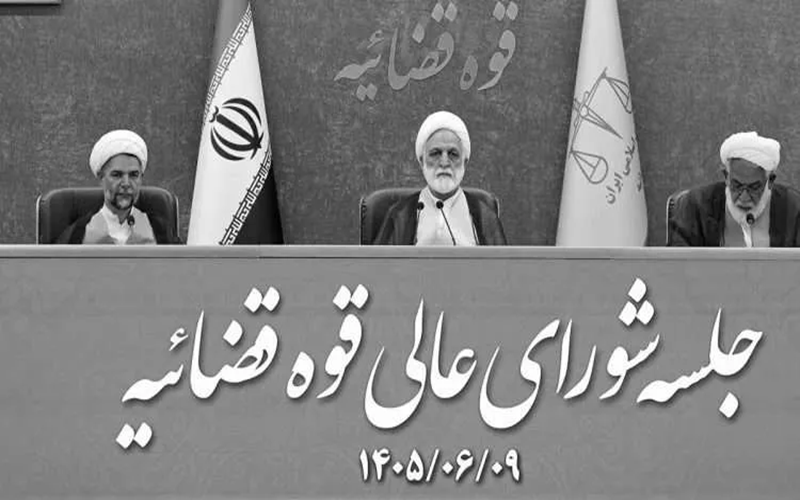

In a strikingly alarmed speech, regime Judiciary Chief Gholam-Hossein Mohseni Ejei openly warned of renewed unrest, exposed fears of internal divisions, and threatened protesters with intensified repression.
The latest remarks by regime Judiciary Chief Gholam-Hossein Mohseni Ejei reveal more than the regime’s familiar threats against its opponents. They expose growing anxiety at the highest levels of power over the possibility of renewed popular uprisings in Iran.
Speaking on Monday, August 31, 2026, during a meeting of the regime’s Judiciary High Council, Ejei devoted a significant portion of his remarks to what he described as efforts by the regime’s “enemies” and their alleged “mercenaries” inside Iran to create unrest.
His language was unusually direct. He warned that if such unrest occurred, the regime would respond with force, emphasizing that intelligence, security and police forces were supposedly at their “highest level of readiness,” while the judiciary would act “more decisively than ever” in prosecuting and punishing those deemed security threats.
Behind this aggressive rhetoric, however, lies a revealing fear: the regime is preparing for the possibility that widespread public anger could once again erupt into nationwide protests.
A Threat Directed at a Restive Society
Ejei claimed that the regime’s enemies were seeking to “disturb the security” of the Iranian people and launch unrest through their alleged agents inside the country.
Yet the language itself exposes the regime’s concern. Rather than addressing the social, economic and political grievances driving public discontent, the judiciary chief framed any future uprising as a security threat requiring punishment.
His warning that the judiciary would respond more forcefully than ever amounts to an explicit threat against anyone who participates in future protests.
The emphasis on the readiness of security and intelligence forces is equally significant. It suggests that the regime anticipates the possibility of renewed unrest and is attempting to deter it in advance through intimidation.
But such threats also reveal the regime’s vulnerability. A government confident in its stability does not normally devote the central message of a judiciary leadership meeting to warning society about a potential uprising.
Ejei Tries to Hide the Regime’s Internal Divisions
Ejei also attempted to project an image of unity at a time when internal disputes have become increasingly difficult to conceal.
He insisted that the population and officials were supposedly “of one mind and one voice” on major issues, including confronting external enemies, maintaining security and protecting national interests. He similarly claimed that there was no disagreement over supporting productive investment, removing obstacles to production and resolving people’s livelihood problems.
The insistence itself is revealing.
Ejei specifically warned against reports and social-media content that, he claimed, were fabricated by “traitors.” His remarks indicate how seriously the regime views the information environment and the growing ability of Iranians to expose its internal disputes.
He then appealed to the need for “national unity and cohesion,” invoking Supreme Leader Mojtaba Khamenei’s repeated warnings about the consequences of division.
The judiciary chief even stressed that criticism should remain “fair” and should not weaken or undermine the regime.
Fear of Social Media and the Collapse of the Regime’s Image
Ejei’s repeated references to social media are particularly significant.
For decades, the regime has relied on censorship and control of information to preserve its political narrative. The expansion of social media and alternative sources of information has made that increasingly difficult.
Iranian society can now rapidly document protests, expose repression, circulate information about government corruption and reveal contradictions among regime officials. The result is a growing gap between the image the regime seeks to project and the reality experienced by the population.
Ejei’s warning against “fabricated” material on social media therefore reflects more than concern about misinformation. It reflects the regime’s fear of losing control over the narrative.
Threats Cannot Resolve the Crisis
Ejei’s speech ultimately illustrates the regime’s familiar strategy: when confronted with mounting social anger, it responds with threats, security measures and punishment rather than addressing the causes of that anger.
His emphasis on the readiness of intelligence, security, police and judicial institutions is particularly telling. The regime appears increasingly preoccupied with preventing another uprising, even as economic hardship, political repression and deepening public dissatisfaction continue to fuel discontent.
The more urgently regime officials insist that there is unity, the more apparent the underlying divisions become. The more they threaten protesters, the more clearly they reveal their fear of them.
Ejei’s remarks therefore provide an unintended glimpse into the regime’s state of mind. Behind the language of strength and readiness is a leadership increasingly worried that another wave of popular resistance could challenge its grip on power—and that neither repression nor control of information can permanently suppress the forces driving that resistance.