


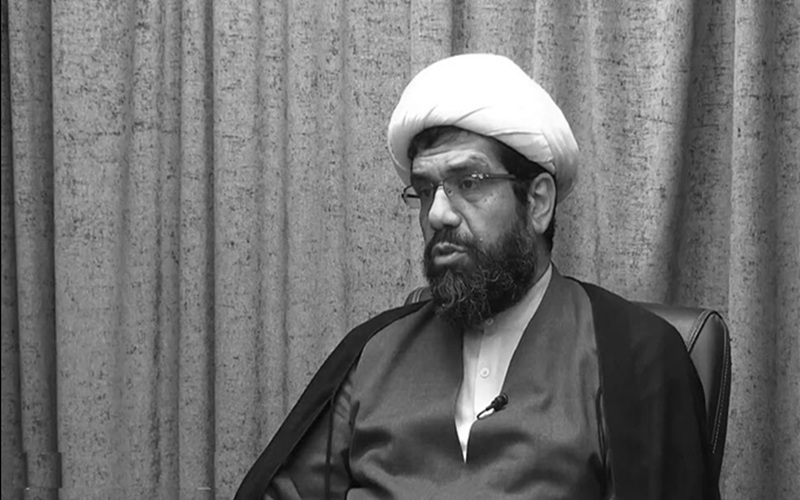

A revealing interview exposes fears inside the regime that the leadership vacuum is allowing political forces to gradually strip the Supreme Leader of his powers—and ultimately undermine the system itself.
The most revealing threats to the Iranian regime are not always articulated by its opponents. Sometimes, they are voiced by those defending the system from within.
A recent interview with cleric Mehdi Abutalebi, a faculty member of the Khomeini Institute, offers an unusually candid glimpse into the regime’s internal anxieties. His concern is not merely factional rivalry, disagreements over negotiations, or disputes between government institutions. It is far more fundamental: the gradual erosion of the principle of Velayat-e Faqih, the cornerstone of the regime’s political structure.
Abutalebi openly warns that political currents inside the regime are attempting to exploit the current absence of the Supreme Leader to weaken his authority.
His warning is striking: “There are currents that want to use this situation to move toward a non-Velayat-e Faqih outlook.”
He then describes what he believes would be the first stage of such a transformation:
“The first steps are definitely to weaken the powers of the Velayat-e Faqih: the Supreme Leader remains, but instead of his decree, institutions make the decisions; the Supreme Leader remains, but instead of his opinion, the opinions of other officials prevail.”
This is perhaps the most politically significant admission in the interview.
The regime fears a gradual erosion, not an immediate abolition
Abutalebi does not appear to believe that opponents inside the establishment will simply announce the abolition of Velayat-e Faqih. His concern is precisely the opposite: that the system could be dismantled incrementally and institutionally.
He explains: “The first step is not to eliminate the principle of Velayat-e Faqih. Rather, it is to gradually weaken the institutions associated with it, replace them, and then little by little…”
The unfinished sentence is revealing in itself.
He is describing a process in which the Supreme Leader formally remains in place while his actual authority is progressively transferred elsewhere. The title survives, but the power attached to it diminishes.
Such a development would strike at the regime’s central political mechanism. The system was constructed around the concept that ultimate political authority belongs to the Velayat-e Faqih. If other institutions begin exercising that authority independently, the principle becomes increasingly ceremonial.
In other words, the regime’s defender is warning about the possibility of hollowing out the system from within.
The leadership vacuum creates an opening
The immediate source of Abutalebi’s concern is the current absence of the Supreme Leader from day-to-day political intervention.
He states:
“Now they are making a great deal of use of this opportunity, especially since we are facing what is ultimately an apparent absence of the Velayat-e Faqih, who is not present in the arena at every moment to take a position. Therefore, they are certainly pursuing this opportunity.”
This is a remarkably direct acknowledgment of a political vacuum.
For decades, competing factions and institutions inside the regime have ultimately been required to operate within boundaries established by the Supreme Leader. Political disputes could be settled by invoking his authority: “The Leader’s position is this.”
But when that authority is absent or unable to intervene continuously, other institutions can begin filling the space.
That creates more than a temporary administrative problem. It creates a political precedent.
Once institutions begin making decisions without waiting for the Supreme Leader, they may acquire an independent political role. Once other officials’ opinions begin carrying the same practical weight as his directives, the hierarchy upon which Velayat-e Faqih rests begins to change.
This is precisely what Abutalebi fears.
From factional dispute to a challenge to the system itself
The interview also places the present crisis within a longer historical trajectory.
Abutalebi refers to attacks on institutions associated with the Supreme Leader during the 1990s and early 2000s, including the Ministry of Intelligence, the IRGC, and the security forces. He also points to the 1999 Tehran University protests and, most importantly, the nationwide unrest of 2009.
Regarding 2009, he acknowledges: “That was approximately where the public chanting began.”
He is referring to the point at which opposition to the regime increasingly moved beyond criticism of particular officials and directly targeted the principle of Velayat-e Faqih.
He then acknowledges an even more serious development:
“Some people openly said that Velayat-e Faqih had reached an impasse and that it had been proven that Velayat-e Faqih was wrong.”
This is precisely the political evolution that concerns him.
Criticism of a government, president, parliament, or individual cleric can be contained within the regime’s political framework. But questioning the principle that gives the Supreme Leader ultimate authority is fundamentally different.
It challenges the architecture of the entire system.
Why the regime’s own acknowledgment matters
The significance of Abutalebi’s remarks lies partly in who is making them.
This is not an opposition figure arguing that the regime is facing an existential crisis. It is a cleric associated with an institution established around Khomeini’s ideological legacy, speaking to an audience sympathetic to the regime.
His warning therefore provides an inside view of what regime supporters themselves regard as dangerous.
He is effectively acknowledging three realities.
First, the principle of Velayat-e Faqih is being openly challenged.
Second, there are currents within the political establishment seeking to reduce the Supreme Leader’s practical authority.
Third, the current leadership vacuum is providing those currents with an opportunity to advance their agenda.
Taken together, these points reveal a system worried not merely about street protests, but about the erosion of its ideological and institutional foundations.
The deeper fear: a regime that discovers it can function without the Leader
The most dangerous possibility for Abutalebi is not necessarily that someone immediately abolishes Velayat-e Faqih.
It is that the regime gradually discovers that its institutions can function without the Supreme Leader exercising decisive authority over every major political dispute.
That is why his formulation is so important:
“The Supreme Leader remains, but instead of his decree, institutions [decide]; the Supreme Leader remains, but instead of his opinion, the opinions of other officials [prevail].”
This is effectively a description of de facto decentralization of the authority of the Supreme Leader.
Once that process begins, restoring the previous hierarchy could become increasingly difficult.
A political institution derives its power not only from what the constitution or ideology says, but from how political actors actually behave. If officials learn to make decisions without the Leader, and if competing institutions begin exercising authority independently, the practical meaning of Velayat-e Faqih changes—even if its formal language remains untouched.
That is why Abutalebi describes the process as something that must be stopped at its earliest stages.
The street and the establishment are confronting the same fault line
There is an important convergence between the developments Abutalebi describes inside the regime and the slogans heard in Iran’s streets.
For years, popular protests have increasingly moved beyond demands directed at individual officials and toward rejection of the political system itself.
Abutalebi’s concern shows that this challenge is not confined to the streets.
The same fundamental question is being debated inside the establishment: should ultimate political authority remain concentrated in the hands of the Supreme Leader, or should other institutions and officials increasingly exercise that authority?
For the regime, the second possibility represents a dangerous precedent.
The irony is that the system’s own concentration of power has made the leadership position indispensable. Once the Leader is absent, the political machinery faces a dilemma: either wait for his intervention, or allow institutions to act.
The longer the latter occurs, the harder it becomes to maintain the fiction that all meaningful political authority remains concentrated at the top.
An admission of structural vulnerability
Abutalebi’s interview should therefore be read as more than another episode of factional infighting.
It is an admission of structural vulnerability.
The regime’s own defenders are acknowledging that its foundational principle is being challenged; that internal currents are seeking to weaken the Supreme Leader’s authority; and that the current leadership vacuum has created an opportunity for such forces to advance.
The process he fears is gradual:
weaken the Leader’s powers → empower institutions → normalize independent decision-making → diminish the practical authority of the Supreme Leader → ultimately undermine the principle of Velayat-e Faqih.
That is the political trajectory Abutalebi is warning against.
And the very fact that a regime insider feels compelled to issue such a warning demonstrates how far the challenge has advanced.
The regime may still formally proclaim the supremacy of Velayat-e Faqih. But its own defenders increasingly understand that the more fundamental battle is over whether that principle can continue to function as the unquestioned center of political power.
The warning from within is unmistakable: the struggle over the future of the regime is no longer taking place only between the streets and the state. It is also taking place inside the state itself.