


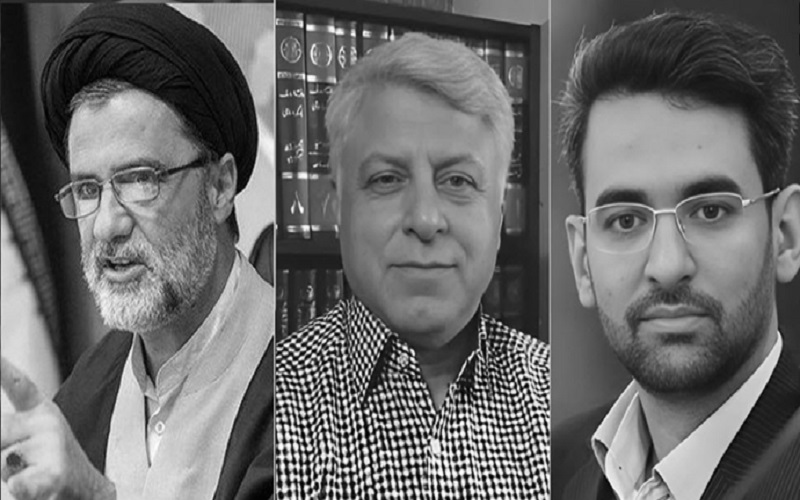

High-ranking officials in the Iranian regime offer conflicting, revealing statements that expose internal chaos, intelligence breakdowns, and increasing fears of societal division following the recent 12-day war.
In the aftermath of the recent 12-day military conflict involving Iran and Israel, a series of revealing and, at times, contradictory statements by Iranian officials have shed light on the regime’s deteriorating internal cohesion, intelligence vulnerabilities, and escalating fears of social unrest. These comments, made between July 12 and 13 (Tir 22–23), suggest a political system in deep crisis and struggling to maintain control amid external threats and internal confusion.
Judiciary Chief Warns of “Psychological Operations” and Social Fragmentation
On July 13, Gholamhossein Mohseni-Eje’i, head of Iran’s judiciary, warned of deliberate attempts by “enemies” to exploit internal societal rifts. He claimed that adversaries are using “psychological warfare,” “wicked individuals,” and “rumor spreaders” to foster division among the public.
“The enemy,” Eje’i said, “continues to try to create false polarization and social fragmentation using any tools available. We must remain vigilant.”
His comments highlight a growing anxiety within the regime about internal dissent and the potential collapse of the tightly controlled social fabric, particularly amid public frustration and political fatigue.
Regime Analyst Criticizes Mass Arrests and Suggests Intelligence Failure
Fayyaz Zahed, a regime-affiliated analyst and journalist, took a surprisingly critical stance in a recent state TV appearance. He questioned the rationale behind the mass arrest of 700 individuals, implying that many were detained for simply posting a tweet or Instagram story.
Instead, he argued that the real threat lies in deeper infiltration and operational planning that allowed coordinated strikes on high-ranking IRGC commanders. Zahed directly accused the People’s Mojahedin Organization of Iran (PMOI/MEK) of involvement in field operations, but he emphasized that the intelligence apparatus, including the Intelligence Ministry and IRGC Intelligence, must “seriously reassess” their vulnerabilities.
“The problem is not someone’s Instagram post,” he said. “We need to find out how they knew exactly where to strike.”
His remarks point to significant cracks in the regime’s internal narrative and raise questions about the capacity of Iran’s intelligence agencies to detect and prevent major breaches.
Former Communications Minister Admits to Digital Vulnerabilities
Mohammad Javad Azari Jahromi, former Minister of Communications, offered a strikingly candid assessment of how Iran was targeted. He emphasized that the recent attacks demonstrate the enemy’s ability to gather operational intelligence through digital and financial data.
He noted that mobile phone metadata, banking information, and other electronic footprints—ostensibly used by the regime for surveillance—can just as easily be used by foreign actors to trace movements and identify targets.
“The martyrdom of a military commander whose location was compromised is not a coincidence,” he said. “Digital data, banking systems, and telecom metadata have become major sources of intelligence for the enemy.”
Azari Jahromi’s remarks indirectly admit that the same surveillance infrastructure built to monitor Iranian citizens has become a liability for the regime itself.
Parliamentary Hardliner Claims US Sought De-Escalation via Back Channels
In a bombastic and theatrical speech, conservative MP Ahmad Nabavian claimed that the United States, via Qatar, attempted to warn Iran of Israel’s impending attack and later begged for a ceasefire. According to him, US Senator Marco Rubio allegedly contacted regional officials with a message to Iran not to retaliate.
Nabavian alleged that the US provided targeting coordinates and even requested Iran strike a base as part of a choreographed escalation, but claimed Iran rejected this and chose its own targets.
“America, which threatened us with retaliation, ended up begging us behind the scenes,” Nabavian said. “They fell at our feet.”
These statements appear aimed at domestic consumption, projecting strength and defiance while crafting a myth of American weakness. However, their inconsistencies and hyperbole suggest deeper insecurity within the regime about its position in the global power balance.
Foundation Chief Admits to Missing Detainees in Evin Prison
Perhaps the most chilling admission came from Saeed Ohadi, head of the Martyrs Foundation, who confirmed that some individuals remain missing in Evin Prison following the recent conflict.
“Some of our martyrs were visiting prisoners,” he said. “Some detainees were caught in the tragedy. There are also some still missing inside Evin.”
This stunning acknowledgment points to potential war crimes or at least a complete breakdown in detention protocols during the conflict. It reflects not only the chaos in Iran’s internal security operations but also the growing human cost of the regime’s violent crackdowns.
Conclusion: A Regime Under Siege From Within
Taken together, these statements paint a stark picture of a regime overwhelmed by both external pressure and internal decay. While publicly projecting resilience and defiance, the Iranian leadership privately grapples with:
- Serious intelligence failures, including infiltration and loss of command-and-control.
- Rising internal dissent, with fears of social polarization being openly discussed.
- A collapsing narrative, as regime insiders criticize their own security and political strategies.
- Human rights crises, as unaccounted detainees and wartime chaos emerge from behind closed doors.
The regime’s simultaneous use of bravado and fear reveals a system unsure of itself—torn between suppression and self-preservation. As internal criticism grows louder and operational weaknesses become harder to conceal, the Iranian regime’s façade of stability may be more fragile than ever.