


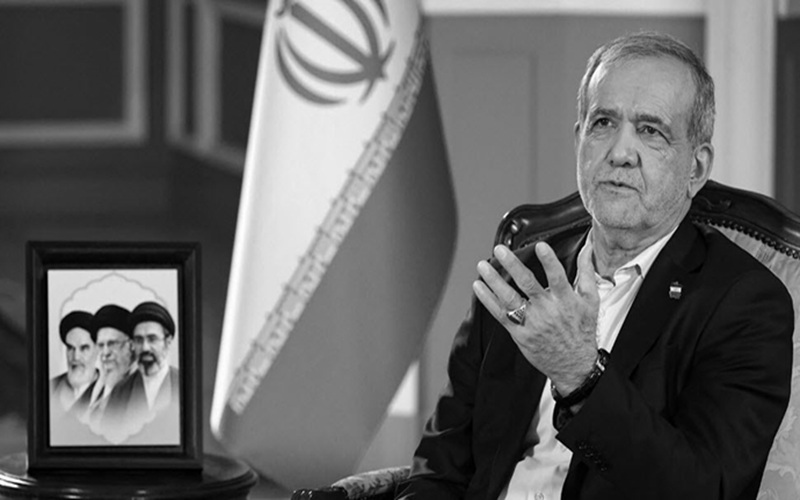

As economic pressures intensify, warnings from Iran’s president and parliament speaker reveal growing fears of social unrest and political instability.
The Iranian regime is facing a convergence of economic and social crises that is increasingly difficult to contain. As inflation, declining purchasing power, unemployment, and mounting economic pressures weigh on millions of people, senior officials have begun issuing unusually stark warnings about the consequences.
The language coming from the regime’s own leadership is revealing. On Friday, August 28, President Masoud Pezeshkian acknowledged the explosive potential of worsening economic conditions, warning that the population was already “on the edge.”
Speaking at a press conference, Pezeshkian said: “People are on the edge right now. If I put another pressure on them, they may fall off the edge. I must not do anything that makes them fall off.”
The statement is significant because it comes from the head of the executive branch itself. Rather than presenting the country as economically stable, Pezeshkian openly acknowledged that additional pressure could trigger a dangerous social reaction.
His warning reflects a broader fear within the regime: that economic grievances are no longer merely producing dissatisfaction, but are accumulating into a potentially uncontrollable force.
The Regime’s Own Officials Link Economic Stability to Its Survival
Pezeshkian is not alone in expressing concern.
Parliament Speaker Mohammad Bagher Ghalibaf, in a message marking Government Week, similarly emphasized the connection between the regime’s political survival and the economic condition of the population.
He stated that under the current “different and decisive circumstances,” the government must prioritize “people’s livelihoods, purchasing power, youth employment and economic security” while protecting the regime’s political foundations and reducing the burdens on the population.
The choice of priorities is telling. The statement effectively acknowledges that economic grievances have become a matter of political stability.
Ghalibaf has previously been even more explicit. He warned: “No matter how much military power we have, if people are hungry, we will not survive.”
Such statements expose a fundamental contradiction. The regime continues to devote enormous resources to its security and military apparatus, while millions of people struggle with declining living standards. Yet its own senior officials recognize that military power cannot indefinitely compensate for economic deprivation and public anger.
A Crisis That Security Measures Cannot Resolve
The growing anxiety among officials also raises questions about the regime’s reliance on repression as a means of maintaining control.
Executions, arrests, intimidation, and other forms of repression may suppress individual acts of dissent, but they cannot resolve the economic conditions generating widespread discontent.
Nor can foreign-policy tensions or military confrontation permanently divert public attention from deteriorating living standards.
The underlying problems remain: high inflation, declining purchasing power, unemployment, poverty, and an economic system increasingly unable to provide ordinary citizens with a secure livelihood.
The authorities therefore face a dilemma. They cannot easily reduce economic pressure without confronting the structural failures that produced it. At the same time, continuing to impose that pressure risks intensifying social unrest.
Economic Grievances Are Becoming Political
The warnings from Pezeshkian and Ghalibaf are particularly significant against the backdrop of recurring protests by workers, retirees, teachers, traders, and other sectors of Iranian society.
These protests are often driven by specific demands—unpaid wages, pensions, low salaries, rising prices, or deteriorating economic conditions. But their accumulation creates a broader political challenge.
When different social groups repeatedly protest over their livelihoods, the problem is no longer simply an isolated labor or economic dispute. It becomes evidence of a widening breakdown in the relationship between the state and society.
The regime’s leadership appears increasingly aware of this danger.
Pezeshkian’s warning that another economic “pressure” could push people over the edge is therefore more than a comment on household finances. It is an acknowledgment that the government has limited room to maneuver before economic grievances translate into broader political unrest.
A Narrowing Path Ahead
The regime’s predicament is consequently not simply an economic crisis. It is a crisis of governance.
The leadership faces a population whose purchasing power has deteriorated while the costs of basic necessities continue to rise. At the same time, the government remains constrained by the structural characteristics of an economy dominated by state-linked institutions, rent-seeking, corruption, and heavy security expenditures.
This leaves the authorities with increasingly limited options.
More austerity risks provoking greater public anger. More repression can deepen resentment. And attempts to divert attention through external confrontation cannot indefinitely compensate for the deterioration of everyday life.
The most revealing evidence may therefore come not from opposition statements, but from the regime’s own officials.
When the president warns that people are already “on the edge,” and the parliament speaker argues that the regime’s survival depends on protecting livelihoods and purchasing power, they are acknowledging a reality that millions of Iranians experience every day.
The Iranian regime may still possess considerable coercive power. But its own leaders increasingly recognize that coercion cannot substitute for economic stability or public legitimacy.
The central question is no longer whether economic hardship is generating anger. It is how long the regime can prevent that accumulated anger from becoming a broader political force.
For a government that openly fears that another economic shock could push society “off the edge,” the warning itself may be the clearest indication of how deep the crisis has become.