



As the clerical regime faces an unprecedented crisis, the struggle over Iran’s future is increasingly defined by a stark choice between a democratic republic and the revival of authoritarian rule.
As the external war involving Iran enters a critical phase and the death of Ali Khamenei removes the central pillar of the doctrine of velayat-e faqih, a pressing question dominates political discussions: what political system will replace the current dictatorship?
At this historical moment, Iran faces several possible futures, but in essence only three paths are conceivable.
One path reflects the aspirations of the Iranian people themselves—a democratic republic grounded in popular sovereignty. The other two represent variations of authoritarianism: the continuation or restoration of dictatorship, or the emergence of a government dependent on foreign powers.
These alternatives are not theoretical. They reflect a longstanding struggle in Iran’s modern history between popular movements seeking freedom and forces determined to maintain control through repression or external influence.
In a society where genuine political freedom exists, dictatorship cannot survive. Wherever citizens are allowed to choose their leaders freely, authoritarian rule inevitably loses its legitimacy. For this reason, both reactionary forces and foreign interests have historically resisted the emergence of a truly democratic alternative in Iran.
The death of Khamenei, however, signals more than the loss of a political leader. It represents the weakening of a system that has defined Iran since the Iranian Revolution of 1979. The structure of clerical absolutism—built around the authority of the supreme leader—now faces a crisis of continuity.
For many Iranians, this moment marks the beginning of the end of religious dictatorship and the possible opening of a new era in which political power returns to the people.
For decades, the organized Iranian Resistance has argued that any genuine transformation must reject both forms of dictatorship that have shaped modern Iran: the monarchy of the past and the current theocratic regime. The movement insists that the country’s future cannot lie in replacing one form of authoritarian rule with another.
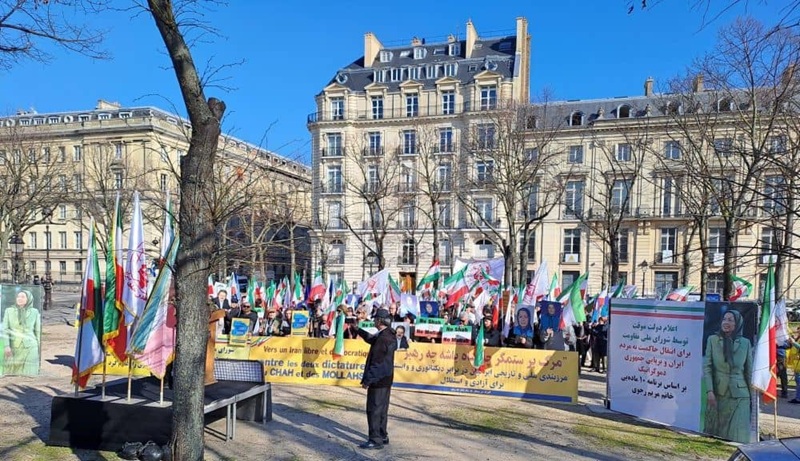
It is in this context that Maryam Rajavi, the president-elect of the National Council of Resistance of Iran (NCRI), announced the formation of a provisional government framework aimed at transferring sovereignty to the Iranian people. As she noted, the concept of a transitional government within the resistance movement is not new; it dates back to October 1981 and has long been part of the political strategy developed by the National Council of Resistance of Iran.
The declaration of a provisional government amid wartime conditions represents a deliberate political initiative. Its message is clear: the uprising and revolution of the Iranian people are neither spontaneous nor directionless. They are rooted in decades of organized resistance against dictatorship and have been sustained by immense sacrifice.
By presenting a structured transitional plan, the Iranian Resistance seeks to prevent two dangers that often follow the collapse of authoritarian regimes—foreign dependency and the re-emergence of dictatorship under a different guise.
Rajavi emphasized this principle clearly, stating that the Iranian people seek a future based on a democratic republic and reject both the tyranny of the cleric and the autocracy of the shah. In this vision, the legitimacy to determine Iran’s political future belongs solely to the people of Iran—not to external actors or to well-funded political projects designed outside the country.
This emphasis on national sovereignty is central to the resistance movement’s position. It argues that Iran’s future cannot be decided through foreign intervention or political engineering, but through the direct will of the Iranian people.
According to this framework, the ultimate authority for shaping the country’s future should be a freely elected constituent assembly. Through democratic elections, citizens would select their representatives, who would then draft the constitutional foundations of a new republic.
The resistance movement therefore frames the struggle ahead not only as a fight against the current regime but also as a battle against attempts to reproduce dictatorship in new forms—whether through remnants of the religious state or through efforts to revive monarchical authoritarianism with international backing.
The guiding principle expressed by many activists within the Iranian opposition has become a clear political boundary: neither shah nor cleric. In this formulation, the path forward lies in unity among democratic forces committed to ending dictatorship in all its forms.
Such unity, proponents argue, is essential if Iran is to avoid the cycles of repression that have defined much of its modern political history. Only a democratic system that respects pluralism, protects minority rights, and ensures equality between women and men can guarantee peaceful coexistence within Iran’s diverse society.
At the same time, the unfolding political crisis raises urgent questions for those currently within the regime’s institutions. Members of the security apparatus and state bureaucracy who have not participated in crimes against the population face a choice: continue defending a collapsing system or stand alongside the Iranian people.
Historical experience suggests that the outcome of revolutions often depends on such moments of decision. When the instruments of repression fracture or refuse to act against society, authoritarian regimes rapidly lose their ability to survive.
The Iranian people, for their part, did not initiate violence against the regimes that have ruled them. In both the monarchy and the mullahs regime, the principal source of political violence has been the state itself.
Yet the history of revolutions around the world demonstrates a consistent pattern: when a nation’s population persists in its demand for freedom, it eventually achieves the political system it seeks.
For the international community, the stakes are equally significant. Governments, parliaments, and political movements across the world face a moral and strategic choice: whether to stand with the Iranian people in their struggle for democratic self-determination or to remain passive as the future of the country is shaped by authoritarian forces.
Support for the Iranian people does not necessarily require military involvement. It can take the form of political recognition, diplomatic engagement, and clear support for democratic principles and human rights.
Moments of historic transition are rarely remembered for neutrality. They are remembered for the choices made by those who witnessed them.
Iran may now be approaching such a moment. The question is whether the world will stand on the side of democracy—and whether the Iranian people will finally be able to secure the freedom for which generations have struggled.