


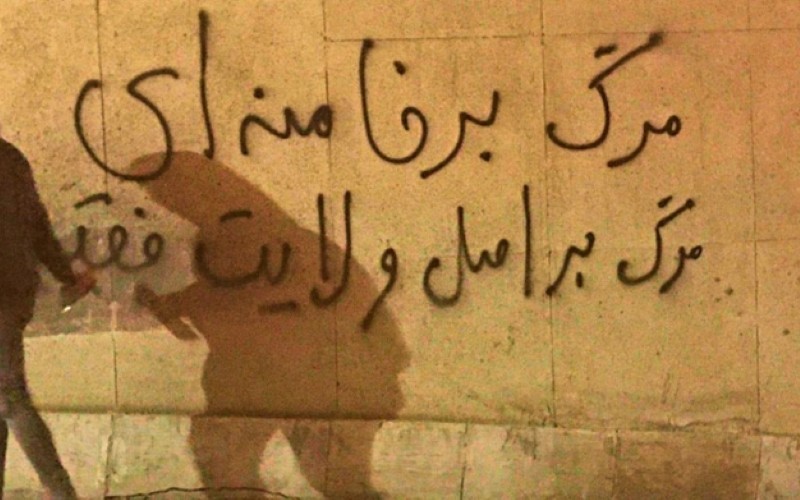

Why appeals to reform, referendum, and peaceful coexistence have repeatedly failed against the absolutist structure of Iran’s ruling system.
In the aftermath of the nationwide uprising of January 2026—when Iran’s streets were stained with the blood of freedom-seekers—we are once again witnessing a surge of political positions and statements across Iran’s social and political landscape. After 47 years of lived experience, however, a fundamental question still insists on being asked: what language does Iran’s clerical regime actually understand?
Is the political–religious structure of Velayat-e Faqih—judging by decades of confrontation both in official politics and on the streets—capable of tolerance, coexistence, or peaceful engagement with dissenters? Has it ever shown genuine openness toward nonviolent activists, reform advocates, or those calling for a referendum?
If the answer has consistently been no, then what has been the cost of investing so much time, energy, and hope in such demands? What tangible outcome has this path delivered for the Iranian people? Is there a single concrete, successful precedent that can be presented as evidence?
How many more years—or decades—must Iranians demand their basic rights from the clerical establishment, only to be met with silence, repression, or betrayal? Why is it that no individual, no social class, and no political current—no matter how peaceful or moderate—has ever succeeded in extracting meaningful concessions from this system? And why have all sworn presidents of this regime, despite repeated promises of reform, ultimately realigned themselves with the Supreme Leader and the doctrine of absolute clerical authority?
The problem lies in two fundamental factors.
First, there is a persistent unwillingness—on the part of those proposing certain “solutions”—to pay the real price required to implement them. Take the recurring call for a referendum as an example. If this is truly presented as the sole viable solution for Iran, why do its proponents stop at issuing statements and collecting signatures? Why do they not commit, relentlessly and at any cost, to turning this proposal into a lived political reality?
Issuing declarations without an operational strategy does little beyond exhausting social energy, wasting time, and misleading the public. In a country ruled by one of the most violent absolutist regimes in modern history, achieving change through a genuine referendum would indeed be remarkable—and highly desirable. But if this is the chosen path, why is there no total mobilization, no sustained national effort, no readiness to confront the inevitable repression? What exactly is the obstacle—if not a totalitarian system that is, by its very nature, unreformable and unreceptive to referendums?
Without a willingness to pay the price of one’s stated demands, what remains is illusion: wasted time, dissipated energy, crushed hope, and an ever-growing cost borne by ordinary Iranians. The result is a recurring cycle of bloodshed without resolution—a chronic tragedy repeating itself across generations.
The second factor is the intrinsic nature of the regime itself. Iran’s ruling system is fundamentally totalitarian, monopolistic, and exclusionary—driven by a “with me or against me” logic. It is a power structure rooted in ideological supremacy, domination, and enforced submission, reinforced by exploitative political and social practices. At its core lies a narcissistic worldview that cannot tolerate “the other.”
Combine these traits with a medieval clerical mindset, and the result is what can only be described as the most formidable reactionary force in Iran’s modern history.
This reality has not diminished over the past 47 years; it has intensified. Year after year, the regime’s absolutism has grown more rigid, more violent, and more resistant to change. Any viable strategy for confronting Velayat-e Faqih must begin with an honest recognition of this reality.
History shows that, at least up to now, the approach adopted by the People’s Mojahedin Organization of Iran (PMOI/MEK) in confronting this system has been consistent with the true nature of clerical rule. Long before armed confrontation became inevitable, the MEK paid the highest price in attempts to compel Ruhollah Khomeini the regime’s founder to recognize the Iranian people’s rights and sovereignty. They exhausted every available avenue in the immediate post-1979 period, hoping the regime might accept even minimal reforms—basic freedoms of expression, press, assembly, and political activity outside the regime’s framework.
Even such modest concessions would have signaled a willingness to retreat from absolute authoritarianism cloaked in religious sanctity. But experience quickly made clear that Khomeini would never relinquish the principle of Velayat-e Faqih, nor tolerate reform, referendum, or peaceful political competition. This inflexibility was not tactical—it was ideological, institutional, and inherent to the system itself. Ali Khamenei has since inherited and preserved this very essence.
After 47 years of repeated trials and failures, the majority of Iranians have reached a stark conclusion: this regime does not respond to dialogue alone. In this context, those who continue to advocate peaceful accommodation or appeal to the regime for a referendum owe the public clear answers. What concrete path do they propose? What cost are they prepared to pay? And by what mechanism do they expect to force an absolutist system to submit to their demands?
Are they prepared to abandon the expectation of regime “consent,” mobilize millions into the streets, and sustain that presence for weeks—despite repression—until the ruling structure is compelled to yield?
Without answers to these questions, calls for moderation risk becoming not a strategy for change, but a prolongation of illusion—one that Iran’s people can no longer afford.