


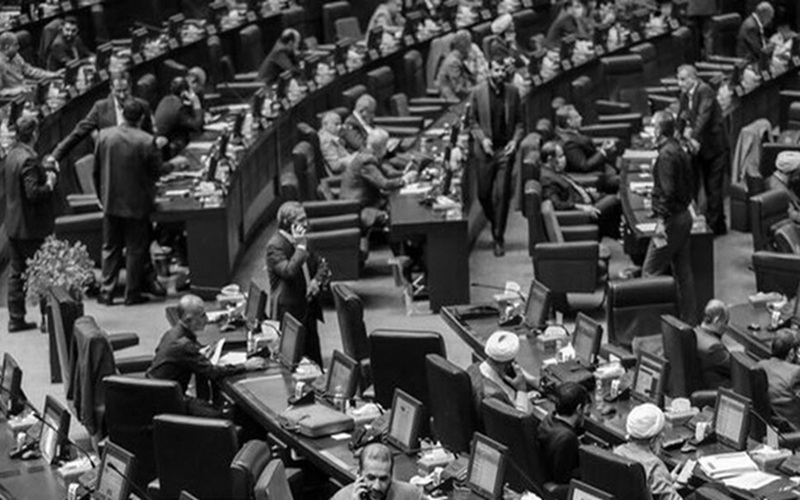

Conflicting decisions, public denials, and an expanding security-military role expose a regime struggling to establish a coherent political direction after the transfer of power.
The Iranian regime is increasingly revealing a fundamental problem: it cannot agree on what direction to take.
In recent days, contradictory statements, unusual public denials, disputed appointments, and increasingly visible rivalries at the highest levels have exposed a leadership structure struggling to establish authority and make coherent decisions.
What may appear on the surface to be a series of isolated political disputes is, in reality, part of a deeper crisis of power.
The regime is attempting to reorganize itself after the dramatic transition at the top, but instead of consolidating authority, it is showing signs of fragmentation, uncertainty, and internal competition.
A president forced to deny rumors of resignation
The latest episode began with widespread reports that President Masoud Pezeshkian was considering resignation.
The rumors became serious enough that Pezeshkian himself was forced to address them publicly. In a televised interview, he denied any intention of stepping down, saying that if he ever made such a decision, he would announce it officially.
He also insisted that his government was fully coordinated with the armed forces and rejected suggestions of a dispute between himself and Mojtaba Khamenei, the regime’s new leader.
The very fact that the president felt compelled to publicly deny such reports is revealing.
Political systems confident in their authority generally do not need repeated public assurances that their leadership is intact. The episode instead exposed the extent to which rumors of internal division can gain traction at the highest levels of the regime.
More significantly, the office of Mojtaba Khamenei took the unusual step of directly denying claims made by hardline cleric Mohammad Bagher Kharrazi, who had alleged that Pezeshkian had repeatedly threatened to resign and that Khamenei had warned he would accept the resignation if it happened again.
Kharrazi subsequently faced severe backlash and was reportedly summoned before the Special Clerical Court.
The controversy demonstrates something more important than the credibility of one cleric’s statements: different factions are openly competing to define the relationship between the presidency and the new leadership.
The regime’s denials reveal the problem
The leadership’s subsequent attempt to demonstrate unity only reinforced the impression of instability.
A few days after the controversy, Mojtaba Khamenei met with Pezeshkian to discuss economic and security issues.
The meeting was evidently intended to project coordination.
Yet the need to publicly emphasize that coordination illustrates the opposite problem: the regime is increasingly concerned about perceptions of division at the top.
Pezeshkian’s supporters have accused hardline elements of attempting to weaken the president, deepen internal polarization, and seize greater control over political institutions.
The dispute is therefore not merely personal.
It reflects a struggle over who gets to define policy in a regime whose new leadership has yet to establish the authority that Ali Khamenei once exercised.
The Mohsen Rezaei appointment exposes another fault line
The controversy surrounding Mohsen Rezaei is even more revealing.
Rezaei, a former Islamic Revolutionary Guard Corps commander and military adviser, was appointed as the representative of the new leader on the Supreme National Security Council. Pezeshkian subsequently announced his appointment as secretary of the council, replacing Mohammad Bagher Zolqadr.
The appointment reportedly came despite earlier indications that Pezeshkian had opposed Rezaei’s appointment and had resisted Zolqadr’s resignation.
Whether every detail of the reported disagreement is accurate matters less than the broader pattern.
The regime is producing contradictory signals about who controls major security and foreign-policy decisions.
And the choice of Rezaei is politically significant.
Unlike Zolqadr, Rezaei possesses extensive networks and longstanding relationships within both the security establishment and the Revolutionary Guard. His elevation can therefore strengthen the security-military current at the highest levels of power.
That current has generally favored confrontation and opposed concessions to Washington.
The real dispute is over the regime’s direction
Rezaei’s own political record makes the situation even more complicated.
He has previously expressed skepticism toward diplomatic initiatives led by Pezeshkian and parliamentary speaker Mohammad Bagher Ghalibaf following the regime’s memorandum of understanding with the United States. Instead, he advocated a harder line toward Washington.
Yet Rezaei is hardly a simple ideological actor.
He is also an ambitious and pragmatic political operator who has repeatedly sought higher office and adjusted his political positioning when circumstances required it.
His elevation therefore does not necessarily mean that the regime has definitively chosen confrontation over diplomacy.
It does, however, demonstrate that the security-military establishment is positioning itself to have a decisive voice in that choice.
The problem is bigger than “hardliners versus moderates”
It would be a mistake to reduce these developments to the familiar formula of “hardliners versus moderates.”
The regime’s power structure has always been more complicated.
There are multiple centers of power, overlapping institutional interests, competing personal networks, and rival economic and security constituencies. Even the Revolutionary Guard is not a completely unified or homogeneous institution.
Under Ali Khamenei, such rivalries could become intense, but he ultimately possessed the authority to arbitrate among competing factions.
That mechanism is now considerably weaker.
Mojtaba Khamenei has inherited the position, but he has not inherited his father’s accumulated political authority, institutional relationships, and ability to act as the uncontested final arbiter.
His prolonged absence from public view has further complicated the process of consolidating authority.
This creates a dangerous vacuum.
When there is no universally accepted center of decision-making, every appointment becomes a power struggle, every policy becomes a factional calculation, and every rumor can become a political weapon.
A regime unable to make the “right” decision
The deeper problem is not simply that different factions disagree.
It is that the regime increasingly appears incapable of making a strategic decision and sustaining it.
On the economy, it faces an accelerating cost-of-living crisis.
On foreign policy, it must choose between pursuing negotiations and attempting to ease external pressure or maintaining a confrontational strategy that risks further isolation and economic damage.
On security, it continues to rely on repression while facing persistent social discontent.
And at the top, competing centers of power are struggling to determine who has the authority to set these policies.
Every option carries serious risks.
Diplomatic compromise could provoke resistance from powerful security factions that have built their influence around confrontation.
A prolonged confrontational strategy, meanwhile, could deepen economic hardship and social dissatisfaction.
The regime therefore appears trapped between choices that threaten different parts of its power structure.
The post-transition power struggle is only beginning
The current disputes are unfolding while the new leadership structure remains in its early stages.
Rather than producing rapid consolidation, the transition appears to have opened new opportunities for competing factions to strengthen their positions.
As the regime moves away from the most active phase of confrontation, senior officials and power centers are increasingly looking to exploit the changing circumstances to secure their place in the emerging order.
This is why the struggle surrounding Pezeshkian, the Supreme National Security Council, Rezaei, and the new leadership should not be viewed as a series of disconnected incidents.
They are pieces of a larger contest over the future architecture of the regime.
The decisive question is whether the regime can contain itself
The consequences extend beyond the careers of individual officials.
The outcome of this power struggle will influence the regime’s approach toward Washington, its willingness to pursue a diplomatic settlement, and the future of the confrontation-oriented doctrine that has shaped its foreign and security policy.
More fundamentally, it could determine what kind of regime emerges from the current transition.
But the leadership is attempting to manage this struggle while confronting an increasingly severe economic crisis and widespread domestic discontent.
That combination is particularly dangerous.
A regime can sometimes survive factional rivalry when the economy is stable, the leadership is secure, and the population is politically subdued.
The Iranian regime currently has none of those advantages in sufficient measure.
Its leadership is unsettled. Its economic problems are deepening. Its population is increasingly burdened by inflation and declining living standards. And competing power centers are fighting over the direction of the state.
The central question, therefore, is no longer simply which faction will prevail.
It is whether the regime can contain its own internal conflicts long enough to establish a functioning political order—or whether the struggle for power will become another crisis that further weakens its ability to govern.
The growing confusion at the top is not merely a symptom of political disagreement.
It is evidence of a regime struggling to decide who is in charge, what policy to pursue, and how to survive the crises that are closing in around it.