


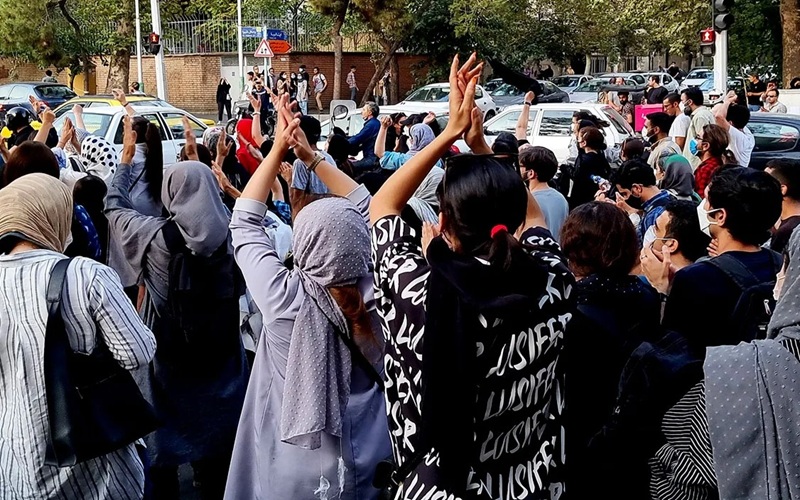

Mohammad-Reza Bahonar’s remarks on generational change, declining trust in state media, and mounting uncertainty expose the widening gap between Iran’s ruling establishment and a society increasingly unwilling to accept ideological control.
A Shift in Rhetoric Reveals a Deeper Crisis of Authority
The changing tone of veteran figures in Iran’s so-called principlist camp offers a revealing glimpse into the crisis confronting the ruling establishment under Mojtaba Khamenei. When longtime insiders begin acknowledging that younger generations reject imposed ideological authority and no longer trust state media, their remarks point to a problem far deeper than a communications failure or a generational disagreement. They expose a widening crisis of legitimacy at the heart of the regime’s political system.
Mohammad-Reza Bahonar, a veteran conservative politician, has recently articulated concerns about generational change, the relationship between state media and its audience, and the uncertain future of Iran’s political, economic, cultural, and diplomatic affairs. His remarks, reported by the Iranian news outlet Rouydad 24 under the headline “The Secret Behind a Veteran Principlist’s Change of Tone: After Nategh Nouri and Ali Larijani, Is It Bahonar’s Turn?”, reflect a broader pattern among established insiders who have found themselves increasingly removed from the center of power.
Bahonar’s comments do not amount to a democratic conversion. Rather, they offer an inadvertent acknowledgment of the mounting difficulties facing a system built on obedience to a supreme authority and the expectation that society should conform to its ideological prescriptions.
A Generation That Refuses to Be Told How to Think
One of Bahonar’s most revealing observations concerns the attitudes of younger Iranians toward intellectual and political authority.
According to Rouydad 24, he stated: “The new generation does not want someone in the position of a president or intellectual leader to tell them how to think; instead, it wants to think for itself and form its own intellectual frame of reference.”
This observation strikes at a central premise of the regime’s governing ideology. The doctrine of velayat-e faqih, or clerical guardianship, places the supreme leader above ordinary political institutions and grants his authority a religious justification. In practice, the system expects citizens and state institutions to operate within boundaries established by the supreme leader and the ideological apparatus surrounding him.
Bahonar’s remarks acknowledge that this model increasingly conflicts with the expectations of a society that wants to make independent judgments rather than accept prescribed answers.
For decades, the regime has attempted to shape public attitudes through religious institutions, state-controlled education, official media, and restrictions on political and cultural expression. Yet younger Iranians have repeatedly demonstrated their rejection of compulsory ideological conformity. Their demands extend beyond particular policies or individual officials to fundamental questions about personal freedom, political accountability, and the right of citizens to determine their own future.
The significance of Bahonar’s observation lies in its source. This is not merely criticism from outside the establishment. It is recognition by a veteran insider that the relationship between authority and society has changed.
A political system may compel outward obedience through coercion, but it cannot indefinitely manufacture genuine consent. When citizens reject the premise that a single authority has the right to dictate how they should think, the ideological foundation of that authority begins to erode.
The Supreme Leader’s Authority and the Limits of Command
The crisis goes beyond generational attitudes. It concerns the structure of power itself.
Iran’s political system concentrates decisive authority in the office of the supreme leader, whose influence extends across the executive, judiciary, security apparatus, and major policy decisions. The doctrine of velayat-e faqih is not simply a religious principle; it is the organizing rationale for a system in which unelected authority places substantial limits on popular sovereignty.
Within this structure, major political disputes and policy questions are ultimately shaped by institutions operating under the supreme leader’s authority. Government directives, religious rulings, and policies issued from above reinforce a model of governance that prioritizes obedience over independent democratic decision-making.
Bahonar’s acknowledgment that the younger generation no longer wants an intellectual or political guardian highlights the contradiction between this structure and the demands of modern society.
Citizens increasingly expect the right to scrutinize public officials, challenge government decisions, and participate meaningfully in determining national policy. They seek institutions that answer to the public rather than a hierarchy that demands compliance with decisions made beyond democratic accountability.
These expectations cannot be reconciled easily with the principle of absolute clerical authority. The conflict is structural, not merely rhetorical.
The consequences are visible in the regime’s recurring political, economic, and social crises. A system that concentrates power at the top also concentrates responsibility for failure. When policies repeatedly fail to address public needs, the authority that claims the final word cannot readily distance itself from the results.
Under Mojtaba Khamenei, the question of authority carries additional weight. The transfer of supreme leadership from father to son has reinforced concerns about the concentration and inheritance of power within a system that presents itself as grounded in religious legitimacy. The regime’s ability to command obedience should not be confused with its ability to secure public acceptance.
State Media: An Information Monopoly Without Public Trust
Bahonar’s criticism of state broadcasting provides another important indication of the regime’s difficulties.
Rouydad 24 reported his question: “What relationship exists today between national media and its audience?”
The report also noted his view that controlling a far-reaching media network does not necessarily translate into influence over public opinion. A media organization can fulfill its role only when a substantial portion of society watches it, listens to it, and trusts what it says.
This is a significant admission in a country where state broadcasting has long served as a central instrument for promoting official ideology and presenting the ruling establishment’s interpretation of political events.
The distinction between access and credibility is crucial. The state may possess extensive broadcasting infrastructure, allocate substantial public resources to its media apparatus, and exercise considerable influence over domestic information channels. None of these advantages guarantees that audiences will accept its narratives.
Trust must be earned. It cannot be secured through administrative control or ideological repetition.
Years of censorship, restrictions on independent journalism, and the exclusion of dissenting voices have deepened the divide between official narratives and the experiences of many Iranians. Audiences seeking alternative sources of information can increasingly turn to satellite broadcasting, online platforms, and social media, despite government efforts to restrict access.
The result is a fundamental contradiction: the regime can maintain control over major domestic broadcasting institutions while losing its ability to persuade significant sections of society.
Bahonar’s question therefore points to more than a problem of programming or public relations. It raises the issue of whether the regime’s propaganda apparatus can still perform one of its central political functions: sustaining the legitimacy of the system it serves.
A government that must rely increasingly on coercion while struggling to persuade its own population faces a serious challenge to its long-term political authority.
A Crisis That Extends Across Politics, Economy, and Diplomacy
Bahonar’s concerns are not limited to young people or state media. As Rouydad 24 reported, he also expressed anxiety about Iran’s future in politics, the economy, culture, and diplomacy.
The breadth of these concerns matters. It suggests that the unease within the establishment extends across several interconnected areas rather than being confined to a single institution.
Economic hardship has intensified public dissatisfaction, while restrictions on social and political freedoms have deepened the conflict between the population and the ruling system. International isolation and diplomatic uncertainty add further pressure. These problems reinforce one another, making it increasingly difficult to address any one crisis without confronting the broader consequences of the regime’s governing model.
The concentration of power compounds the problem. When independent institutions, meaningful public accountability, and open political competition are restricted, the mechanisms that might correct policy failures are weakened. Decisions can be imposed from above, but the system has fewer effective means of responding to criticism or incorporating society’s demands.
The resulting predicament is not simply a shortage of competent officials. It is a crisis of governance in which the political structure itself obstructs the changes needed to restore public confidence.
Bahonar’s remarks do not establish that the ruling establishment is on the verge of collapse. They do, however, reveal concerns that are difficult to dismiss: the authorities face a society whose expectations increasingly conflict with the foundations of the political order.
From Elite Unease to the Demand for Democratic Change
The changing language of figures such as Bahonar, following earlier shifts among established politicians including Ali-Akbar Nategh Nouri and Ali Larijani, should be understood in this context.
Differences in tone among insiders can reflect changing calculations, political marginalization, or an effort to adapt to a changing social environment. They do not necessarily indicate a commitment to democracy. Criticism of the regime’s methods is not the same as rejecting the system that sustains them.
Nevertheless, such statements matter because they expose tensions that the ruling establishment has struggled to contain. When senior figures acknowledge that younger generations reject intellectual guardianship, or that state media cannot command public trust merely because it dominates broadcasting, they give voice to realities that official propaganda seeks to obscure.
The deeper challenge comes from Iranian society itself. Repeated waves of protest and resistance have demonstrated that dissatisfaction cannot be reduced to isolated grievances or managed indefinitely through repression and messaging. The demand for freedom, accountability, and the right to choose one’s political future challenges the principle that authority should flow from an unelected clerical hierarchy.
For Iran’s democratic opposition, the central issue is therefore not whether individual insiders adopt a more conciliatory vocabulary. It is whether the country can move beyond a system that places ideological authority above the sovereignty of its citizens.
That requires more than replacing one supreme leader with another, reshuffling officials, or improving the performance of state media. It requires a fundamental change in the relationship between the state and society: an end to imposed ideological rule and the establishment of institutions accountable to the people.
The contrast between the regime’s claims of authority and the public’s demand for self-determination has become increasingly difficult to conceal. Bahonar’s remarks do not prove that Mojtaba Khamenei’s rule is collapsing, but they expose the erosion of assumptions on which the system depends.
The decisive question is no longer whether the ruling establishment recognizes that society has changed. Even its own veterans are acknowledging that reality. The question is whether a political order founded on obedience to supreme authority can accommodate a population that increasingly insists on thinking independently, exercising its rights, and determining its own future.
The growing gap between those two positions is one of the central challenges confronting Iran’s ruling establishment today.