


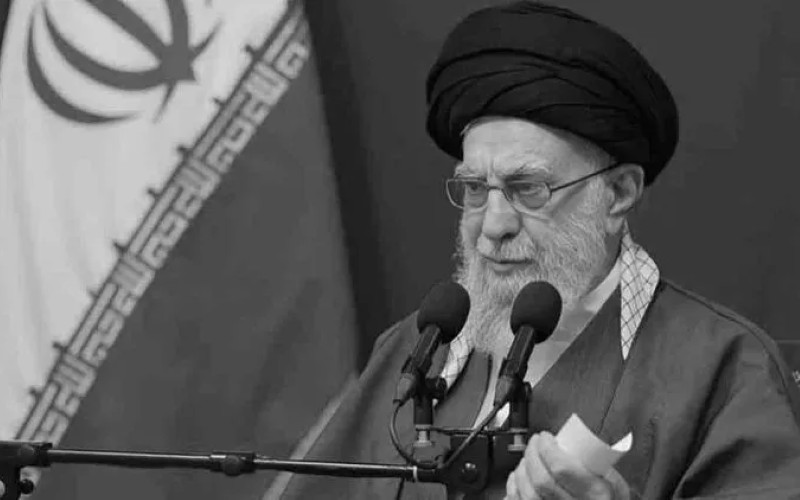

As Iran regime’s supreme leader speaks of justice and global injustice, the country he rules sinks deeper into repression, poverty, and state violence.
Ali Khamenei’s latest message to Islamic student associations once again lays bare the chasm between the lived reality of Iranian society and the rhetoric emanating from the apex of power. Published by the regime-affiliated Tasnim news agency on December 27, the statement is less a reflection on justice than an exercise in political self-absolution by a figure whose rule is inseparable from repression, executions, and mass impoverishment.
Tasnim quotes Khamenei as claiming that the turmoil facing “corrupt bullies” stems from Iran’s resistance to an unjust global order. In this framing, the supreme leader casts himself as a victim and a moral challenger to injustice. Yet for Iranian society, Khamenei is not a symbol of resistance but the embodiment of coercion and systematic violence. His attempt to occupy the moral high ground collapses under the weight of daily realities inside the country.
For him, inverting reality is not a challenge but a method. Like other authoritarian rulers, Khamenei externalizes the failures of his own rule by projecting them onto abstract global enemies. Internal crises are repackaged as the byproduct of foreign injustice, while the machinery of domestic repression continues unchecked. This rhetorical maneuver allows him to evade accountability while sustaining the illusion of ideological legitimacy.
This narrative is not new. Khamenei governs a system in which shame and responsibility have no institutional place. He speaks of opposing oppression while presiding over a state where naked force is the primary tool of governance. The contradiction is not accidental; it is structural. Violence is not a deviation from his rule but its central pillar.
Following a series of strategic setbacks in the region, Khamenei is now attempting to recast the image of his regime. Yet Iranians overwhelmingly view him as the most powerful and unaccountable strongman in the country. The labels he assigns to others are, in truth, a precise description of his own conduct. For years, the regime sought to dominate the Middle East through proxy forces, exporting instability, war, and fundamentalism as a way to deflect internal contradictions. That project has ended in visible failure, leaving behind isolation abroad and fragility at home.
Now, faced with exhaustion and defeat, Khamenei suddenly invokes order and justice. This comes at a time when executions are recorded with alarming frequency, sometimes only hours apart. His words about fairness ring hollow in a country governed by an anti-human order imposed through fear.
The injustice of this system is evident across every dimension of life in Iran. Economically, the population experiences little beyond relentless hardship. Families are crushed by poverty, inflation has surpassed fifty percent, and purchasing power continues to erode. Workers and wage earners are pushed to the brink, while entire social groups struggle simply to survive. These pressures are no longer silent. Daily protests by retirees and other sectors echo through the streets, increasingly marked by open rejection of the regime.
Socially, repression has become the regime’s default response to dissent. The rising number of executions points to one of the darkest periods in Iran’s contemporary history. Religious minorities, ethnic communities, border porters, and fuel carriers face systematic violence. Roads across the country are routinely stained with civilian blood, while students and teachers are subjected to constant security pressure. Their demands are met not with dialogue but with arrests, threats, and intimidation.
Inside prisons, mass detentions, torture, and forced confessions have become routine. This is the order Khamenei defends and presents as just. It is an order sustained by fear and normalized brutality.
As a result of these anti-human policies, Iranian society has become volatile and deeply strained. Public endurance is nearing its limit. The regime attempts to contain this pressure through executions and intimidation, sacrificing lives in the hope of buying time. History suggests such tactics offer only temporary reprieve. The more force is applied, the tighter the encirclement becomes. This has been the fate of all dictators, and Khamenei is no exception.
The trajectory is clear. The end of this path is the end of institutionalized oppression. Iranian society will ultimately move toward a democratic and humane order, one in which freedom, dignity, and a decent life replace repression and manufactured poverty. No amount of propaganda can permanently obscure that horizon.