


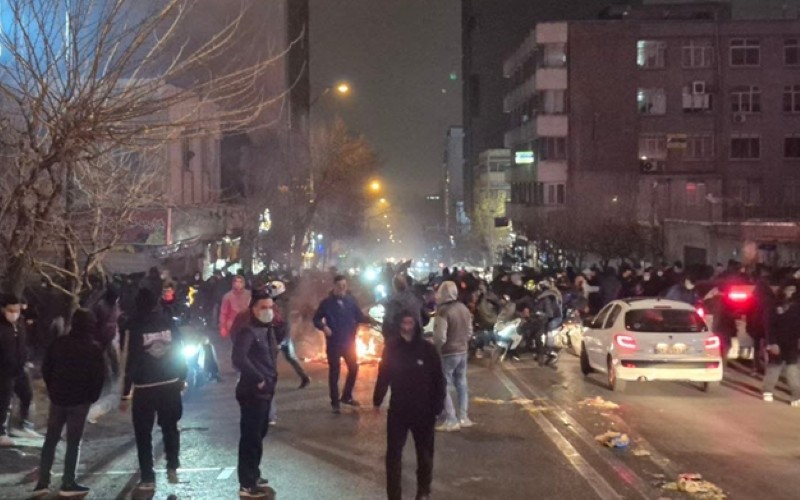

Ali Khamenei’s January 9, 2026 speech exposes a regime trapped in strategic paralysis on the thirteenth day of Iran’s nationwide uprising.
A Speech Born of Crisis, Not Confidence
Iran regime supreme leader Ali Khamenei’s speech on January 9, 2026, delivered on the thirteenth day of Iran’s nationwide uprising, stands as a strategic document of regime vulnerability rather than authority. Far from projecting control, the Supreme Leader appeared as a ruler confronting a historic dead end—unable to suppress, redirect, or politically neutralize a revolt that has moved beyond spontaneous protest into organized resistance.
The tone and vocabulary of the speech reflected neither stability nor command. Instead, Khamenei spoke from the position of a spectator watching the gradual collapse of his regime’s grip on the streets. A close reading of his remarks exposes a truth the ruling establishment desperately seeks to conceal: the steady victory of organized resistance over a worn-out and ineffective apparatus of repression.
Trivialization as an Admission of Defeat
Khamenei’s attempt to reduce the scale of the uprising to “burning trash bins” and “damaging buildings” was not merely dismissive—it was revealing. Such language signals an inability to engage with the deep political consciousness driving the revolt. By attributing the uprising to the “pleasure of foreigners,” he implicitly acknowledged that he has no serious political response to the magnitude and coherence of the resistance confronting him.
This rhetorical escape forward reflects a frightened political charlatanism. The uprising’s participants are not instruments of foreign powers; they are architects of a new political order. Their actions target centers of repression with a clear objective: reclaiming popular sovereignty from a regime that has long ruled through coercion alone.
When Threats Replace Governance
Khamenei’s repeated references to “blood shed for the survival of the system” and his insistence that the regime “will not retreat” do not intimidate the revolting people. Instead, they underscore the regime’s total exhaustion of governance tools. When a political system relies on sanctified violence and direct threats against its own citizens to ensure survival, it is admitting the collapse of all remaining civic legitimacy.
Issuing threats on the thirteenth day of a nationwide uprising is a tacit confession: neither the security layers nor the propaganda machine are capable of extinguishing a fire now burning across 107 cities. The escalation of repression rhetoric confirms that the regime is reacting, not controlling.
The Regime’s Real Fear: Organization, Not Numbers
What forced Khamenei to intervene publicly was not merely the scale of the uprising, but its quality of participation. The 2026 uprising has marked a decisive transition from fragmented protests to coordinated, goal-oriented resistance. The seizure of regime centers, disarming of security forces in direct confrontations, and unprecedented synchronization between bazaars and streets all point to a level of organizational maturity that has immobilized the repression machine.
Khamenei’s fixation on imaginary enemies is, in reality, a response to the emergence of insurgents operating with clear strategy—systematically dismantling the symbols and mechanisms of his authority. The regime’s widespread internet shutdowns serve as further evidence of fear: fear of coordination, communication, and collective intelligence among the people.
Staged Loyalty Versus the Reality of the Streets
The regime’s choreographed gatherings in Qom, complete with scripted chants of “Death to the hypocrites [referring to the People’s Mojahedin Organization of Iran (PMOI/MEK)],” were a desperate attempt to simulate popular support that no longer exists. The contrast between the sterilized atmosphere of these managed events and the blood-soaked streets of Andimeshk, Isfahan, and Tehran exposes the depth of the rupture between society and the ruling system.
A government that must resort to greenhouse-style rallies to prove its existence has already lost to the authentic energy of the streets—an energy born of lived suffering and political awareness.
The End of the “Control” Illusion
Khamenei’s January 9 speech marked the definitive collapse of the illusion of “control.” His threats did not stem from power, but from structural fear—fear of a generation that has returned terror to the heart of the system itself. Iran’s organized resistance will not retreat in response to intimidation, nor will it be halted by internet blackouts.
Reality on the ground makes one fact unmistakably clear: the sharper the threats from the apex of power, the more radical, cohesive, and determined the response from the streets becomes. The ruling theocracy now faces a force absent from its calculations—an organized will for freedom that has encircled the tent of oppression from all sides.
This speech was not a show of strength. It was the final act of a collapsing authority, reduced to incoherence when confronted with the uncompromising reality of a nationwide uprising.