

A brief official statement placed the war, military capabilities, internal cohesion, and continued street mobilization at the center of the leadership’s agenda, offering clues to the crises confronting the Iranian regime.
A Brief Meeting Statement With a Broader Political Message
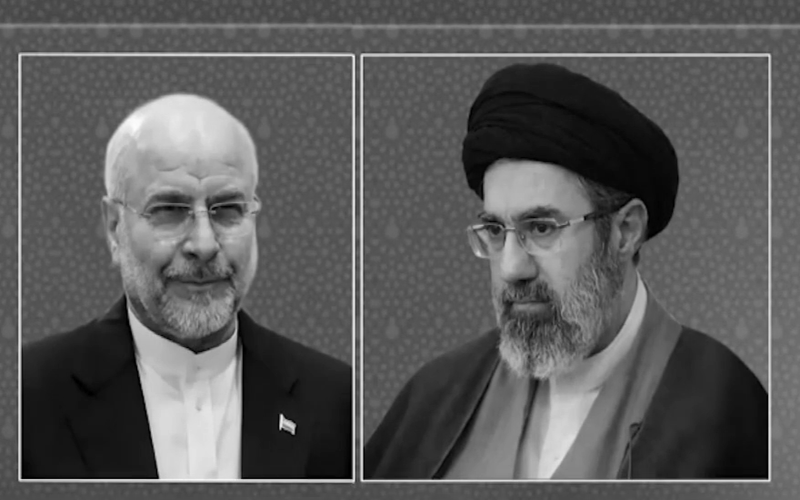
A short announcement about a meeting between Mojtaba Khamenei and parliament speaker Mohammad Bagher Qalibaf has drawn attention to the pressures confronting Iran’s ruling regime as military tensions, economic hardship, and internal political divisions continue.
The announcement came after visits to Tehran by Russian Foreign Minister Sergey Lavrov and Pakistan’s army chief, placing the meeting within a broader period of diplomatic and military activity surrounding Iran. Yet the official statement offered few details about the substance of the discussions. Instead, it highlighted a carefully selected set of priorities: the military, economic, and “cognitive” dimensions of the war; the strengthening of national power; social cohesion and national unity; continued public presence at street gatherings; and cooperation between the government and parliament to address economic and livelihood problems.
The choice of language is significant. Rather than providing a substantive account of the meeting, the statement presented a compact list of issues the leadership wanted to emphasize. Read together, these themes point to the regime’s efforts to manage external confrontation while containing internal strains.
The prominence given to the war is particularly notable. The statement did not treat the conflict as one issue among many in the country’s routine affairs. It placed the military, economic, and information-related dimensions of the confrontation at the forefront, before turning to domestic unity, public mobilization, and economic difficulties.
This combination offers a revealing picture of the challenges facing the regime: sustaining its strategic capabilities, maintaining cohesion among its own political factions, and managing a society under mounting pressure.
The War Remains at the Center of the Regime’s Agenda
The official statement referred to what it described as the “military, economic, and cognitive war” waged by the United States and Israel. The terminology reflects the regime’s effort to frame the confrontation as extending beyond the battlefield into economic conditions, public perceptions, and information flows.
The military dimension concerns the regime’s strategic capabilities and its ability to respond to external threats. The economic dimension encompasses the pressures affecting the country’s resources, government priorities, and citizens’ livelihoods. The reference to cognitive warfare, meanwhile, reflects the authorities’ longstanding emphasis on the struggle over public opinion and how the conflict is understood inside Iran.
By grouping these dimensions together, the announcement presented the confrontation as a broad challenge to the regime’s security and political position.
The timing also matters. Lavrov’s visit to Tehran and the subsequent visit by Pakistan’s army chief preceded the announcement of the meeting between Mojtaba Khamenei and Qalibaf. These diplomatic contacts took place against the backdrop of continuing regional tensions and uncertainty over the conflict’s trajectory.
The available statement does not establish what specific military or diplomatic decisions were discussed. Nevertheless, its emphasis on the war indicates that the leadership wanted this issue to define the public understanding of the meeting.
“Strengthening National Power” and the Regime’s Strategic Priorities
Another central phrase in the announcement was the call to strengthen the country’s “components of power.”
In the context of the regime’s security doctrine, this language can encompass missile and drone capabilities, the nuclear program, and strategic leverage associated with the Strait of Hormuz. These are among the principal instruments through which Tehran has sought to project power and deter adversaries.
The emphasis on strengthening these capabilities is notable because it appeared alongside references to the continuing war and efforts to address economic hardship. It suggests that the leadership wanted to reaffirm its commitment to maintaining strategic instruments even as the country faces multiple pressures.
This creates a fundamental tension in the regime’s priorities. Maintaining military and strategic capabilities requires resources, while the government and parliament are simultaneously being urged to address the economic and livelihood problems confronting the population.
The statement did not explain how the leadership intends to reconcile these competing demands. Nor did it provide details about specific decisions concerning missiles, drones, the nuclear program, or the Strait of Hormuz. Its significance lies instead in the decision to place the strengthening of national power among the meeting’s principal messages.
Calls for Social Cohesion Amid Internal Divisions
The statement also emphasized the role of parliamentarians in preserving and consolidating social cohesion and national unity.
Such language serves more than one purpose. It presents a message of unity to the public while addressing the political establishment itself. At a time of external confrontation, disagreements among officials and competing centers of power can complicate the regime’s ability to project a unified position.
Debates over ministerial accountability, including efforts to challenge Foreign Minister Abbas Araghchi and disputes surrounding other government officials, have illustrated tensions within the political establishment. Against this backdrop, the appeal for cohesion can be read as an effort to reinforce coordination among institutions whose interests and approaches do not always align.
The statement, however, did not identify particular disputes or acknowledge specific divisions. The significance of the wording comes from its placement alongside the war and the call to strengthen national power.
The leadership was not merely discussing the need for political coordination in the abstract. It was presenting unity as a priority within a wider set of military, economic, and social challenges.
Why Emphasize “Deterrent” Street Gatherings?
Perhaps the most revealing phrase in the announcement was the call for the continuation of what it described as an informed and “deterrent” presence at street gatherings.
The wording raises an important question: what is this public presence intended to deter?
Officially, the reference can be understood as a call to demonstrate support, maintain mobilization, and project resilience in the face of external pressure. But the explicit use of the word “deterrent” gives the phrase a broader political significance.
Public gatherings can serve as displays of loyalty and unity, particularly during periods of conflict. For a government seeking to demonstrate that it retains domestic support, maintaining such mobilization can be an important part of its public messaging.
At the same time, the emphasis on continued street presence invites scrutiny of the regime’s concerns about the domestic political environment. Iran has experienced repeated waves of protest in recent years, driven by political grievances, economic hardship, and demands for fundamental change. The authorities therefore face a domestic challenge that cannot be reduced to the external military confrontation.
The announcement does not explicitly identify domestic protests as the target of the proposed deterrence. It would be unwarranted to treat that interpretation as a confirmed explanation of the leadership’s intentions. Nevertheless, the language underscores the importance the regime attaches to public mobilization at a time when social discontent remains a significant political factor.
Economic Hardship Adds to the Pressure
The final major theme was the need for the government and parliament to cooperate in resolving economic and livelihood problems.
This acknowledgment stands in contrast to the statement’s emphasis on strategic power and continued public mobilization. While the leadership reaffirmed the importance of military capabilities and national unity, it also recognized the need to address the population’s economic difficulties.
The inclusion of this issue suggests that economic hardship cannot simply be pushed aside in favor of security priorities. Rising living costs, declining purchasing power, and widespread dissatisfaction with economic conditions have contributed to public anger in Iran. The regime must therefore contend with the consequences of its policy choices while attempting to sustain its strategic posture.
Yet the announcement offered no concrete economic measures, timetable, or explanation of how cooperation between the government and parliament would translate into material improvements for households.
The reference to economic problem-solving was therefore an expression of priority rather than evidence of a practical solution.
This distinction is important. Public statements about cooperation and livelihood concerns do not, by themselves, demonstrate that the government has the capacity or political will to resolve the problems facing the population.
A Compact Statement Reflecting Multiple Pressures
The meeting between Mojtaba Khamenei and Qalibaf produced little publicly available detail about the discussions themselves. Its official announcement, however, brought several of the regime’s principal concerns into a single message.
The war occupied the foreground, followed by the need to strengthen strategic capabilities. The statement then turned to political cohesion, continued street mobilization, and cooperation over economic difficulties.
Taken together, these themes reveal the breadth of the challenges the leadership is attempting to manage. External confrontation demands strategic resources and political coordination. Economic hardship places pressure on the government’s domestic priorities. Internal divisions complicate the projection of unity, while the emphasis on public gatherings highlights the continuing importance of mobilization in the regime’s political messaging.
The announcement does not prove that the leadership is on the verge of collapse, nor does it establish the precise motives behind every phrase. But it does show which issues the authorities chose to place at the center of their public account of the meeting.
The central question is whether the regime can sustain its strategic ambitions while addressing economic grievances, managing internal rivalries, and maintaining public support. The language used in this brief announcement suggests that these challenges are increasingly intertwined—and that the leadership considers all of them important enough to feature in a single, carefully framed message.