


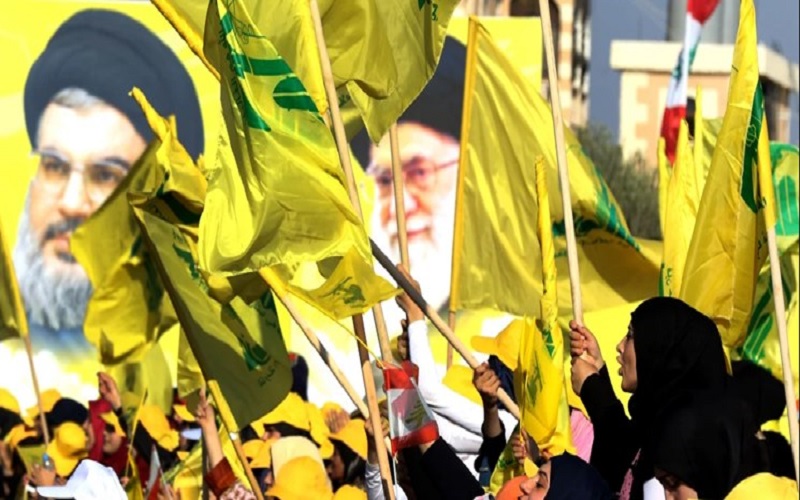

The failures of Iran’s Supreme Leader, Ali Khamenei, both in domestic governance and regional strategy, are pushing the regime towards collapse. The regime’s leadership is fully aware that, just as Hezbollah’s setbacks in Lebanon reflect a broader defeat, Khamenei and the Velayat-e Faqih system in Tehran are also on a similar trajectory.
The ongoing war in Gaza, initially between Israel and Hamas, has now expanded into a broader conflict involving Hezbollah, Iran’s most important proxy in the region. According to Hassan Nasrallah, Hezbollah’s leader, the group has recently suffered severe military, logistical, humanitarian, and security losses. Iran, caught in a state of desperation and inaction, has been unable to offer meaningful support to Hezbollah, leaving the terror group vulnerable to further setbacks.
Khamenei is finding it increasingly difficult to accept the reality of Hezbollah’s failures. Not only has Hezbollah struggled militarily in the recent conflict, but its political standing in Lebanon and the broader Arab-Muslim world has also been significantly diminished. Iran, witnessing Hezbollah’s collapse, is now scrambling to prevent the conflict’s expansion, essentially pleading for a resolution.
The regime, particularly Khamenei, recognizes the dead-end they find themselves in. Hezbollah’s elite fighters are being decimated, and the continuation of the current situation will only exacerbate their losses. Neither militarily nor politically does the outlook seem to favor Khamenei or Hezbollah.
This current crisis was never part of the Iranian regime’s strategic calculations. Initially, after the October 7 Hamas attacks on Israel, Iran likely believed that a limited conflict between Hezbollah and Israel would give it leverage in negotiations with the West, allowing Tehran to secure concessions on issues like its nuclear program and regional influence. However, the opposite has occurred. Rather than gaining leverage, the regime finds itself increasingly isolated, with Hezbollah’s leadership suffering severe losses under Israel’s counteroffensive.
Hezbollah is now facing an unprecedented crisis, not only on the battlefield but also in its standing within Lebanon’s political landscape. For the first time, the group’s ability to dominate other political factions in Lebanon is in jeopardy. This leaves Iran with few options, the most extreme being open conflict with Israel—an action that would likely hasten the downfall of the Velayat-e Faqih system in Tehran. Such a military venture would be catastrophic for the Iranian regime.
Khamenei’s entire regional strategy has unraveled. He now faces a situation similar to the one Iran’s founding leader, Ayatollah Khomeini, faced at the end of the Iran-Iraq War when he was forced to accept a humiliating ceasefire by drinking from the “poisoned chalice.” But while Khomeini had a firm hold on power at home at that time, Khamenei faces a vastly different scenario. Today, the majority of Iranians oppose the regime, and the country is on the brink of economic collapse—a key factor that had forced Khomeini to accept the peace deal back then.
Domestically, Khamenei’s policies have been a disaster. Even Masoud Pezeshkian, the regime’s new president, admits the government lacks the funds to buy essential goods like wheat, medicine, and agricultural supplies. The economic crisis is so severe that the regime is too afraid to admit failure, as doing so would not only necessitate apologizing to the Iranian people but could also lead to trials for those responsible for the country’s dire situation.
For more than 40 years, Khamenei and his regime have inflicted war, misery, and economic ruin upon Iran. Despite Iran possessing about ten percent of the world’s wealth, three-quarters of its population now relies on humiliating state subsidies to survive. Lacking legitimacy at home, the regime has sought to bolster its standing by supporting proxy forces abroad. But with these proxies now facing defeat, the Iranian regime’s strategic depth has been rendered meaningless.
In conclusion, the failures of Khamenei’s regional and domestic policies leave the Iranian regime with little to no hope for survival. Unlike in Khomeini’s era, the majority of Iranians today demand the downfall of the system. Khamenei himself is aware of this reality and knows that the people will not even tolerate him passing power to his son. The regime is on the brink of collapse, with no path to redemption.