


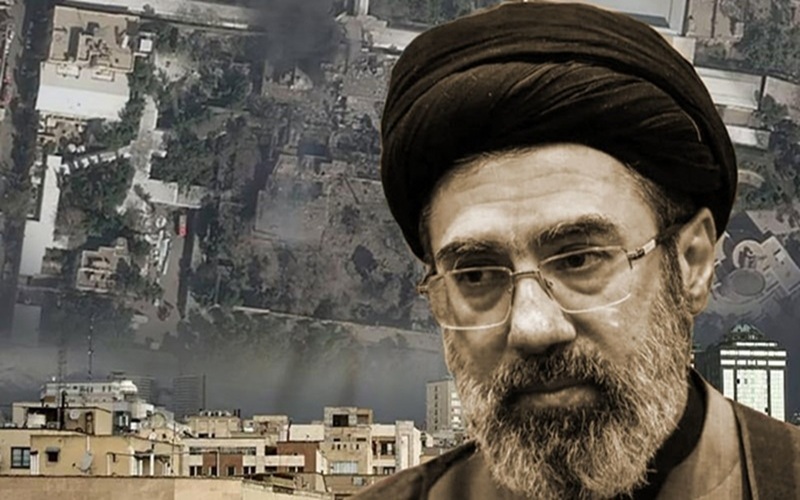

The announcement of Mojtaba Khamenei as the new leader of Iran’s regime has triggered intense debate among regional analysts and political observers. Many view his elevation not merely as a political appointment but as the culmination of a long-standing alliance between the Islamic Revolutionary Guard Corps and the family of Ali Khamenei.
This development signals what critics describe as the consolidation of power around a network of military, financial, and security interests that have shaped the Iranian state for decades.
The IRGC–Khamenei Power Nexus
Observers argue that the rise of Mojtaba Khamenei reflects a mutual dependency between the ruling family and the Revolutionary Guards. Over the past two decades, the IRGC has evolved into the backbone of Iran’s political security apparatus and a dominant economic force.
Since 1989, when Ali Khamenei assumed leadership, vast segments of the country’s commercial infrastructure, financial institutions, and industrial assets have gradually been transferred to entities affiliated with the IRGC. Critics say billions of dollars in national resources have flowed into networks controlled by the Guards and their commanders.
Within this structure, Mojtaba Khamenei has frequently been mentioned as a behind-the-scenes figure who helped coordinate both economic patronage networks and the regime’s security mechanisms. His influence, according to numerous reports over the years, has extended from financial circles to the coordination of security forces during periods of unrest.
Alleged Role in Crackdowns on Protests
During the nationwide protests of 2017, 2019, 2022, and 2026, various reports cited Mojtaba Khamenei as playing a key role in coordinating repression. Analysts and activists claim he was involved in the command structure that linked the IRGC, the Basij militia, and intelligence agencies during the suppression of demonstrations.
The protests reflected growing public frustration with political repression and economic hardship, and the authorities responded with extensive security measures and mass arrests.
From Clerical Rule to Hereditary Succession?
Critics argue that Mojtaba Khamenei’s appointment represents a new phase in the evolution of the regime’s political system: the transformation of clerical rule into a hereditary structure.
Although he lacks the traditional religious credentials historically associated with the leadership position, supporters within the security establishment appear to have backed his rise as a means of safeguarding their political and economic interests.
Many regional and international observers suggest that Mojtaba Khamenei’s authority derives less from religious legitimacy and more from the backing of the IRGC, reinforcing the perception that the military-security establishment is now the dominant force in Iran’s governance.
Origins of His Influence
Mojtaba Khamenei’s connections to the security establishment date back to the Iran–Iraq War, during which he reportedly served in a unit of the Revolutionary Guards.
After the war, networks formed among veterans of those units reportedly evolved into influential intelligence and security circles. Many individuals associated with those wartime networks later rose to senior positions within the IRGC and the intelligence ministry, forming what some analysts describe as a “shadow state” that gradually expanded its control over political institutions.
The 2005 Election Controversy
One of the first public controversies surrounding Mojtaba Khamenei emerged during the 2005 presidential election. In a highly unusual letter addressed to the Supreme Leader, reformist politician Mehdi Karroubi accused Mojtaba of orchestrating interference in the electoral process and mobilizing IRGC and Basij resources to secure the victory of Mahmoud Ahmadinejad.
Karroubi’s allegations highlighted what he described as extensive and unlawful influence over the election. The controversy foreshadowed future political tensions and contributed to the increasingly polarized environment surrounding Iranian elections.
The 2009 Crisis and Aftermath
Mojtaba Khamenei’s name resurfaced prominently during the protests that followed the disputed 2009 presidential election. Demonstrators took to the streets in what became one of the largest political crises in the Islamic Republic’s history.
International media and diplomatic sources suggested that he played a central role in coordinating the regime’s response to the unrest. Protesters themselves echoed this perception in chants directed against him during demonstrations in Tehran.
The events of 2009 marked a turning point in Iran’s political landscape, reinforcing the perception that key decisions were being shaped by a powerful inner circle within the leadership structure.
Financial Networks and Global Assets
Beyond politics and security, critics claim that Mojtaba Khamenei’s power is intertwined with a vast financial network. Investigations and reports over the years have alleged that wealth connected to the leadership’s inner circle extends across multiple regions, with assets and financial activities reportedly reaching from the Persian Gulf to major European financial centers such as Frankfurt and property markets in London.
These allegations contrast sharply with the official image promoted by state media of a modest and austere leadership.
A System Under Strain
Critics describe Mojtaba Khamenei not simply as a wealthy political insider but as a key architect of a system in which security institutions, economic power, and political authority are deeply intertwined.
They argue that his rise reflects a strategy of tightening control in response to growing internal pressures. In this interpretation, even the limited republican elements of Iran’s political structure are being replaced by a more closed and hereditary form of governance.
Yet the system faces persistent challenges. Repeated waves of public protest suggest that significant segments of Iranian society are demanding fundamental political change and greater democratic representation.
Whether Mojtaba Khamenei’s leadership will stabilize the current system or intensify existing tensions remains uncertain. What is clear, however, is that his emergence marks a pivotal moment in the evolving power structure of the Iranian regime—one that may shape Iran’s political trajectory for years to come.