


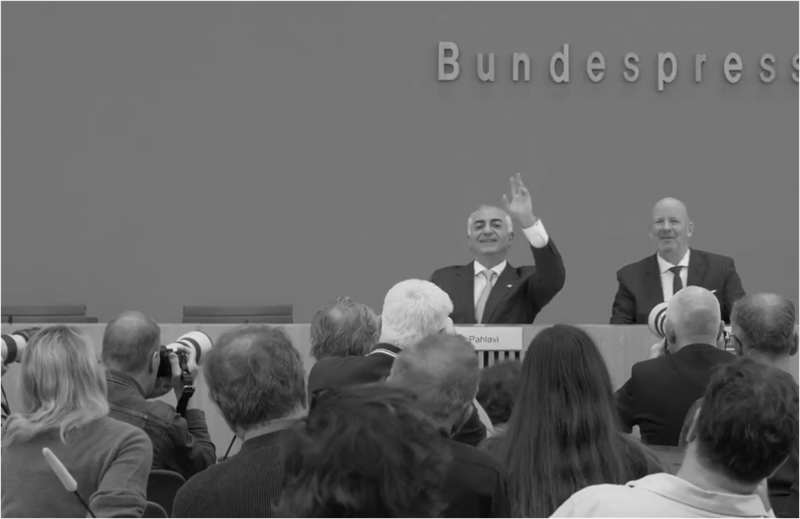

When the language of choice sounds suspiciously like permission, Europe’s tour of Iran’s would-be savior reveals more than intended
There’s something almost poetic about a man fleeing history—only to trip over it in front of 150 journalists.
During his recent European tour, Reza Pahlavi, son of Iran’s last monarch, appeared eager to position himself as a modern democrat. He spoke of meetings with parliaments, governments, and media outlets across Europe, projecting the image of a statesman-in-waiting. Yet, amid this carefully staged performance, a curious grievance emerged: not one of the 150 journalists, he lamented, asked him about the reported killing of 40,000 Iranians during the January protests.
A remarkable complaint—less for what it reveals about journalists, and more for what it reveals about the speaker. After all, when a political figure is disappointed by the questions not asked, it often means there are answers they were hoping to give.
Instead, the journalists reportedly focused on Iran’s past. An odd choice, one might think—until you remember that for a man whose political identity is inseparable from his lineage, the past is not just history; it’s branding.
And here lies the central paradox: a self-declared champion of the future, perpetually haunted by the inheritance of the past.
Democracy, with Terms and Conditions
The most revealing moment of this European tour did not occur in a grand hall or a packed press conference, but in response to a simple question from a German journalist: why insist on keeping the option of monarchy alive in a supposedly democratic future?
The answer was disarmingly candid.
“I want to bring the Iranian people to a position where they can choose,” he said.
A reassuring statement—until the clarification arrived.
“We will allow people to have the right to choose.”
Allow.
It’s a small word, doing very heavy lifting.
Because in functioning democracies, people don’t receive the right to choose as a favor granted from above. They possess it inherently. The moment that right is framed as something to be “allowed,” democracy begins to sound less like a system—and more like a managed experience.
One might call it democracy-as-a-service: carefully curated, selectively enabled, and subject to approval.
The Custodian of Acceptable Choices
But the conditions didn’t stop there.
Pahlavi added that such choices would only be valid if they were “democratic”—quickly noting that “not every option is democratic.”
Which raises an inconvenient question: who decides?
If the people’s choice must first pass through a filter of acceptability—defined, presumably, by the very figure offering them this “freedom”—then the locus of power has not shifted at all. It has merely been rebranded.
This is not the language of participatory sovereignty. It is the vocabulary of guardianship.
Historically, such phrasing has been a hallmark of paternalistic governance: the assumption that the public, left to its own devices, might choose incorrectly—and therefore requires supervision. The rhetoric may be modernized, polished for European audiences, but the underlying logic remains stubbornly familiar.
The Royal “We”
Equally telling is the persistent use of “we.”
Authoritarian figures, past and present, have often preferred this plural pronoun—not as a gesture of inclusivity, but as an assertion of structural authority. “We” implies an apparatus, a system, a legitimacy that extends beyond the individual.
For a man without formal office, it is a curious choice of words. Or perhaps not so curious, if one considers the psychological residue of monarchy: the quiet assumption that power is not claimed, but inherited—and occasionally, benevolently exercised.
Europe’s Silent Stage
Ironically, the setting for this rhetorical unraveling was Europe—a continent that prides itself on championing human rights and democratic values. Yet the tour itself reportedly unfolded without meaningful engagement from major political representatives, particularly in Germany.
One might interpret this as diplomatic caution. Or perhaps, a recognition that the performance on display raised more questions than it answered.
After all, Europe has seen its share of leaders who spoke eloquently about democracy—right up until the moment they began defining its limits.
The Tragedy of Unexamined Contradictions
In the end, the most striking aspect of this episode is not the criticism of journalists, nor the awkward phrasing of political ideals. It is the unintentional clarity.
Because when rhetoric slips, it often reveals what polished messaging conceals.
A figure who claims to fight for the people, yet speaks of granting them rights.
A self-styled democrat who reserves the authority to define acceptable outcomes.
A modern political actor, echoing the cadence of a decidedly pre-modern worldview.
These are not merely rhetorical inconsistencies—they are diagnostic signals.
Final Thought: A Monarchy of Good Intentions
There is, of course, a certain irony in all this. For years, critics have debated whether monarchy in Iran is a relic of the past or a viable future alternative. But perhaps the more relevant question is this:
Can a system truly be called democratic if its most enthusiastic advocate still speaks the language of permission?
Because democracy, in its simplest form, does not ask for approval.
It does not wait to be allowed.
And it certainly does not arrive as a gift—from a prince.