


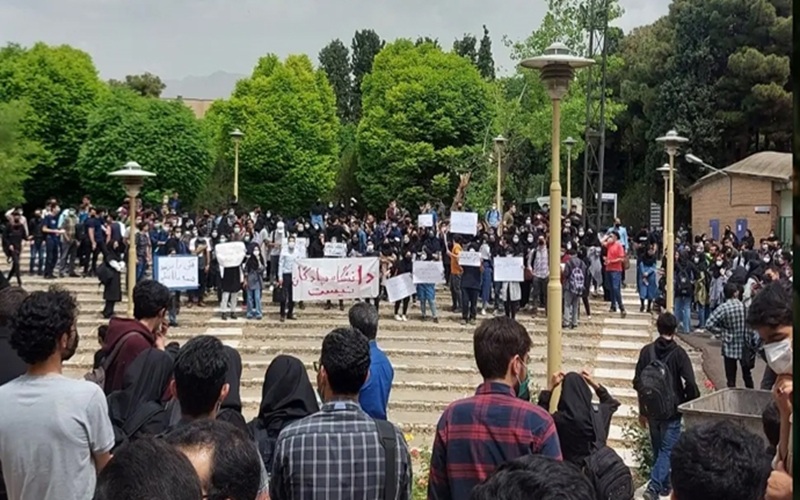

The return of coordinated student demonstrations during final exams reflects more than campus unrest—it reveals the growing convergence of workers, retirees, students, and youth against the Iranian regime.
Political change in Iran has rarely begun with a single dramatic event. Instead, it has emerged through the gradual convergence of different sectors of society—each responding to the same structural crises from its own position. When separate grievances begin to merge into a common political movement, governments can no longer dismiss unrest as isolated or temporary. That is precisely what recent student demonstrations suggest is unfolding once again across Iran.
The coordinated protests by students at Islamic Azad University campuses in Tehran, Karaj, and Ahvaz on July 1 came at an especially revealing moment. Rather than waiting until after final examinations, students chose to demonstrate during one of the most important periods of the academic year. That decision speaks volumes. It suggests that dissatisfaction has reached a point where academic concerns are no longer enough to outweigh the perceived urgency of public protest.
The demonstrations, centered around the slogan urging students to raise their voices and demand their rights, extended beyond objections to examination procedures. While the immediate dispute involved university policies, the protests reflected a broader transformation that has become increasingly visible throughout Iran: social and economic grievances are rapidly acquiring political meaning.
This evolution has long characterized Iranian universities. Throughout the country’s modern history, campuses have served not merely as educational institutions but as incubators of political debate and civic activism.
The recent protests indicate that, despite intensified security measures following previous nationwide uprisings, universities remain capable of mobilizing collective action and connecting localized grievances with wider public dissatisfaction.
Perhaps the most significant aspect of these demonstrations is not the students themselves but the broader pattern into which they fit.
Over recent months, Iran has witnessed continuing protests by retirees demanding pensions that have been eroded by inflation and economic mismanagement. Teachers have repeatedly protested deteriorating educational conditions and declining living standards.
School students have also challenged official authority in ways that were once considered almost unimaginable inside educational institutions. Each movement emerged from different immediate concerns, yet all have reflected growing frustration with the regime’s inability to address deepening political, economic, and social crises.
University students now occupy a unique position within this expanding landscape of dissent. They bridge generations, connecting the aspirations of younger students with the economic frustrations of older citizens. Their return to organized protest therefore represents more than another isolated demonstration; it reinforces a broader process through which separate social movements increasingly complement rather than replace one another.
This horizontal convergence across generations and professions has important political implications. It suggests that opposition to the regime is no longer confined to specific occupational groups or regions. Instead, diverse segments of Iranian society are expressing different manifestations of the same underlying discontent.
Several characteristics of the recent demonstrations reinforce this assessment.
First, the timing itself is significant. Students willingly accepted potential academic consequences by protesting during final examinations, indicating that political and social pressures have become more compelling than individual educational considerations.
Second, the simultaneous emergence of demonstrations in multiple cities demonstrates a level of coordination—or at minimum, a shared political mood—that extends beyond local campus disputes. Similar protests appearing simultaneously in Tehran, Karaj, and Ahvaz suggest that dissatisfaction is geographically widespread rather than concentrated in one region.
Third, the protests challenge the regime’s long-standing assumption that intensified security measures can permanently suppress civic mobilization. Following previous nationwide protests, authorities invested heavily in expanding surveillance, increasing arrests, and tightening control over universities. Yet the re-emergence of organized demonstrations illustrates that repression may delay protest without eliminating its underlying causes.
The broader significance lies in the cumulative trajectory of Iranian society. Teachers, retirees, school students, university students, labor activists, and other sectors have all entered public life with distinct demands. Increasingly, however, those demands intersect around common themes: economic hardship, political exclusion, lack of accountability, and demands for fundamental rights.
For analysts of Iranian politics, this convergence deserves close attention. Revolutionary moments are rarely created by one social class acting alone. They typically emerge when multiple constituencies begin recognizing that their separate grievances share common structural roots.
Whether Iran is approaching such a turning point cannot be predicted with certainty. Political crises rarely unfold according to a fixed timetable. Nevertheless, the return of coordinated student protests indicates that the social dynamics which fueled previous nationwide uprisings have not disappeared. If anything, they appear to be evolving into a broader coalition that crosses generational, occupational, and geographic boundaries.
The demonstrations at Islamic Azad University therefore represent more than another campus dispute. They offer a snapshot of a society where discontent continues to spread across institutions once regarded as politically fragmented.
As students, retirees, teachers, and younger generations increasingly find themselves speaking a common political language, the Iranian regime faces a challenge that extends well beyond any single protest. It confronts a society in which the boundaries separating individual grievances are steadily dissolving into a broader demand for fundamental political change.